RussiansInUSA editorial team · Facts checked October 28, 2026
What to see
All places (8)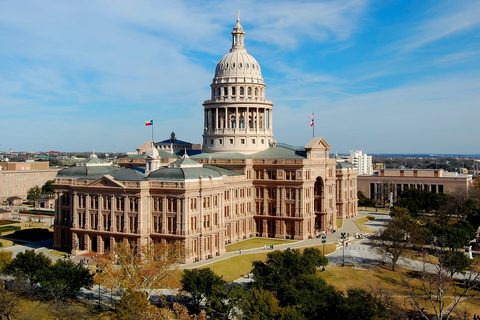
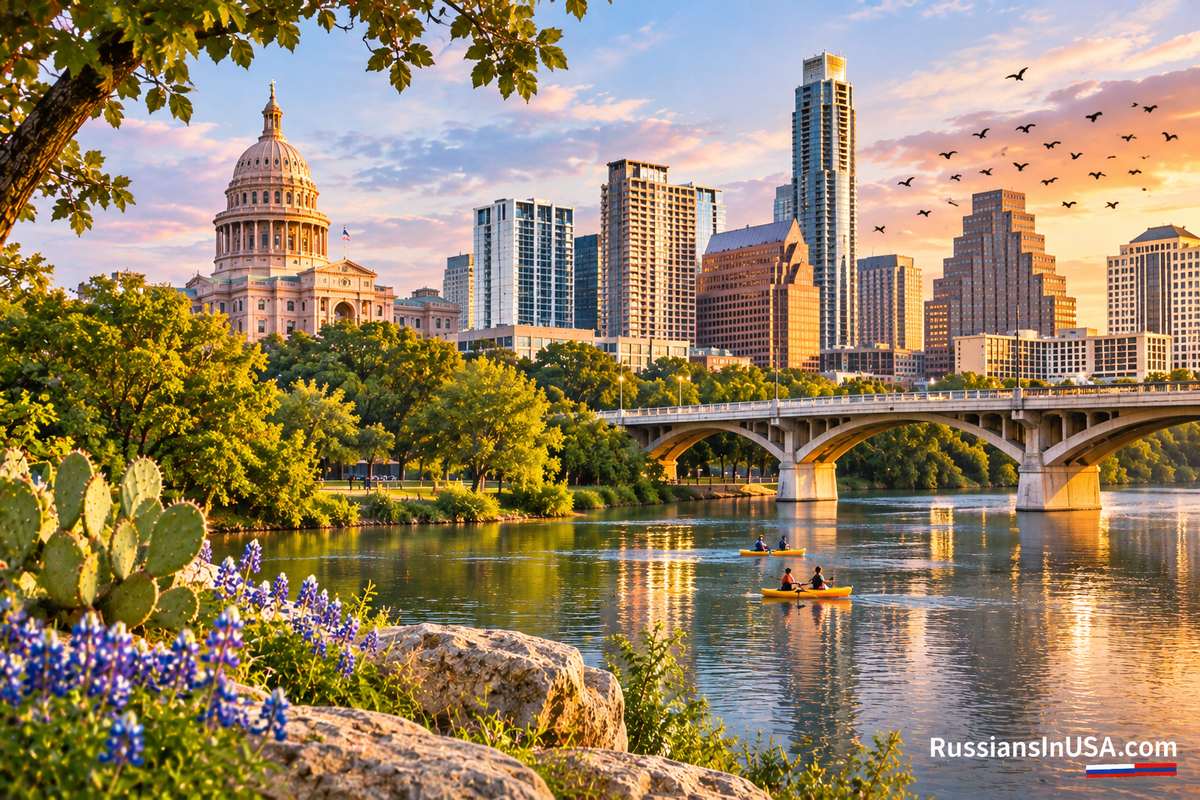
Austin for Russian speakers starts with the basics: it is the capital of Texas and one of the country's main tech hubs, a city on the Colorado River in the middle of the state. The Census Bureau estimates 1,002,632 residents as of July 1, 2025; 18.7% were born abroad and 30.3% of people over five speak a language other than English at home. Russian-speaking life is concentrated in the north: the stores and the Saturday school sit on Parmer Lane and Justin Lane, and in the suburbs of Cedar Park and Round Rock. Below: what to see, the city's history and the community's, neighborhoods, Russian stores and restaurants, transit and weather for anyone thinking of moving.
Austin city history: from Waterloo to state capital
In January 1839 a site-selection commission appointed by the Congress of the Republic of Texas chose the site for a new capital and bought 7,735 acres, including the hamlet of Waterloo. Edwin Waller laid out a grid fourteen blocks square, cut in half by Congress Avenue. The first lots sold at auction on August 1, 1839, Congress convened there in November, and the city was incorporated on December 27. In 1840 Austin had 856 residents, 145 of them enslaved.
In 1842 Mexican troops took San Antonio and Sam Houston ordered the national archives moved. Austin residents stopped the removal of the land office records in December 1842, the episode known as the Archives War, and the population fell below 200 between 1842 and 1845. Austin officially became the state capital on February 19, 1846. Statewide votes in 1850 and 1872 kept it there, the second time for good, ahead of Houston and Waco.
The University of Texas was placed in Austin in 1881 and began teaching in 1883. The present Capitol was dedicated in 1888. A dam on the Colorado was finished in 1893 and collapsed on April 7, 1900; its replacement, Tom Miller Dam, was completed in 1940, and Mansfield Dam upriver in 1941.
The tech story began in 1967 with IBM, then Texas Instruments in 1969 and Motorola in 1974; the research consortia MCC and Sematech were founded in the 1980s. These dates come from the Texas State Historical Association's Handbook of Texas. The census counted 472,020 residents in 1990, 790,390 in 2010 and 961,855 in 2020, and the 2025 estimate passes one million.
Russian community Austin: how it grew
The Russian community in Texas is small next to New York or California. As The Texas Tribune reported on November 20, 2013 (Lisa Surganova and Alana Rocha), census data for 2010-2012 counted 78,500 Texans of Russian ancestry, just over 0.3% of the state, and most Russian immigrants lived in Houston and Dallas. The article gives no figure for Austin, and we do not invent one.
The same story describes the early anchors. The Russian Community School of Austin was started by several Russian families about 15 years before 2013, with parents as the first teachers; by 2013 it had 80 students from more than 50 families. The Holy Protection Russian Orthodox parish traces its roots to 2001, when Father Lubomir Kupecz began coming from St. Vladimir's in Houston to serve; regular services started in 2007, and by 2013 Sunday attendance had grown from 10 to 15 people to 60 or more.
In late August 2016 two friends, Tatiana from Russia and Taras from Ukraine, opened Borderless European Market in north Austin, and it is still open. Today the Russian Cultural Center, a 501(c)(3) nonprofit, runs the Saturday school Sputnik, publishes the magazine "Russian Austin" (issue 15 came out in September 2026) and holds events; its Dobro festival is set for Sunday, November 1, 2026, at 3 p.m.
Where Russian speakers live: Austin, Round Rock, Cedar Park
There is no official count of Russian speakers by neighborhood. The addresses of the stores, restaurants and school, though, point north: to north Austin and its northern suburbs. Census Bureau figures (2020-2024 data, 2025 population estimate):
| Austin | Round Rock | Cedar Park | |
|---|---|---|---|
| Residents, 2025 | 1,002,632 | 141,282 | 79,032 |
| Growth since 2020 | 4.6% | 18.2% | 1.8% |
| Born abroad | 18.7% | 17.0% | 20.2% |
| Median rent per month | $1,729 | $1,763 | $1,846 |
| Median household income | $93,658 | $99,287 | $129,545 |
| Owner-occupied homes | 43.4% | 55.5% | 66.7% |
Figures checked October 28, 2026 on census.gov.
North Austin. Along Parmer Lane and near Justin Lane: Borderless European Market and the Sputnik school on Justin Lane. Practical for anyone working in the north of the city.
Cedar Park. The northwest suburb is the most family-oriented of the three: 25.7% of residents are under 18 and two thirds of homes are owner-occupied. Whitestone and Bell boulevards hold three Russian-speaking addresses: a grocery, a Georgian restaurant and a dumpling kitchen.
Round Rock. The suburb to the north is growing fastest, up 18.2% since 2020. It has the Georgian restaurant Nikala, and the Orthodox church is further north in Georgetown.
When you start looking for a place, Russian-speaking realtors know which areas fit your commute and school.
Russian stores and restaurants in Austin
We checked every address below on October 28, 2026, on the business's own site, its Yelp page or Google. Hours change, so call before a long drive.
- Borderless European Market, 2121 W Parmer Ln, Suite 113, Austin. Eastern European groceries from Ukraine, Poland, Romania, Hungary, Bulgaria, Lithuania and more: bakery and sweets, tea and coffee, frozen food, meat, fish, dairy, spices. Monday to Saturday 10 a.m. to 8 p.m., Sunday until 7 p.m.
- Austin European Market, 601 E Whitestone Blvd, Suite 512, Cedar Park. Groceries from Turkey, Georgia, Belarus, Ukraine, Poland, Russia and Romania. Open daily, Sundays until 7 p.m.
- Multicook, 251 N Bell Blvd, Unit 101, Cedar Park. Frozen homemade food: varenyky, pelmeni, khinkali, chebureki, cutlets, crepes, syrniki, deruny, cabbage rolls, plus kvass, bread, herring and sweets. Pickup or delivery.
- Sami Sumeli, 401 E Whitestone Blvd, Suite A101, Cedar Park. Georgian and European restaurant with a Russian-language website. Closed Mondays.
- Nikala, 1205 Round Rock Ave, Round Rock. A family-owned Georgian restaurant, by the owners' account the first in the heart of Texas. Open Tuesday to Sunday, noon to 9 p.m.
- Sputnik school, Russian Cultural Center, 2008 Justin Ln, Building A, Austin. A Saturday school; the fall 2026 semester began September 5.
- Holy Mother of God Orthodox Church, 2806 Mesquite Ln, Georgetown. A parish of the Russian Orthodox Church Outside Russia; its site says services are in English. It is on the parish list of the ROCOR Diocese of Chicago and Mid-America.
More vetted places are in our Russian restaurant directory.
Moving there: transit, weather and costs
Getting around. Austin is hard without a car: the city sprawls and buses and the MetroRail commuter line do not reach everywhere. CapMetro runs the system. A local bus ride costs $1.25, rides after the second one in a service day are free, and a monthly pass costs $41.25. MetroRail costs $3.50 a ride. On buses you can pay by tapping a contactless card, or use the Umo app; with the app or a reloadable card, once you hit 17 capped days the rest of the month is free.
| Fare | Single ride | Daily cap | Month |
|---|---|---|---|
| Local bus | $1.25 | $2.50 | $41.25 |
| MetroRail and Express | $3.50 | $7.00 | $96.25 |
Fares checked October 28, 2026 on capmetro.org.
Weather. NOAA's 1991-2020 normals for the Camp Mabry station give an annual average of 70.0 degrees Fahrenheit. Summers are hot: the average June to August high is 95.9 degrees, and about 123 days a year reach 90 degrees or more. Winters are mild, averaging 54.0 degrees with nights around 43.7. Rain totals 36.25 inches a year and snow is rare. Air conditioning is a necessity, not a luxury.
Costs and paperwork. Median rent in Austin was $1,729 a month in the 2020-2024 census data, and the median owner-occupied home was valued at $555,300. 13.6% of residents under 65 have no health insurance. The first thing you will need for work and banking is a Social Security number; our SSN guide explains how to get one. For comparison, read about Houston: The Texas Tribune found most Russian Texans live there and in Dallas.
Questions people ask
Where can I buy Russian groceries in Austin?
In north Austin, Borderless European Market at 2121 W Parmer Ln has been open since 2016, started by Tatiana from Russia and Taras from Ukraine. In Cedar Park, Austin European Market at 601 E Whitestone Blvd carries products from Russia, Ukraine, Belarus and Georgia, and Multicook at 251 N Bell Blvd sells frozen pelmeni, varenyky and crepes.
Is there a Russian school for children in Austin?
Yes. The Russian Cultural Center, a nonprofit, runs the Saturday school Sputnik at 2008 Justin Ln, Building A, in north Austin. The fall 2026 semester began on September 5. The center also publishes the magazine "Russian Austin" and hosts events such as the Dobro festival on November 1, 2026.
When can you see the bats at the Congress Avenue Bridge?
The Mexican free-tailed bat colony lives under the bridge from late March through early fall, and millions of bats fly out around sunset. Arrive at least half an hour early and watch from the southeast side of the bridge, where there is a grassy viewing area, or from Lady Bird Lake on a bat cruise or a kayak.
How hot does Austin get in summer?
NOAA's 1991-2020 normals for Camp Mabry put the average high in June, July and August at 95.9 degrees Fahrenheit. On average about 123 days a year reach 90 degrees or higher. Winters are mild, with an average December to February temperature of 54 degrees, and snow is rare.
Sources
- U.S. Census Bureau QuickFacts: Austin, Round Rock and Cedar Park cities, Texas
- Handbook of Texas (Texas State Historical Association): Austin, TX (Travis County)
- Wikidata: Austin (Q16559)
- Wikimedia Commons: Flag of Austin, Texas
- State Preservation Board: Texas Capitol tours
- Bat Conservation International: Congress Avenue Bridge
- City of Austin: Barton Springs Pool
- City of Austin: Zilker Metropolitan Park
- Bullock Texas State History Museum: Visit
- Austin City Code (Municode): no rule restricting use of the city flag
- Blanton Museum of Art: Plan your visit
- LBJ Presidential Library: Visit
- Lady Bird Johnson Wildflower Center: Visit
- The Texas Tribune (Nov. 20, 2013, Lisa Surganova and Alana Rocha): Russian immigrants in Texas embrace heritage and their new home
- Russian Cultural Center, Austin: School Sputnik, Russian Austin magazine
- Borderless European Market, 2121 W Parmer Ln, Austin
- Yelp: Austin European Market, 601 E Whitestone Blvd, Cedar Park
- Multicook Austin, 251 N Bell Blvd, Cedar Park
- Yelp: Multi Cook, 251 N Bell Blvd, Cedar Park
- Sami Sumeli Georgian and European Restaurant, Cedar Park
- Nikala Georgian Restaurant, Round Rock
- Holy Mother of God Orthodox Church (ROCOR), Georgetown
- ROCOR Diocese of Chicago and Mid-America: Parishes
- CapMetro: Fares
- NOAA NCEI: 1991-2020 annual and seasonal normals, Austin Camp Mabry


