Dental care in the USA: insurance, Medicaid and where to pay less
RussiansInUSA editorial team · Updated November 16, 2026 · Facts checked October 28, 2026
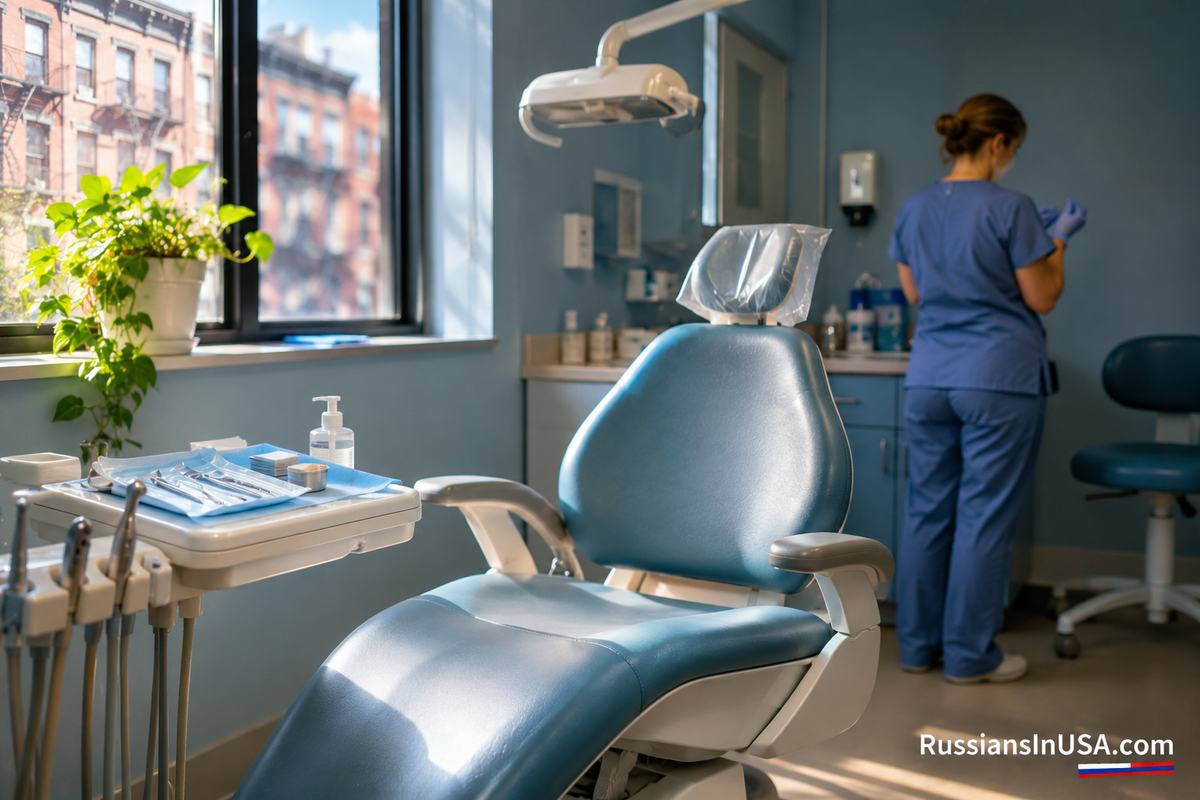
Dental care in the USA is usually paid for separately from regular health insurance: most adult health plans leave teeth out, and the cheaper places to get treated are income-based community health centers, dental school clinics and Medicaid, if your state covers adult dental. Children get dental coverage under Medicaid and CHIP in every state. Below: what insurance covers, where to find lower-cost care and what to do when a tooth hurts right now.
This guide has no prices on purpose. Costs depend on the state, the clinic and your plan, and any "average" figure would mislead. We focus on where and how to pay less.
Why dental insurance is separate in the US
Many newcomers are surprised: they have health insurance, yet a filling comes with a full bill. The reason is how the federal insurance rules are written.
HealthCare.gov says dental coverage is an essential health benefit for children 18 and under, but not for adults. Marketplace plans (the government insurance exchange, also called Obamacare) don't have to offer adult dental. Children's dental must be available, but you are not required to buy it.
Sometimes separate dental plans are sold next to the health plans. What to know about them:
| Question | What the rules say |
|---|---|
| Can I buy only a dental plan on the Marketplace? | No, only together with a health plan |
| What it costs | A separate monthly premium on top of the health plan premium |
| When it starts paying | Adult coverage can have a waiting period: no coverage, but premiums are due |
| When to buy | Open Enrollment, November 1 to January 15 each year, or a Special Enrollment Period |
Rules checked on October 28, 2026 at healthcare.gov.
A common mistake is buying a stand-alone plan for urgent work and then finding the waiting period has not ended. Read the plan details for any waiting period before you enroll. For how insurance works for newcomers in general, see our guide to health insurance for immigrants.
If your employer offers insurance, dental may be a separate line there too. Ask HR which dental plan is offered and when it takes effect.
Medicaid dental for adults depends on your state
Medicaid (the public health program for people with low income) treats children and adults differently. Medicaid.gov states there are no minimum requirements for adult dental coverage. Each state decides which dental services it pays for adults.
Two people with the same income in two different states can end up with very different coverage. Check with your state Medicaid agency or your Medicaid plan for the exact list.
Whether an immigrant qualifies for Medicaid depends on status and time in the country. Our guide to Medicaid and Obamacare for immigrants covers those rules. If you are already enrolled, call your plan and ask whether you have dental coverage and which dentists accept it.
Children's teeth: Medicaid and CHIP
For children the rules are firmer. Medicaid must cover dental services for all enrolled children as part of EPSDT (early and periodic screening, diagnostic and treatment services). At a minimum the state must pay for:
- relief of pain and infections;
- restoration of teeth;
- maintenance of dental health.
The state sets the checkup schedule and decides what is medically necessary, but it cannot limit children's dental to emergency care only.
CHIP (the Children's Health Insurance Program, for families who earn too much for Medicaid) must include dental too. According to Medicaid.gov, separate CHIP programs cover prevention, restoring teeth and emergency conditions. The National Institute of Dental and Craniofacial Research (NIDCR) adds that CHIP covers children up to age 19 and that dental services vary by state.
To see your state's programs, go to InsureKidsNow.gov or call 1-877-543-7669 (1-877-KIDS-NOW). The same site has a locator for dentists who see children with Medicaid and CHIP.
Medicare and dental care for older relatives
Parents and grandparents often count on Medicare (federal insurance for people 65 and older). Medicare.gov says Original Medicare doesn't cover routine dental care: cleanings, fillings, tooth extractions, dentures and implants. You pay all costs for those.
The exceptions are narrow:
- some dental services you get as a hospital inpatient;
- dental services directly tied to certain covered medical treatments, such as a complication during head and neck cancer treatment.
For covered Part B dental services you pay 20% of the Medicare-approved amount after the Part B deductible. For choosing Medicare plans, see our guide to Medicare for older immigrants.
Where to get cheaper dental care: income-based health centers
For people without dental insurance, the most reliable option is a community health center funded by HRSA (the Health Resources and Services Administration). HRSA describes them as local clinics that treat medical, dental and mental health needs, with doctors, dentists, therapists and social workers on staff.
What matters for a newcomer:
- fees are adjusted for income and family size (a sliding fee scale);
- health centers must serve everyone, even people who cannot pay;
- many have on-site pharmacies with discounted drugs and can help with transportation.
About 90% of health center patients have incomes below 200% of the federal poverty level. These clinics are built for people with modest income and thin coverage.
Find the nearest one with the Find a Health Center search by city, state or ZIP code. Before you go, call and ask three things: does this site have a dentist, what proof of income to bring, and how long the wait is for a first appointment.
Dental schools and other low-cost options
NIDCR's page on finding low-cost dental care lists several routes many people miss.
Dental school clinics. Students treat patients under the close supervision of experienced, licensed dentists, and care costs less. To find accredited programs, use the program search of the Commission on Dental Accreditation (CODA) at coda.ada.org.
Dental hygiene schools. Supervised, low-cost cleanings and exams as part of hygienists' training.
Clinical trials. Study participants sometimes get limited free or low-cost treatment for the condition being studied. Search ClinicalTrials.gov.
Local services. Your state or county health department may know of free or reduced-cost programs nearby. You can also dial 2-1-1 to find services in your area, or contact your local United Way.
Watch out for scams. NIDCR warns that ads, emails or texts claiming the institute offers dental implants or money for treatment are likely fraudulent: it does not offer implants or provide money for dental treatment.
If you want a dentist who speaks Russian, browse our directory of Russian-speaking dentists and ask the office in advance which plans and payment options it accepts.
When a tooth hurts now: emergency dental care
Severe pain, facial swelling, fever or a broken tooth won't wait for Open Enrollment. First call your dentist or the nearest HRSA health center and ask how soon they can see you.
If swelling spreads fast or it is hard to breathe or swallow, go to a hospital emergency room. Under the federal EMTALA law, as described by CMS, a Medicare-participating hospital with emergency services must give a medical screening exam to anyone who asks for emergency care and stabilize an emergency condition, regardless of ability to pay. The law is about screening and stabilizing, not routine treatment, so the tooth itself will still need a dentist afterward. For other cases, our guide to urgent care vs. the emergency room explains where to go.
Questions people ask
Does Obamacare health insurance include dental?
For children 18 and under, dental is an essential health benefit and Marketplace plans must make it available. For adults it is not, and plans don't have to include adult dental. You can buy a separate dental plan, but only together with a health plan, for a separate monthly premium and sometimes with a waiting period.
Does Medicare pay for dental work?
Original Medicare doesn't cover cleanings, fillings, extractions, dentures or implants. It covers only certain dental services tied to a hospital stay or to specific covered medical treatment, such as a complication during head and neck cancer treatment. For covered Part B services the patient pays 20% of the approved amount after the deductible.
Where can I get dental care without insurance for less?
At HRSA-funded community health centers, where fees depend on income and family size and the center must serve patients who cannot pay. Other options are dental school and dental hygiene school clinics, clinical trials and local programs your health department or the 2-1-1 line can point you to.
Does Medicaid cover dental for adults?
It depends on the state. Federal rules set no minimum requirements for adult dental in Medicaid, so each state decides what to cover. Children in Medicaid get dental everywhere: relief of pain and infections, restoration of teeth and maintenance of dental health. Ask your state Medicaid agency for the exact list.
Sources
- HealthCare.gov: Dental coverage in the Health Insurance Marketplace
- Medicaid.gov: Dental care
- Medicaid.gov: CHIP benefits
- InsureKidsNow.gov: Medicaid and CHIP for kids
- Medicare.gov: Dental services
- HRSA: What is a health center?
- HRSA: Find a Health Center
- NIDCR: Finding low-cost dental care
- CMS: Emergency Medical Treatment and Labor Act (EMTALA)
- Commission on Dental Accreditation (CODA)