RussiansInUSA editorial team · Facts checked November 18, 2026 · Official site
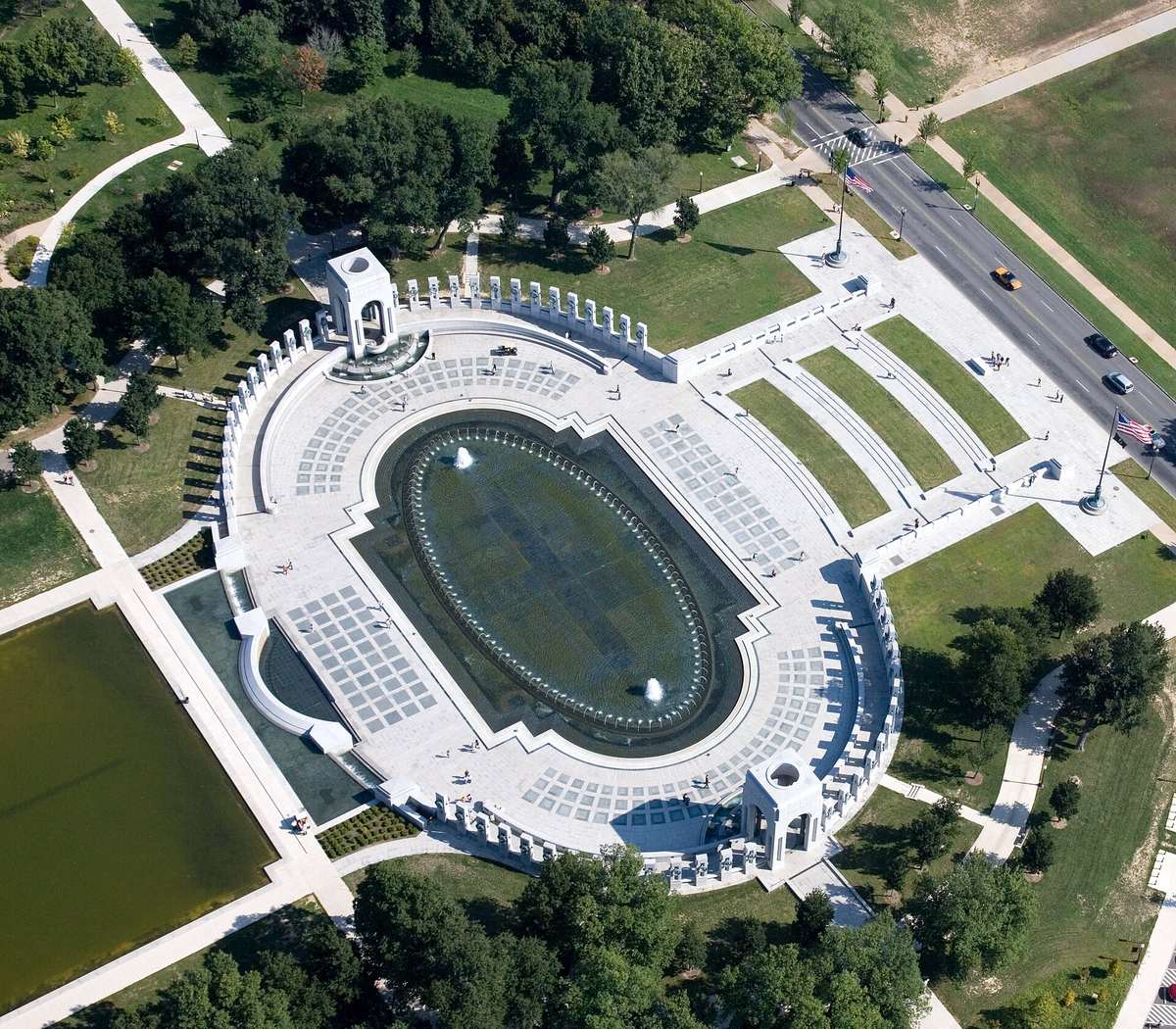
The National World War II Memorial stands at the center of the National Mall in Washington, DC, next to the Washington Monument, between it and the Lincoln Memorial. The National Park Service (NPS) gives its mailing address as 1100 Ohio Drive SW. It honors the 16 million Americans who served in the armed forces during the war, the 405,399 who died, and the millions who supported the war effort at home. It is open 24 hours a day, every day, and free. Below: its history, what to see, how to get there and the one rule about the fountains. More of the city is on our Washington, DC page.
World War II Memorial history, from a 1987 bill to the 2004 dedication
The American Battle Monuments Commission (ABMC), which built the memorial, keeps its timeline. In 1987 Rep. Marcy Kaptur of Ohio introduced a bill for a memorial in or near Washington. Similar bills followed in 1989, 1991 and 1993, and the last one passed: President Bill Clinton signed it on May 25, 1993, and gave the project to ABMC.
The site took years. Constitution Gardens was chosen in March 1995, reviewing agencies objected, and that fall the Rainbow Pool site, between the Lincoln Memorial and the Washington Monument, was approved instead. The President dedicated the site on November 11, 1995. The main challenge, the NPS says, was keeping the view between the Lincoln Memorial and the Washington Monument open.
A two-stage design competition ran in 1996. Friedrich St. Florian, an Austria-born architect based in Rhode Island, won over more than 400 other entrants, according to the NPS; his design was announced in January 1997. Sculptor Ray Kaskey of Brentwood, Maryland, joined the team. Senator Bob Dole became national campaign chairman in March 1997, with Frederick W. Smith as co-chairman from August.
The final design was approved in 2000, and about 15,000 people came to the groundbreaking on November 11, 2000. A lawsuit delayed construction in March 2001; in May, Congress passed a law directing work to go ahead at the Rainbow Pool, signed on May 28, 2001. A $56 million contract went to a joint venture of Tompkins Builders and Grunley-Walsh, and site work began in late August 2001.
The memorial opened to the public on April 29, 2004, and was dedicated on May 29, 2004, over Memorial Day weekend, before about 150,000 people, after a four-day reunion of veterans on the Mall. On November 1, 2004, it was transferred to the National Park Service.
What to see at the World War II Memorial
The state pillars. 56 granite pillars ring the oval pool: the 50 states, the District of Columbia and the US territories of the time. The NPS describes them as a formal procession. Delaware and Pennsylvania stand closest to the Freedom Wall, then the states alternate from side to side in the order they joined the Union, with the territories last. Each pillar carries a bronze wheat wreath for agriculture and an oak wreath for industry.
The Atlantic and Pacific pavilions. Two 43-foot arches list the major campaigns of each theater. Inside each, four bronze eagles with 11-foot wingspans hold a 5,000-pound laurel wreath above a medallion.
The Freedom Wall. 4,048 gold stars, each for 100 American military deaths, more than 400,000 in all. During the war a family replaced the blue star in its window with a gold one when a death was reported. The inscription below reads "Here We Mark The Price Of Freedom." The stars are gold-plated stainless steel.
The bronze bas-reliefs. 24 panels line the 17th Street entrance, 12 on each side, showing scenes from the home front and the war. One of them, which the NPS titles "Russians Meet Americans at the Elbe," shows the meeting of the American and Soviet armies at the Elbe River on April 25, 1945. Handouts explaining them are at the visitor contact station on Home Front Drive.
Inscriptions. The Announcement Stone on 17th Street ties the site to Washington and Lincoln. Near the Freedom Wall, a Truman quote says the nation's debt to those who served "can never be repaid."
Two Kilroys. "Kilroy was here," a cartoon man peeking over a wall, was graffiti American troops drew in both theaters; the NPS says it most likely comes from a British cartoon and the name of an American shipyard inspector. Two are hidden in the memorial for visitors to find.
Most of the memorial is granite, nearly 17,000 stones from South Carolina, Georgia, Brazil, North Carolina and California. The sculptures are bronze.
How to get to the World War II Memorial
The memorial's own NPS pages do not name a Metro station. It sits next to the Washington Monument, between it and the Lincoln Memorial. For the Lincoln Memorial, the NPS names Foggy Bottom-GWU (about 0.8 miles from Lincoln) and Smithsonian (about 1.2 miles), and suggests the WMATA Trip Planner.
| Option | Details |
|---|---|
| Metro | Foggy Bottom-GWU and Smithsonian, both on the Blue, Orange and Silver lines (per wmata.com) |
| Car | metered street and lot parking around the Mall; accessible parking at the memorial itself |
| Tour bus | parking mainly along Ohio Drive SW, near the Lincoln and Jefferson Memorials |
| Bike | Capital Bikeshare |
The NPS warns that parking on the Mall can be difficult. Train and bus times are on wmata.com. The memorial does not lend wheelchairs; bring your own or rent one from a private company in the area.
Hours and tickets
| What | Rule |
|---|---|
| Memorial | open 24 hours a day, every day of the year |
| Admission | free, no tickets |
| Rangers on duty | daily, 9:30 a.m. to 10:00 p.m. |
| Programs | ranger talks through the day and on request |
| Park phone | 202-426-6841 |
Hours and prices checked November 18, 2026 on nps.gov.
The NPS fees page says there is no fee to visit. The hours page lists no holiday closures. Check the Alerts page before you go.
Tips before you visit
- The NPS suggests early morning or early evening, when the Mall is calmer.
- Do not wade in the Rainbow Pool. The NPS says it has lights and sharp fountain heads, and it is part of the memorial.
- Anyone who served or supported the war effort can be added to the memorial's Registry, run by ABMC at wwiiregistry.abmc.gov; help line 1-800-639-4992.
- The other memorials nearby are on our Washington, DC places page. The Washington Monument is the next stop east.
Questions people ask
Is the World War II Memorial in Washington free?
Yes. The National Park Service says there is no fee to visit the World War II Memorial and no ticket is needed. It is open 24 hours a day, every day of the year, and rangers are on duty daily from 9:30 a.m. to 10:00 p.m.
What do the gold stars on the Freedom Wall mean?
The Freedom Wall holds 4,048 gold stars, each standing for 100 American military deaths, more than 400,000 in all. During the war a family swapped the blue star in its window for a gold one when a death was reported. The inscription reads "Here We Mark The Price Of Freedom."
Can you wade in the Rainbow Pool fountain?
No. The National Park Service asks visitors to stay out of the Rainbow Pool because it has lights and sharp fountain heads, and because the pool is part of the memorial, honoring the victory and the people who won it.
When was the World War II Memorial built?
President Clinton signed the law authorizing it on May 25, 1993. Ground was broken on November 11, 2000, and construction started in 2001. The memorial opened to the public on April 29, 2004, and was dedicated on May 29, 2004, before about 150,000 people, according to ABMC.
What Metro stop is closest to the World War II Memorial?
The memorial's NPS pages do not name one. It stands between the Washington Monument and the Lincoln Memorial, and for the Lincoln Memorial the NPS names Foggy Bottom-GWU and Smithsonian. Both stations are on the Blue, Orange and Silver lines of the Washington Metro.
Places on the map
Sources
- World War II Memorial (NPS)
- Basic Information, World War II Memorial (NPS)
- Operating Hours and Seasons, World War II Memorial (NPS)
- Fees, World War II Memorial (NPS)
- Alerts, World War II Memorial (NPS)
- Frequently Asked Questions, World War II Memorial (NPS)
- History and Culture, World War II Memorial (NPS)
- Memorial design, World War II Memorial (NPS)
- Memorial Design Features (NPS)
- Timeline, WWII Memorial Registry (ABMC)
- Operating Hours, National Mall and Memorial Parks (NPS)
- Directions, National Mall and Memorial Parks (NPS)
- Directions, Washington Monument (NPS)
- Directions and Transportation, Lincoln Memorial (NPS)
- Smithsonian station (WMATA)
- Foggy Bottom-GWU station (WMATA)
- World War II Memorial guide (NPS)
- Atlantic Theater Bas-relief Sculptures, World War II Memorial (NPS)