RussiansInUSA editorial team · Facts checked November 18, 2026 · Official site
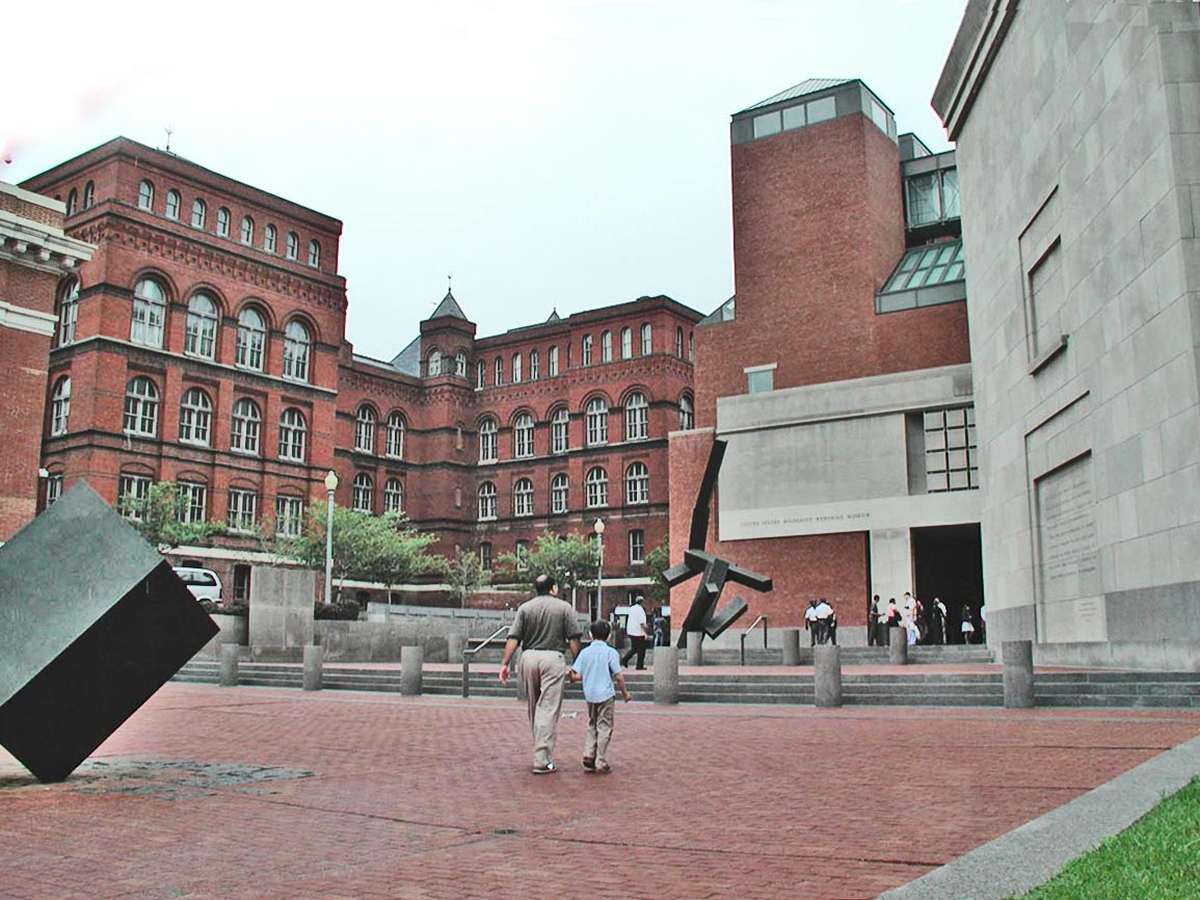
The United States Holocaust Memorial Museum stands on the National Mall in Washington, just south of Independence Avenue SW between 14th Street and Raoul Wallenberg Place. Admission is free and it is open every day except Yom Kippur and Christmas Day. The Permanent Exhibition needs a free timed-entry ticket. It is the national museum of Holocaust history: documents, photographs, personal objects and survivor testimony. For the city as a whole see the Washington DC page, and for other sights the list of places.
History of the Holocaust Museum
The museum defines the Holocaust as the state-sponsored persecution and annihilation of European Jewry by Nazi Germany and its collaborators between 1933 and 1945. Six million Jews were murdered.
On November 1, 1978, President Jimmy Carter set up the President's Commission on the Holocaust to recommend a memorial to the victims. Its 34 members were chaired by Elie Wiesel, and it submitted its recommendations on September 27, 1979. In 1980 a unanimous Act of Congress chartered the museum as a nonpartisan federal educational institution. Federal support guarantees its place on the Mall; donors pay for its educational programs. Since its dedication in 1993, the museum says, it has welcomed some 50 million visitors, including more than 100 heads of state and over 11 million school-age children.
The architect was James Ingo Freed of Pei Cobb Freed & Partners. Before designing it he visited Holocaust sites, camps and ghettos among them, to study their structures and materials. The building looks plain from outside, but its forms allude to the history inside. Freed said he kept the form "open-ended so the Museum becomes a resonator of memory."
What to see at the Holocaust Museum
Permanent Exhibition: The Holocaust. A self-guided, chronological walk over three floors, reached by elevators from the First Floor. "Nazi Assault, 1933 to 1939" covers the Nazi rise to power, the Nuremberg Race Laws, Kristallnacht, the voyage of the St. Louis and the invasion of Poland. "The Final Solution, 1940 to 1945" traces the path from ghettos to mass murder, including the invasion of the Soviet Union, deportation photographs and oral testimony from Auschwitz. One of its key objects is a rusty milk can from the Warsaw ghetto that hid part of the Oneg Shabbat archive. "Last Chapter" covers liberation, the Allied victory in 1945, rescue, resistance and the aftermath, ending with survivor video testimony in the theater. Plan 1 to 3 hours; recommended for ages 11 and up.
Remember the Children: Daniel's Story. On the First Floor, in the Anne and Isidore Falk Gallery, this exhibition tells one family's Holocaust experiences through the eyes of a boy growing up in Nazi Germany and is the museum's main program for young people and families. It draws on family photo albums, documents and pictorial diaries of the period; Daniel's diary entries are based on real wartime writings by young people and survivors' memories. Ages 8 and up, about 30 minutes, no ticket needed.
Hall of Remembrance. A hexagonal hall overlooking Eisenhower Plaza, a quiet space for public ceremonies and private reflection.
Hall of Witness and the art. The main hall shows its industrial-era construction methods openly. Four commissioned works belong to the building: Sol LeWitt's wall drawing Consequence in the second-floor lounge, Richard Serra's sculpture Gravity by the black granite wall in the southwest corner of the Hall of Witness, Ellsworth Kelly's four white wall sculptures Memorial in the third-floor lounge, and Joel Shapiro's Loss and Regeneration on the plaza along Raoul Wallenberg Place.
The museum is preparing a new permanent exhibition. Per ushmm.org, the current permanent exhibition will not be available to the public during the construction of the new one, which will begin in January 2027 and be completed in 2029. Check ushmm.org for what is open before you go.
The museum's online Holocaust Encyclopedia comes in many languages, Russian and Ukrainian among them, which helps with relatives who do not read English.
How to get to the Holocaust Museum
The nearest Metro station is Smithsonian, on the Orange, Blue and Silver lines, about one block east of the museum. Lines and schedules are on wmata.com.
The museum has no public parking. A paid garage is across the street on D Street SW between 13th and 14th Streets, and there is some metered parking on Independence Avenue. The National Park Service has about ten accessible spaces for tagged vehicles at and around the Washington Monument, along Independence Avenue west of 14th Street and at the Tidal Basin lot. The building is fully accessible to visitors who use mobility devices.
Hours and tickets
| Address | 100 Raoul Wallenberg Place, SW, Washington, DC 20024 |
| Hours | daily 10 a.m. to 5:30 p.m. |
| Exhibitions and shop | close at 5:20 p.m. |
| Last Permanent Exhibition entry | 4:30 p.m. |
| Closed | Yom Kippur and Christmas Day |
| Admission | free |
| Timed-entry ticket | free, required for the Permanent Exhibition |
| Booking online | $1 transaction fee (Etix) |
| Phone | 202-488-0400 |
Hours and prices checked November 18, 2026 on ushmm.org.
Timed tickets can be booked in advance, and a limited number of same-day tickets are released online every day at 7 a.m. Eastern. Daniel's Story and some other exhibitions need no ticket. Groups of ten or more request tickets through a form, and the museum replies within two business days. See the tickets page for current dates.
Security and building rules
Everyone and everything is screened at the door, and at peak times the line takes 15 minutes or more. Capped water bottles are allowed; hold yours in your hand through security. No eating or drinking in the galleries except water or for medical need. Not allowed: aerosols and sprays (prescriptions excepted), any knives or weapons, coolers, scooters, bikes and skateboards (unless a mobility aid), signs, flags and balloons. Personal photos without flash are fine; selfie sticks and tripods are not. Large bags, suitcases and umbrellas go to the coat check. The galleries are kept cool to protect the artifacts, so bring a sweater and comfortable shoes. Restrooms and water fountains are on the Lower Level and at the entrance to each Permanent Exhibition floor. The cafe is open daily.
Questions people ask
Do you need tickets for the Holocaust Museum in DC?
Entry to the United States Holocaust Memorial Museum is free. A free timed-entry ticket is required for the Permanent Exhibition, booked online in advance with a $1 fee or taken from the same-day release at 7 a.m. Daniel's Story, the exhibition for families on the First Floor, needs no ticket.
What age is the Holocaust Museum appropriate for?
The museum recommends its Permanent Exhibition for visitors 11 and older. For children 8 and up and their families there is Remember the Children: Daniel's Story on the First Floor, which takes about 30 minutes and needs no timed ticket.
How long does the Holocaust Museum take?
The museum suggests 1 to 3 hours for the Permanent Exhibition and about 30 minutes for Daniel's Story. Add time for security, which can take 15 minutes or more at peak hours. Last entry to the Permanent Exhibition is 4:30 p.m., and the building closes at 5:30 p.m.
When is the Holocaust Museum closed?
The museum is open daily from 10 a.m. to 5:30 p.m. and closed on Yom Kippur and Christmas Day. According to ushmm.org, the current permanent exhibition will not be available to the public during the construction of the new one, which will begin in January 2027 and be completed in 2029.
Places on the map
Sources
- United States Holocaust Memorial Museum
- USHMM: Hours, Location, and Transportation
- USHMM: Admission and Tickets
- USHMM: Building Policies
- USHMM: Tips for Your Visit
- USHMM: About the Museum
- USHMM: Mission and History
- USHMM: The President's Commission on the Holocaust
- USHMM: Architecture and Art
- USHMM: Museum Accessibility
- USHMM: Museum Cafe
- USHMM: Museum Exhibitions
- USHMM: Permanent Exhibition
- USHMM: Remember the Children: Daniel's Story
- Holocaust Encyclopedia (Russian)
- WMATA: Smithsonian station