RussiansInUSA editorial team · Facts checked November 18, 2026 · Official site
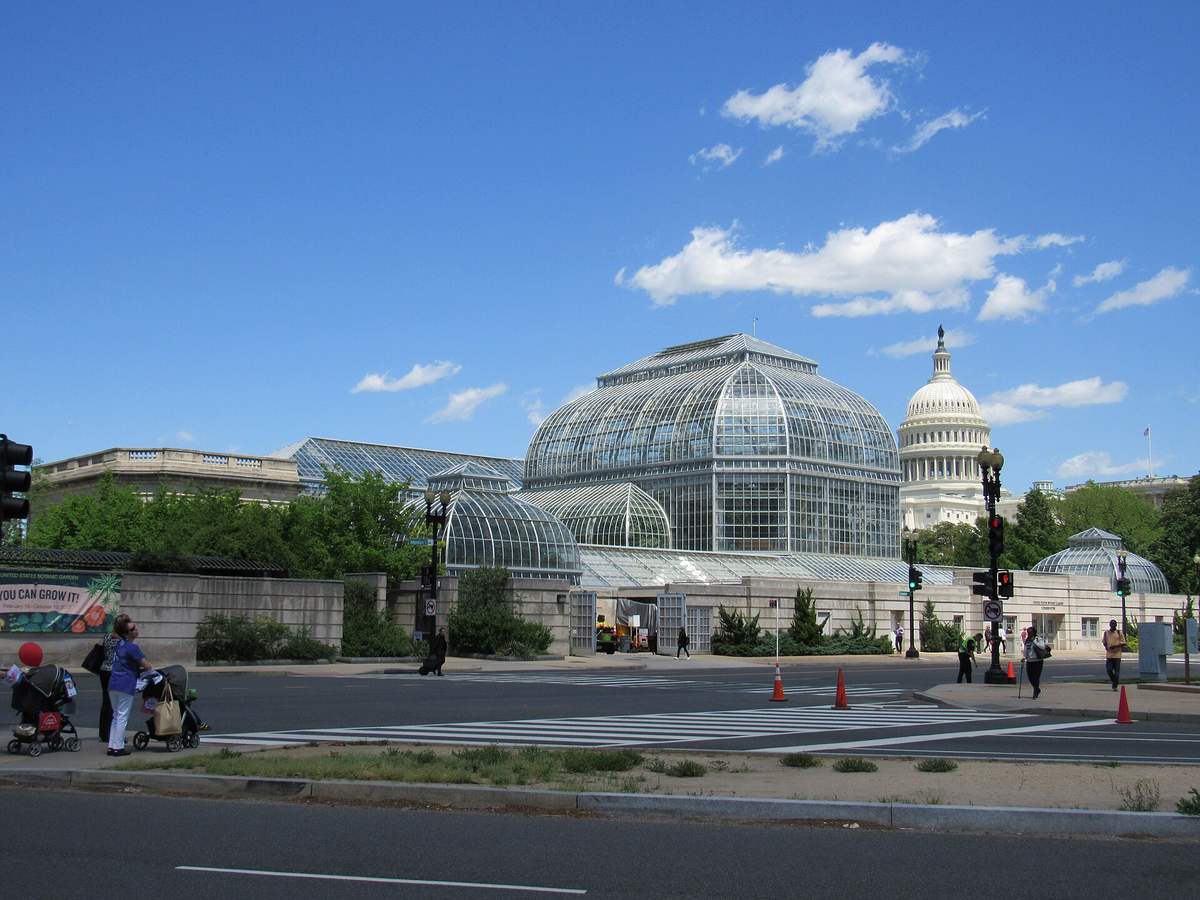
The United States Botanic Garden in Washington, DC sits at the foot of the Capitol, on the National Mall, on both sides of Independence Avenue between First and Third Streets SW. A tropical forest grows under a 93-foot glass dome, with deserts, orchids and medicinal plants in the rooms around it, three acres of outdoor gardens next door and the Bartholdi Fountain across the street. Admission is free and no tickets are needed. More of the city is on our Washington, DC page.
United States Botanic Garden history
According to the Garden itself (usbg.gov), the idea dates to 1816, when the Columbian Institute for the Promotion of Arts and Sciences wrote a botanic garden into its constitution. On May 8, 1820, President James Madison signed a bill setting aside land west of the Capitol Grounds, between First and Third Streets. The Institute soon stopped meeting, and the first garden stopped functioning in 1837.
The Wilkes Expedition, formally the United States Exploring Expedition, revived it. In 1842 the expedition brought living plants to Washington, and they became the Garden's first permanent collection. Four of those plants still grow here. While a new conservatory was built, the plants were kept in a greenhouse behind the Old Patent Office Building. The Victorian conservatory opened to the public in 1850, and the Garden has been open ever since.
In 1856 the Garden was placed under the Joint Committee on the Library of Congress. In 1867 the conservatory gained a central dome and two 300-foot wings. The Garden moved to its present site on Independence Avenue in 1933, and since 1934 it has been run by the Architect of the Capitol, who serves as its acting director.
The production facility in Anacostia opened in 1993, with 34 greenhouse bays and 85,000 square feet under glass. The conservatory was renovated from 1997 to 2001, and the gated outdoor gardens, once called the National Garden, opened in fall 2006. Today the Garden counts more than 9,500 accessions, about 44,000 plants, and more than a million visitors a year.
What to see in the Conservatory
The Conservatory has two courtyard gardens and 10 garden rooms, 28,944 square feet of growing space.
| Room | What is there |
|---|---|
| Garden Court | pools and plants people use for food, fiber, clothing and fuel |
| The Tropics | a tropical forest under a 93-foot dome, with a mezzanine at canopy level |
| Primeval Garden | the plant world of about 150 million years ago, before flowering plants took over |
| Hawaii | plants that evolved in the islands' isolation |
| World Deserts | cacti, succulents and other desert plants |
| Medicinal Plants | medicinal plants from around the world |
| Orchids | a collection of about 3,000 orchids, hundreds on show at any time |
| Mediterranean | plants of the world's five Mediterranean climate regions |
| Plant Adaptations | how plants adapted to different places |
| Plant Conservation | rare and endangered plants and the work to save them |
| Southern Exposure and Children's Garden | outdoor courtyards, open spring through fall |
The West and East Galleries hold changing exhibits.
Outdoor gardens and the Bartholdi Fountain
Next to the Conservatory are three acres of gated outdoor gardens. The Regional Garden holds Mid-Atlantic native plants, the Rose Garden roses chosen for the DC climate, and the Pollinator Garden plants for birds, bats and insects. The First Ladies Water Garden honors the nation's first ladies with a tiled fountain. The amphitheater is built from marble steps salvaged from the Capitol's East Front and looks out at the Conservatory and the Capitol dome.
Across Independence Avenue, at 245 First Street SW, are the two-acre Bartholdi Fountain and Gardens. The cast-iron Fountain of Light and Water, over 15 tons and 30 feet tall, was made for America's 100th anniversary by Frederic Auguste Bartholdi, the sculptor of the Statue of Liberty. From 1877 to 1927 it stood north of the first conservatory; the garden around its present site was created in 1932 and redesigned in 2016 as a Sustainable SITES pilot, with rain gardens, native plants and a Kitchen Garden.
How to get to the US Botanic Garden
The Garden has no parking lot of its own and points visitors to Metro.
| Way | Details |
|---|---|
| Metro | Federal Center SW station (401 3rd Street SW), Blue, Orange and Silver lines, three blocks away |
| Car | metered street parking within a few blocks only |
| Conservatory and outdoor gardens | 100 Maryland Ave SW |
| Bartholdi Fountain and Gardens | 245 First St SW |
Plan the walk from the station with the Trip Planner on wmata.com.
Hours and tickets
| What | Hours |
|---|---|
| Conservatory | daily 10 a.m. to 5 p.m., closed December 25 |
| Gated outdoor gardens | daily 7:30 a.m. to 5 p.m., to 7 p.m. from April 1 to September 15; closed December 25 |
| Bartholdi Fountain and Gardens | dawn to dusk |
| Admission | free, no tickets |
Hours and prices checked November 18, 2026 on usbg.gov. Check the Hours & Location page before you go.
Every winter the Garden puts on a holiday show with poinsettias, evergreens, model trains and Washington landmarks made from plants, and every year it holds a joint orchid exhibition with Smithsonian Gardens. Themes and dates change each year; see the exhibits page on usbg.gov.
Rules and tips
- Leashed pets may use the outdoor garden paths but not the Conservatory. Trained service dogs are welcome everywhere.
- Personal photos and videos are fine; posed photo shoots are not.
- Walk bikes, scooters, skateboards and rollerblades.
- Do not pick flowers, leaves or fruit, collect seeds, feed wildlife, smoke or vape.
- Food and drink are allowed, but outdoor bins are few, so pack out your trash.
- The West Gallery, East Gallery and South Transition are air-conditioned. Drinking fountains and a bottle refill station are in the south Conservatory near the restrooms.
- For the phone audio tour, call (202) 730-9303 and enter a stop number (normal call charges apply).
Planning a day on Capitol Hill? See more places to visit in Washington.
Questions people ask
Is the US Botanic Garden in Washington free?
Yes. Admission to the United States Botanic Garden is free and no tickets are required, for the Conservatory at 100 Maryland Ave SW, the gated outdoor gardens and the Bartholdi Fountain and Gardens at 245 First St SW. The only cost is street parking, since the Garden has no lot of its own.
Can I bring my dog to the US Botanic Garden?
Leashed pets may walk the paths of the outdoor gardens, but pets are not allowed inside the Conservatory. Trained service dogs are welcome in every part of the US Botanic Garden, the Conservatory included. Owners are asked to clean up after their animals.
What Metro station is closest to the US Botanic Garden?
The Garden names Federal Center SW, three blocks away, served by Metro's Blue, Orange and Silver lines. There is no Garden parking lot, so Metro is usually easier than driving.
When is the US Botanic Garden closed?
The Conservatory and the gated outdoor gardens close on December 25. Otherwise the Conservatory is open 10 a.m. to 5 p.m., the outdoor gardens 7:30 a.m. to 5 p.m., or to 7 p.m. from April 1 to September 15. The Bartholdi Fountain and Gardens are open dawn to dusk.
Places on the map
Sources
- Visit the U.S. Botanic Garden
- History of the U.S. Botanic Garden
- Conservatory, U.S. Botanic Garden
- Outdoor Gardens, U.S. Botanic Garden
- Bartholdi Fountain and Gardens
- Exhibits, U.S. Botanic Garden
- Garden etiquette: do's and don'ts
- Tours of the U.S. Botanic Garden
- WMATA: Federal Center SW station
- United States Botanic Garden
- Hours and Location, U.S. Botanic Garden
- Architect of the Capitol: U.S. Botanic Garden
- Architect of the Capitol: USBG Outdoor Gardens