RussiansInUSA editorial team · Facts checked November 18, 2026 · Official site
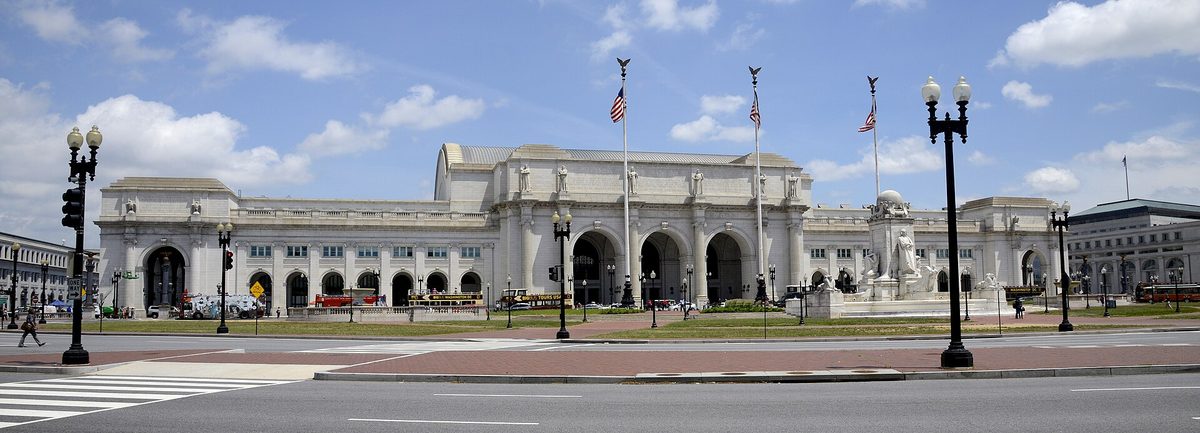
Union Station in Washington, DC is the capital's main railroad station and one of the city's finest buildings. It stands at 50 Massachusetts Ave. NE on Columbus Circle, near the U.S. Capitol. Amtrak, MARC and VRE trains leave from here, a Red Line Metro station sits beneath it, and the intercity bus terminal is in the garage behind it. Even with no train to catch, it is worth stepping in for the Main Hall, with its gilded coffered ceiling and Roman legionnaire statues. More of the city is on our Washington, DC page.
Union Station history
According to the Union Station Redevelopment Corporation (USRC), which looks after the building, the Pennsylvania Railroad and the Baltimore and Ohio Railroad agreed in 1901 to take their tracks and terminals off the National Mall and build one station together. Congress authorized it in 1903. Daniel Burnham and his firm, D.H. Burnham & Company, designed it in the Beaux-Arts style, faced in white Bethel Granite, and it was built from 1905 to 1908.
The first train arrived on October 27, 1907, and the building was completed in April 1908. The statuary and Columbus Plaza in front were finished in 1912. The station's own site calls it one of the country's first major union railroad terminals. Streetcars served the station from 1908 until January 27, 1962.
In the early 1940s the station handled up to 42,000 passengers a day. After 1945 travelers moved to cars and planes, and the building wore down. The District made it a historic landmark in 1964, and it was listed in the National Register of Historic Places in 1969. In the mid-1960s the federal government turned it into a National Visitor Center, which opened in 1976 and failed for lack of money and poor design. In 1981 a driving rain brought pieces of the leaking ceiling down into the main waiting room, and most of the building closed.
Congress passed the Union Station Redevelopment Act that same year, and in 1983 the Secretary of Transportation set up USRC. A $160 million public and private restoration followed, and the station reopened in 1988 with three levels of shops. The 5.8 magnitude earthquake of August 2011 damaged the Main Hall's plaster ceilings; they were repaired one of five bays at a time, about six months each, and finished in spring 2016, regilded with 23 karat gold. USRC says the station now sees over 100,000 visitors a day.
What to see at Union Station
The facade. Three matching grand arches framed by Ionic columns form the central pavilion. Above the columns stand the "Progress of Railroading" statues, representing fire, electricity, mechanics, agriculture, imagination and freedom. Charles W. Eliot wrote the inscriptions on the high frieze, and granite eagles stand on the east and west pavilions.
The Main Hall. The former main waiting room is 120 feet wide and 220 feet long under a 96-foot Roman barrel vault with 255 octagonal coffers, each gilded at the center. Doric columns run around the hall.
The Roman legionnaires. In arched alcoves above the columns, at balcony level, stand 36 legionnaire statues by Louis Saint-Gaudens. The full set has 46, one for each state when the station opened in 1907. They were restored in 2019, for the first time since the 1980s.
The Presidential Suite. Burnham gave the station a separate, grander entrance for the president and foreign guests. Woodrow Wilson left from it for his inauguration in March 1913; Calvin Coolidge welcomed Queen Marie of Romania there in 1926, and Franklin and Eleanor Roosevelt greeted King George VI and Queen Elizabeth in 1939. In the Second World War it was a lounge for soldiers. Today it hosts private events, so it is not open to walk in.
The station does not run guided tours; for a self-guided walk there is the Union Station Tour App on the App Store and Google Play. Shops, a food court and restaurants are listed in the station directory.
How to get to Union Station
Metro. Union Station is on Metro's Red Line. The station's site puts the Metro entrances on the west and First Street sides of the street level and on the west side of the lower level. First and last trains are on the WMATA station page.
Trains. All train service leaves from the street level:
| Operator | Service |
|---|---|
| Amtrak | its station page lists Acela, Northeast Regional, Vermonter and Floridian |
| MARC | Maryland's three lines: Penn (to Baltimore via BWI Airport), Camden (to Baltimore's Camden Yards) and Brunswick (to Brunswick, Maryland) |
| VRE | Northern Virginia commuter trains |
Baggage storage is near Gate A on the Amtrak concourse.
Buses. The bus terminal is on the garage's main level, reached from the station's mezzanine. The station lists FlixBus, Megabus, Greyhound, Peter Pan, Washington Deluxe, BestBus and Virginia Breeze. Local buses are Metrobus.
Taxi and car. The taxi stand is on the front portico just outside the Main Hall doors, 8 a.m. to 1 a.m. daily. Alamo, Avis, Budget, Hertz, Enterprise and National rent cars on the mezzanine near the garage entrance. Drive into the garage from Massachusetts Avenue NE by the ramp on the east side, or from H Street NE by the ramp behind the station.
Union Station hours, tickets and parking
The station itself is free to enter. Train tickets come from the operators: amtrak.com, MARC ticket machines (cash and card), and VRE.
| What | Hours and prices |
|---|---|
| Station | 24 hours for ticketed passengers; closed to the public 11 p.m. to 5 a.m. |
| Shops | Mon-Sat 10 a.m.-9 p.m., Sun noon-6 p.m. |
| Food court | closes 9 p.m. Mon-Sat and 6 p.m. Sun; opening times vary by vendor |
| Restaurants | each sets its own hours |
| Garage | 24 hours: up to 1 hr $13, 1-2 hrs $18, 2-10 hrs $23, 10-24 hrs $25; lost ticket $26 |
| Garage with validation | up to 1 hr $8, 1-2 hrs $10 |
| Amtrak Metropolitan Lounge | same-day single visit pass $35 |
Hours and prices checked November 18, 2026 on unionstationdc.com and amtrak.com. The station notes that some shops keep different hours, so check a particular one in the directory.
Tips before you go
- Arrive early for Amtrak: gates are posted 15 minutes before departure and close 3 minutes before.
- The station itself does not rent out wheelchairs. Amtrak's phone number is 1-800-872-7245.
- Tour and charter buses may not pick up or drop off in front of the station, on Columbus Plaza or on Massachusetts Avenue, only on the garage bus level.
- From 11 p.m. to 5 a.m. you need a train ticket to get in.
- The Main Hall is an easy stop on the way to the nearby Capitol; more nearby sights are on our Washington, DC places page.
Questions people ask
What Metro station is at Union Station?
The Metro station is called Union Station and sits right under the train station on WMATA's Red Line. There are entrances on the west and First Street sides at street level. The station opens 10 minutes before the first train, and WMATA's site has the first and last train times.
Can you go into Union Station without a ticket?
Yes. Union Station is free to enter, and during the day anyone can walk into the Main Hall, the shops and the food court. From 11 p.m. to 5 a.m. it is closed to the public and only ticketed passengers are let in.
How much is parking at Union Station?
The garage behind the station is open 24 hours. On November 18, 2026 the first hour cost $13, up to two hours $18, two to ten hours $23 and up to 24 hours $25. With a store validation the first hour is $8. Enter from Massachusetts Avenue NE or H Street NE.
Which trains leave from Union Station?
Amtrak trains, including Acela and Northeast Regional, MARC commuter trains on three Maryland lines (Penn, Camden and Brunswick), and VRE trains to Northern Virginia all leave from the street level of Union Station in Washington, DC.
Places on the map
Sources
- Union Station, Washington DC
- Union Station: Hours & Directions
- History of Union Station
- Union Station: Trains & Metro
- Union Station: Buses, Taxis & Rental
- Union Station: Parking
- Union Station: FAQ
- Union Station Redevelopment Corporation: History
- Union Station Redevelopment Corporation: Station Stories
- USRC: Main Hall Roman Legionnaire Statues Restoration Project
- Amtrak: Washington, DC Union Station (WAS)
- Maryland Transit Administration: MARC Station Information
- WMATA: Union Station