RussiansInUSA editorial team · Facts checked November 18, 2026 · Official site
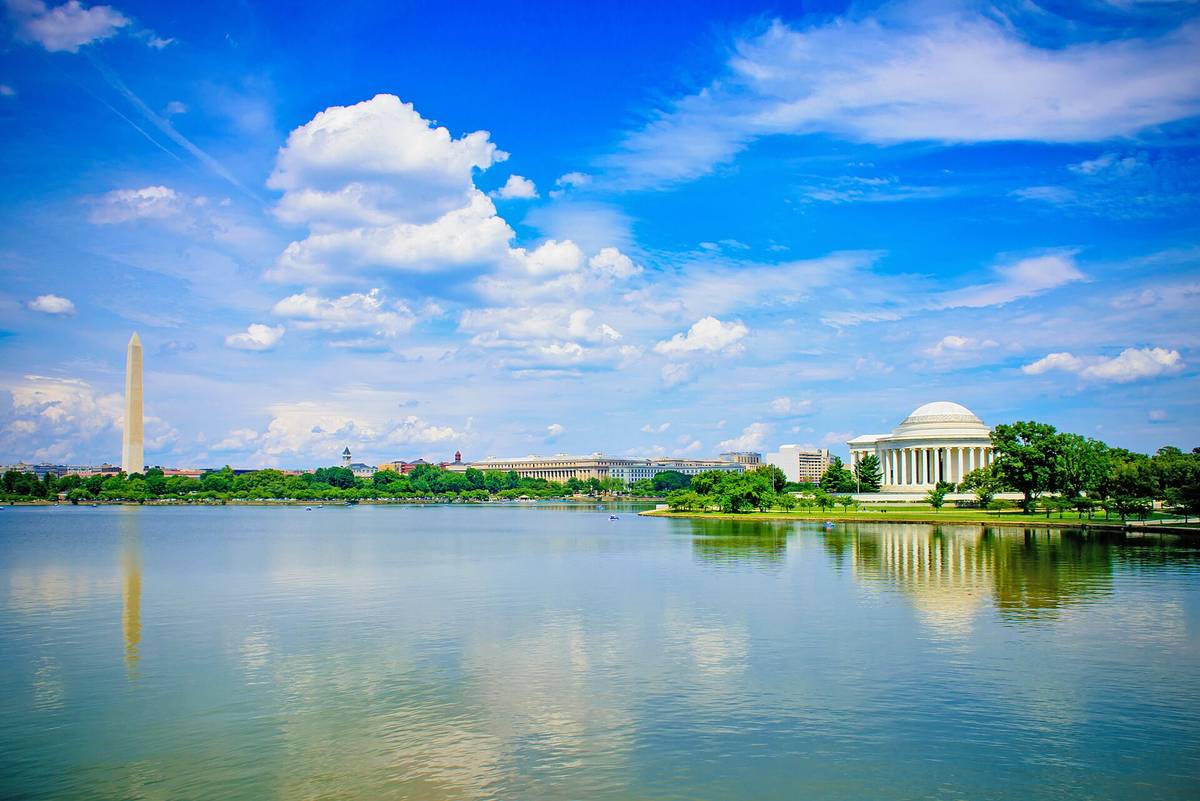
The Tidal Basin in Washington, DC is a man-made pond of about 107 acres at the southern edge of the National Mall, in West Potomac Park. The Jefferson, Martin Luther King Jr. and Franklin Delano Roosevelt memorials stand on its shores, and the Japanese cherry trees along its banks draw visitors from across the country each spring. The two-mile loop path is open 24 hours and free. More of the city is on our Washington, DC page.
Tidal Basin history: from Potomac mudflats to cherry trees
In the National Park Service (NPS) timeline, this area was once shallow mudflats known as Potomac Flats. In 1875 the Army Corps of Engineers proposed filling them with silt dredged from the Potomac. By 1882 Major Hains of the Corps had finished most of the dredging and set up the flow of water: in through the Inlet Bridge and out through the Outlet Bridge. The reclaimed land became East and West Potomac Park.
The basin has a job. NPS explains that it flushes silt out of the Washington Channel: twice a day at high tide, about 250 million gallons of Potomac water enter through the inlet gates. As the tide turns, those gates close, the outlet gates on the channel side open, and the outflow carries silt away. The basin is about 10 feet deep.
In 1897 Congress set the area aside "for the recreation and pleasure of the people," and by 1907 paths and roads ran around the whole shore. On March 27, 1912, First Lady Helen Herron Taft and Viscountess Chinda, wife of the Japanese ambassador, planted the first two Yoshino trees on the north bank. The first shipment of 2,000 trees, in 1910, had arrived diseased and was burned; the second, 3,020 trees in 12 varieties, was shipped from Yokohama on the Awa Maru and reached Washington on March 26, 1912.
In 1937 part of the southeast corner of the basin was filled and the seawall realigned for the Jefferson Memorial. In 1938, 50 women marched on the White House to defend cherry trees marked for removal and the next day chained themselves to a tree at the site, an episode NPS calls the "Cherry Tree Rebellion." The bridge and seawall were finished in the 1940s by Alexander and Repass of Iowa, a firm founded in 1929 by engineer Archie Alexander, a 1912 University of Iowa graduate, and Maurice Repass, which hired mixed crews of white and Black workers.
Over decades the old wall had sunk more than five feet in places, and its walkways flooded every day. On December 10, 2025, NPS announced it had finished rebuilding the Tidal Basin seawall, with deeper foundations and a wider, more accessible walkway, and said it would plant 426 trees, 269 of them cherries, to replace the 306 removed for the work.
What to see around the Tidal Basin
Nearly everything is on the Tidal Basin Loop Trail, which NPS describes as level and about two miles long, a walk of one to three hours.
| Sight | Where and what |
|---|---|
| Thomas Jefferson Memorial | south shore |
| Franklin Delano Roosevelt Memorial | west shore, an open-air memorial to FDR's four terms, quotes in stone and bronze |
| Martin Luther King Jr. Memorial | on the basin, visible from the loop |
| Japanese Stone Lantern | just north of the basin in a cherry grove; carved in 1651, dedicated here in 1954 |
| First Cherry Tree Planting site | north bank |
The Washington Monument is in view from the path too.
Paddle boats. Guest Services, an NPS concessioner, rents paddle boats from the boathouse at 1501 Maine Avenue SW. It is seasonal: one NPS page says March through September, another late spring through early fall. Call 202-479-2426 for dates and prices.
Fishing. NPS allows fishing from the banks, including near the inlet and outlet bridges, with a DC Fishing License.
When the cherry blossoms bloom
The trees around the basin are mostly Yoshino, with single white blossoms. NPS counts about 3,800 cherry trees in the park; the double pink Kwanzan grow mainly in East Potomac Park and bloom about two weeks after the Yoshino.
NPS defines peak bloom as the day 70% of the Yoshino blossoms are open. It most often falls between the last week of March and the first week of April; the extremes on record are March 15, 1990 and April 18, 1958. The blossoms last several days. Cool, calm weather stretches that, while rain and wind can end it in a day, and a late frost can stop the bloom altogether.
Nobody knows the date far ahead: NPS says forecasting peak bloom more than 10 days out is almost impossible. Its horticulturists track five bud stages and post them on the NPS Bloom Watch page, the page to watch in spring.
How to get to the Tidal Basin
NPS points visitors to Metro and Capital Bikeshare and names no single station. One option is Smithsonian station, on the Blue, Orange and Silver lines; plan the walk from it with the Trip Planner on wmata.com.
| Way | What NPS says |
|---|---|
| Metro | Metrorail, check wmata.com for your route |
| Bike | Capital Bikeshare stations |
| Car | West Basin Drive, Ohio Drive SW and the Tidal Basin lot on Maine Ave SW |
| Accessible parking | Home Front Drive SW, from southbound 17th St, and next to the FDR and Jefferson memorials |
| Tour bus | loading zone on Home Front Drive SW |
| Train | Amtrak, MARC and VRE at Union Station and L'Enfant Plaza |
Hours, tickets and rules
| Item | What NPS says |
|---|---|
| Loop path and memorials | open 24 hours, every day, all year |
| Entry | free, no reservations |
| Rangers | at the Jefferson, FDR and MLK memorials, daytime until 10 p.m. |
| Restrooms | accessible restrooms at each memorial |
| Dogs | allowed on the path on a leash of 6 feet or less; not inside memorials, except service animals |
| Paddle boats | seasonal, paid, from the concessioner |
Hours and prices checked November 18, 2026 on nps.gov. The park's hours page has not been updated in years, so call the park before a late visit.
Before you go
- If a stretch of the waterfront path is closed for work or flooding, NPS posts it on its Alerts and Conditions page. Check it on the day.
- The path is level and wheelchair accessible, and so are the memorials on it. Assistive listening devices and large print brochures are available on request or with notice.
- The stones at the FDR Memorial can be slippery.
- NPS calls the early morning and early evening beautiful and tranquil times to visit the memorials.
Every memorial around the basin is on our Washington, DC places page.
Questions people ask
Does it cost anything to visit the Tidal Basin?
No. The National Park Service says the Tidal Basin Loop Trail and the memorials along it are free and open 24 hours a day, with no reservations. You pay only for a paddle boat rental at the boathouse on Maine Avenue SW or for paid parking nearby.
How long is the walk around the Tidal Basin?
The Tidal Basin Loop Trail is about two miles long. The National Park Service says the walk takes one to three hours, past the Jefferson, FDR and Martin Luther King Jr. memorials. The path is level and wheelchair accessible.
When is the best time to see the cherry blossoms in Washington?
Peak bloom of the Yoshino cherry trees at the Tidal Basin usually falls between the last week of March and the first week of April. The National Park Service says the exact date is almost impossible to forecast more than 10 days ahead, so follow its Bloom Watch page in spring.
Can you rent a boat on the Tidal Basin?
Yes. Guest Services, a National Park Service concessioner, rents paddle boats from the boathouse at 1501 Maine Avenue SW. Rentals run only in the warm season, roughly spring to early fall, so call 202-479-2426 for current dates and prices.
Places on the map
Sources
- Walk Around the Tidal Basin (NPS)
- Tidal Basin, Washington, DC (NPS)
- Memorial Construction Timeline, Thomas Jefferson Memorial (NPS)
- History of the Cherry Trees (NPS)
- Bloom Watch, Cherry Blossom Festival (NPS)
- A Field Guide to the Cherry Trees (NPS)
- National Park Service Finishes Tidal Basin Seawall Work (NPS, December 10, 2025)
- Outdoor Activities, National Mall and Memorial Parks (NPS)
- Operating Hours and Seasons, National Mall and Memorial Parks (NPS)
- Alerts and Conditions, National Mall and Memorial Parks (NPS)
- Basic Information, Franklin Delano Roosevelt Memorial (NPS)
- Smithsonian station (WMATA)
- Japanese Stone Lantern, Cherry Blossom Festival (NPS)