RussiansInUSA editorial team · Facts checked November 5, 2026 · Official site
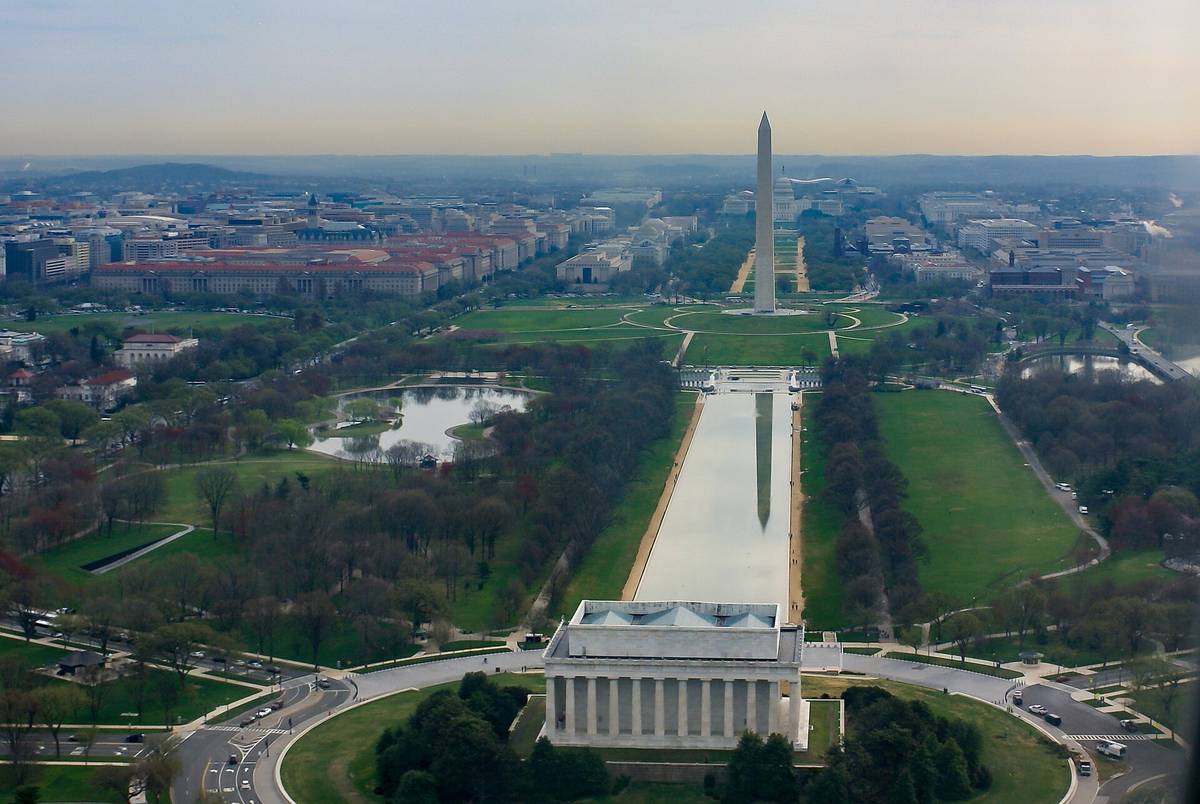
The National Mall in Washington DC is the long green strip at the center of the city, running from the foot of the US Capitol to the Potomac River. It is free and open 24 hours a day. The country's best-known memorials stand around it, along with the Smithsonian museums, which are free as well. In one day you can walk from the Capitol to the Washington Monument and the Lincoln Memorial and still see a couple of museums, spending next to nothing on tickets.
The National Park Service runs the Mall and its memorials as National Mall and Memorial Parks. It says the park protects over 1,000 acres of green space and gets an estimated 32 million visitors a year. Our Washington DC city page has the short version; this page goes further.
History of the National Mall: from L'Enfant to the McMillan Plan
The idea of a grand public avenue goes back to 1791, when the French engineer Pierre Charles L'Enfant drew his plan for the new federal city, commissioned by George Washington. He pictured a wide, tree-lined promenade linking the Capitol with an equestrian statue of Washington to the west.
After L'Enfant was dismissed, the plan was only partly carried out. In the early 1800s the Mall was more pastoral than grand: gardens, canals and scattered buildings, including the Washington City Canal along what is now Constitution Avenue. It was often muddy, overgrown or cluttered.
The turning point came with the McMillan Plan of 1902, the report of the Senate Park Commission. Senator James McMillan had appointed the architect and city planner Daniel Burnham to lead it. Drawing on the City Beautiful movement and European formal landscapes, the plan went back to L'Enfant's axes. It cleared buildings off the Mall, filled in the canal and set out the long open lawn framed by museums. It also planned the new land created by changing the path of the Potomac.
The Smithsonian Castle, the Smithsonian's oldest building, was completed in 1855. Over the 20th century more Smithsonian museums rose along the Mall's edges, while the lawns became the stage for national celebrations, protests and moments of shared memory.
What to see on the National Mall
Memorials
The park holds the Franklin Delano Roosevelt Memorial, the Korean War Veterans Memorial, the Lincoln Memorial, the Martin Luther King, Jr. Memorial, the Thomas Jefferson Memorial, the Vietnam Veterans Memorial, the Washington Monument and the World War II Memorial, plus 150 statues, circles, fountains and small parks downtown. Some 2,000 American elms line the Mall, and 3,000 Japanese cherry trees grow around the Tidal Basin.
The Lincoln Memorial, the Washington Monument, the Library of Congress and the National Air and Space Museum each have their own page in our list of places to see in Washington DC.
Smithsonian museums
The Smithsonian lists its museums on the north and south sides of the Mall, from 15th to 3rd Streets between Constitution and Independence Avenues, about a mile. All are free, and most are open every day except December 25. Among the museums on the Mall:
- National Museum of Natural History: the Hope Diamond, the fossil hall with T. rex and Triceratops, the Sant Ocean Hall with megalodon jaws, and a live insect zoo.
- National Museum of American History, with play and invention spaces for children.
- National Museum of African American History and Culture.
- National Air and Space Museum.
- The American Indian Museum, the Hirshhorn (modern and contemporary art), the African Art and Asian Art museums, and Smithsonian Gardens.
The Castle is closed for its first major renovation in more than 50 years.
Beyond the museums
The Park Service lists paddle boats, bike tours and nighttime walks with a ranger. Maps and direction pylons around the Mall help you find your way.
How to get to the National Mall
The Park Service suggests Metro rail and bus because parking in the city is at a premium. Maps and trip planning are on WMATA.
| Metro station | Lines |
|---|---|
| Smithsonian | Blue, Orange, Silver |
| Federal Triangle | Blue, Orange, Silver |
| Archives (Navy Memorial) | Green, Yellow |
| Metro Center | Red, Blue, Orange, Silver |
Lines are as listed on wmata.com. The Natural History Museum names Federal Triangle, Archives/Navy Memorial and Metro Center as its closest stations.
Driving: the Park Service says there is metered parking on streets and lots around the Mall, but spaces are hard to find. The Smithsonian has no public parking on the Mall; check enforcement days and hours on the meters and curbside signs. Capital Bikeshare is another option. The nearest airports are Reagan National, Dulles and BWI. Details are on the Park Service Directions page.
Hours and tickets
| What | Hours | Entry |
|---|---|---|
| National Mall and memorials | 24 hours; rangers on duty 9:30 am to 10 pm | free |
| Washington Monument | timed tickets | free, $1 fee per advance ticket |
| Natural History Museum | 10 am to 5:30 pm daily, closed December 25 | free, no tickets |
| American History Museum | 10 am to 5:30 pm daily | free, no tickets |
| African American History and Culture Museum | open daily | free timed-entry pass required |
| Air and Space Museum | see the museum's site | free timed-entry pass required |
Hours and prices checked November 5, 2026 on nps.gov and si.edu.
Washington Monument tickets
Entry is free, but you need a timed ticket. Advance tickets are released 30 days ahead at 10:00 am each day, with more released the day before. Each advance ticket carries a non-refundable $1.00 service charge. Free same-day tickets are handed out first come, first served at the Washington Monument Lodge on 15th Street between Madison and Jefferson Drives; the window opens at 8:45 am, and one person aged 16 or older can take up to six. The monument closes for high wind and thunderstorms, one day in the first week of each month for maintenance, and on July 4 and December 25. Current rules are on the Washington Monument fees page.
Tips before you go
- Come early in the morning or in the early evening, which the Park Service calls the most beautiful and tranquil times.
- Only two Smithsonian museums on the Mall need a free timed pass: African American History and Culture, and Air and Space. Walk into the rest.
- For the Washington Monument, book online at 10:00 am thirty days ahead, or be at the Lodge window before 8:45 am.
- Rangers answer questions at the sites from 9:30 am to 10 pm; the park's phone is 202-426-6841.
Questions people ask
Does it cost anything to visit the National Mall and its museums?
No. The National Park Service says there is no cost to visit any site in National Mall and Memorial Parks, and the Smithsonian museums on the Mall are free too. You may pay for parking or transportation, and each advance Washington Monument ticket carries a $1 service charge.
Which museums on the National Mall need a timed pass?
According to the Smithsonian, the National Museum of African American History and Culture and the National Air and Space Museum require free timed-entry passes. The Natural History, American History and Hirshhorn museums and the other Smithsonian museums on the Mall need no passes.
What is the closest Metro stop to the National Mall?
Smithsonian and Federal Triangle stations are on the Blue, Orange and Silver lines. The Natural History Museum also names Archives/Navy Memorial on the Green and Yellow lines and Metro Center, which also serves the Red line, as close by. The Park Service recommends Metro because parking downtown is scarce.
When is the best time to walk the National Mall?
The Mall is open 24 hours a day, and rangers are on duty at the memorials from 9:30 am to 10 pm. The National Park Service calls early morning and early evening the most beautiful and tranquil times to visit. The Natural History and American History museums are open 10 am to 5:30 pm.
Places on the map
Sources
- National Park Service: National Mall and Memorial Parks
- NPS: Plan your visit, National Mall and Memorial Parks
- NPS: National Mall history and culture
- NPS: The Mall
- NPS: Make No Little Plans (McMillan Plan)
- NPS: Directions
- NPS: Fees and passes
- NPS: Operating hours and seasons
- NPS: National Mall FAQ
- NPS: Washington Monument tickets
- Smithsonian: Plan your visit
- Smithsonian: Museums and Zoo (hours, passes)
- National Museum of Natural History: Visit
- National Museum of Natural History: Getting here and parking
- National Museum of American History: Visit
- NMAAHC: Plan your visit
- WMATA: Smithsonian station
- WMATA: Archives station
- National Air and Space Museum: Visit the museum in DC (free timed-entry passes)
- Recreation.gov: Washington Monument tickets
- WMATA: Federal Triangle station
- WMATA: Metro Center station