RussiansInUSA editorial team · Facts checked November 18, 2026 · Official site
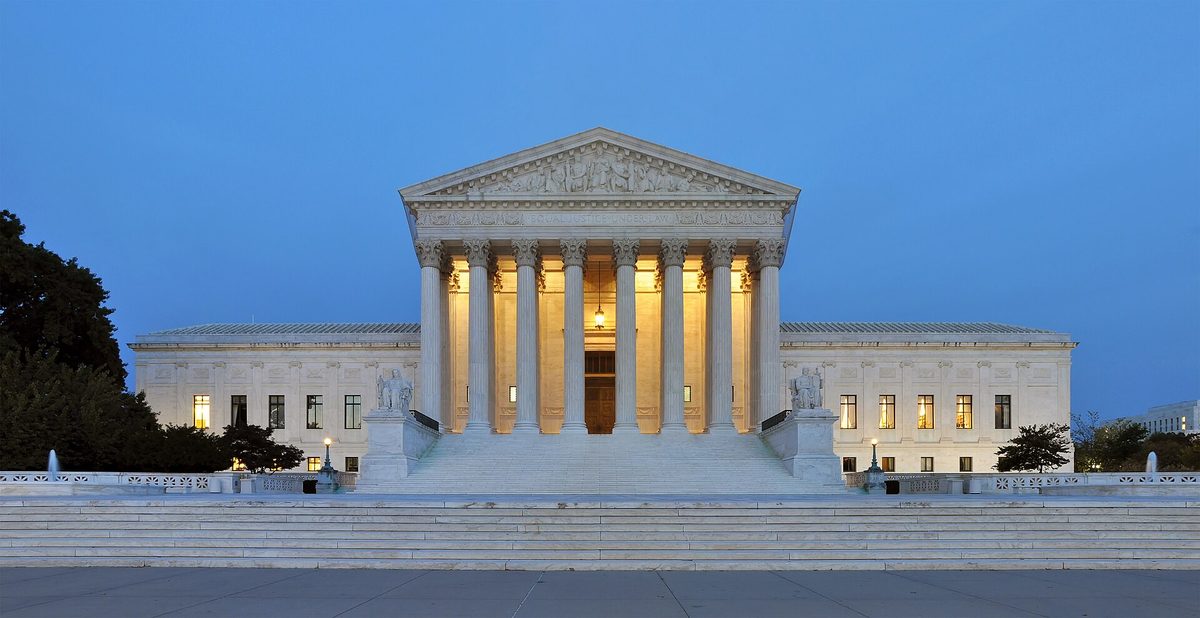
The Supreme Court Building stands at 1 First Street NE in Washington, DC, and it is open to visitors. On weekdays from 9 a.m. to 3 p.m. anyone can walk through the public areas for free: the Great Hall, the ground-floor exhibitions, a lecture inside the Courtroom itself and, on argument days, a seat at an oral argument if you get one. More of the city is on our Washington, DC page.
Supreme Court Building history
For most of its first 146 years the Court had no building of its own. According to the Court's website, it first met in the Exchange Building in New York. From 1790 it sat in Philadelphia, first in the State House (Independence Hall), then in City Hall. From 1800 it worked inside the Capitol in Washington: briefly in a private house after the fire of the War of 1812, in a chamber of the Capitol from 1819 to 1860, and in the Old Senate Chamber from 1860 to 1935.
Chief Justice William Howard Taft pushed for a home of its own. In 1929 he persuaded Congress to authorize it, and he chose the architect Cass Gilbert, asking for "a building of dignity and importance suitable for its use as the permanent home of the Supreme Court of the United States." Chief Justice Charles Evans Hughes laid the cornerstone on October 13, 1932, and the building was finished in 1935. Gilbert did not live to see it; Cass Gilbert, Jr., and John R. Rockart completed the work.
Congress authorized $9,740,000, and about $94,000 went back to the Treasury. Marble worth $3 million was gathered: Vermont marble outside, white Georgia marble in the four inner courtyards, creamy Alabama marble in the corridors and entrance halls. The style is classical Corinthian. The foundation measures 385 feet east to west and 304 feet north to south, with four stories above the terrace.
What to see at the Supreme Court
West front. An oval plaza 252 feet wide leads to sixteen marble columns under a pediment with Robert Aitken's "Liberty Enthroned," guarded by figures of Order and Authority. "Equal Justice Under Law" is carved above the entrance. James Earle Fraser's two seated marble figures flank the steps: "Contemplation of Justice" and the "Guardian" or "Authority of Law."
Bronze doors. Each door weighs six and a half tons. John Donnelly, Jr.'s panels show scenes from the history of Western law, from the trial scene on the shield of Achilles and King John sealing Magna Carta to Chief Justice John Marshall with Justice Joseph Story.
East front. Hermon A. MacNeil's pediment includes Moses, Confucius and Solon, above the words "Justice the Guardian of Liberty."
Great Hall and Courtroom. The Great Hall has double rows of marble columns under a coffered ceiling, with busts of former Chief Justices. The Courtroom is 82 by 91 feet with a 44-foot ceiling and 24 columns of Siena marble; its walls and friezes are marble from Alicante, Spain.
Spiral staircases and exhibitions. One of the building's two self-supporting marble spiral staircases can be seen from the ground floor. All exhibitions are on the ground floor and self-guided; they change, so see the exhibitions page.
Courtroom lectures and oral arguments
On days the Court is not sitting, volunteer docents and interns give 25-minute lectures in the Courtroom, usually Monday to Friday at 10:30 and 11:30 a.m. and 12:30, 1:30 and 2:30 p.m., except federal holidays. The line forms in the Great Hall at the "Courtroom Lecture Line Forms Here" sign. The Court suggests arriving at least 15 minutes early, especially in spring and summer; latecomers are not admitted. Lectures can be canceled for Court business; the lectures page has the schedule for the next 30 days.
The Court's Term begins on the first Monday in October and usually runs until late June or early July. Sittings and recesses alternate at roughly two-week intervals. During a sitting, public sessions are usually Monday through Wednesday, starting at 10 a.m., with two arguments a day and 30 minutes per side. Arguments usually end in April, and the Court then releases opinions for the rest of the Term. Dates are on the Court's calendars.
Seats are limited. The line forms on the East Capitol Street sidewalk, and seating for the first argument begins at 9:30 a.m. Do not hold a place for anyone not yet there. Big cases draw lines before the building opens. For an afternoon session you must line up again outside. The Court may also offer seats through an online lottery; check the Courtroom seating page for how it works now. The Court does not recommend bringing infants or young children.
How to get to the Supreme Court
| Mode | Route |
|---|---|
| Metrorail | Capitol South (Blue, Orange, Silver lines), 0.3 miles |
| Metrorail | Union Station (Red Line), 0.5 miles |
| Bus | D1X or D10 to First Street and Independence Avenue, two blocks |
| Train | Amtrak, VRE and MARC to Union Station, about 0.5 miles |
| Car | Street parking is extremely limited; nearest public garage at Union Station |
Private buses and passenger vans cannot reach the building. Visitors use the Northwest and Southwest doors on either side of the main steps; the accessible entrance is on Maryland Avenue, on the left side of the building.
Hours and tickets
| What | When and how much |
|---|---|
| Building | Monday to Friday, 9 a.m. to 3 p.m. |
| Closed | Saturday, Sunday and federal holidays |
| Admission | Free |
| Courtroom lectures | 10:30, 11:30, 12:30, 1:30, 2:30, not on Court days |
| Cafe and gift shop | Monday to Friday, 9 a.m. to 3 p.m., ground floor |
| Argument days | Visitor entrances open at 7:30 a.m. for those attending Court |
Hours and prices checked November 18, 2026 on supremecourt.gov. The Court warns that its business may affect public access and visitor programs, so check "Today at the Court" on the Court's home page on the day you go.
Security rules and what not to bring
Everyone goes through a magnetometer and an x-ray. Not allowed: food or drink of any kind, including unopened packages; any liquid, water included (empty bottles are fine); bags larger than 18 by 14 by 8.5 inches; sprays and pepper spray; weapons and replicas; knives and pointed objects (pens are fine); razors. The full list is on the prohibited items page.
In the Courtroom during a session, no electronic devices of any kind, no bags, hats, overcoats, sunglasses or books (notepads are allowed), and no political buttons or attire. Non-flash personal photos are fine in the public areas of the ground and first floors, never in the Courtroom. Free lockers are near the restrooms on both floors. From March through June expect longer security lines. For more sights nearby, see what to see in Washington.
Questions people ask
Do you need a ticket to visit the Supreme Court?
No. The Supreme Court Building is free and needs no ticket, Monday to Friday from 9 a.m. to 3 p.m., except federal holidays. Everyone passes security screening. Courtroom lectures are free too, and oral argument seats are given first come, first seated from the line on East Capitol Street.
Can you go inside the Courtroom when the Court is not sitting?
Yes, on a 25-minute Courtroom lecture. On days the Court is not in session they usually start at 10:30, 11:30, 12:30, 1:30 and 2:30, Monday to Friday. Line up in the Great Hall outside the Courtroom at least 15 minutes early.
When does the Supreme Court hear cases?
The Term starts on the first Monday in October. Arguments usually run through April, in sittings that alternate with recesses about every two weeks, Monday through Wednesday from 10 a.m. Exact dates are on the calendar at supremecourt.gov.
What is the closest Metro station to the Supreme Court?
Capitol South on the Blue, Orange and Silver lines, about 0.3 miles away. Union Station on the Red Line is about 0.5 miles away and also serves Amtrak, VRE and MARC trains. Street parking near the Court is extremely limited.
Places on the map
Sources
- Supreme Court of the United States
- Visiting the Court, Supreme Court of the United States
- Hours and Directions, Supreme Court of the United States
- Courtroom Lectures, Supreme Court of the United States
- Prohibited Items, Supreme Court of the United States
- Visitor Guidelines, Supreme Court of the United States
- Cafe and Building Amenities, Supreme Court of the United States
- Exhibitions, Supreme Court of the United States
- Courtroom Seating, Supreme Court of the United States
- Calendars and Lists, Supreme Court of the United States
- The Court and Its Procedures, Supreme Court of the United States
- Building History, Supreme Court of the United States
- Building Features, Supreme Court of the United States
- Capitol South station (WMATA)
- Union Station station (WMATA)