RussiansInUSA editorial team · Facts checked November 18, 2026 · Official site
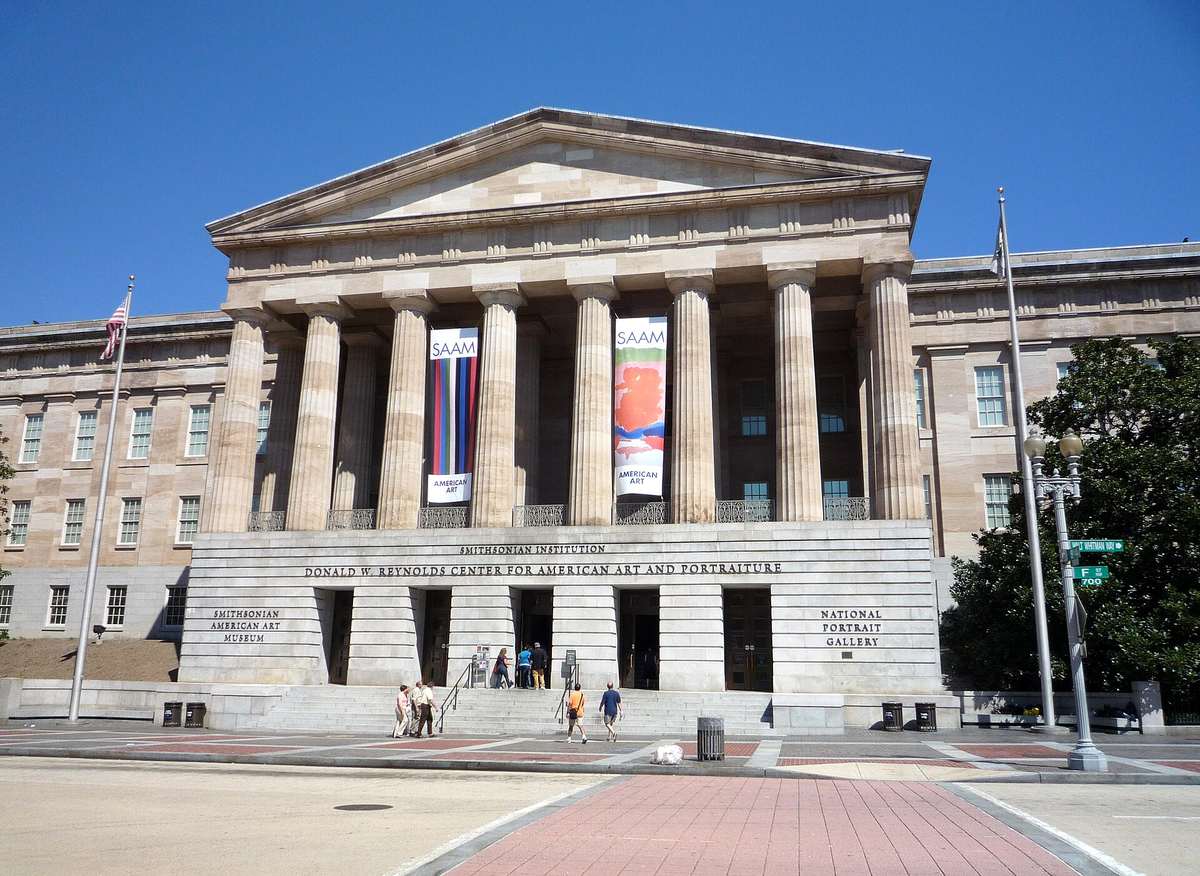
The National Portrait Gallery is the Smithsonian museum that tells the story of the United States through portraits of the people who shaped it: presidents, inventors, writers, performers and activists. It fills the block between 7th and 9th Streets and F and G Streets NW in Penn Quarter, a short walk from the National Mall and the White House. It is open every day from 11:30 am to 7 pm except December 25, and admission is free. The main draw is the only complete collection of presidential portraits outside the White House. For the rest of the city, see our Washington DC city page and the list of places to see.
History of the building and the National Portrait Gallery
The museum sits in the Old Patent Office Building, one of Washington's oldest public buildings and, in the museum's words, one of the finest examples of Greek Revival architecture in the country. President Andrew Jackson laid the cornerstone in 1836. The Patent Office moved in in 1842 while work was still going on, and the building was finished in 1868. The south wing went up between 1836 and 1842; the north wing was finished in 1857.
The building issued patents and displayed the scale models that came with applications. During the Civil War it served as barracks and a hospital, and Clara Barton and Walt Whitman both volunteered here as nurses. From 1865 the Department of the Interior used the second floor. Whitman worked there as a clerk and was fired after six months when a revised copy of Leaves of Grass was found on his desk. Abraham Lincoln's second inaugural ball was held here in 1865.
In the 1950s Congress marked the building for demolition to make room for a parking lot. Preservationists got it named a National Historic Landmark, and it went to the Smithsonian in 1958. Congress created the National Portrait Gallery in 1962, and it opened on October 5, 1968, sharing the building with what is now the Smithsonian American Art Museum.
The new museum started without a collection; its first director, Charles Nagel (1964 to 1969), relied mostly on donors. Today the collection holds more than 23,000 objects. Photographs were allowed into it from 1976, and since 2001 the museum can collect portraits of living people. The building closed in 2000 for a six-and-a-half-year renovation, and the museum now counts more than a million visitors a year.
What to see at the National Portrait Gallery
America's Presidents, second floor, west galleries. The museum's signature exhibition, first called the Hall of Presidents, has been here since 1968. The museum holds more than 1,700 likenesses of presidents and shows more than sixty presidential portraits. Visitors can touch replicas of Lincoln's life masks, and QR codes lead to video and audio.
The "Lansdowne" Washington. Gilbert Stuart's 1796 portrait opens the presidential galleries. It had been on loan since 1968 when its owner decided to sell it in 2000; the Donald W. Reynolds Foundation bought it as a gift to the nation.
The Meserve Collection. Acquired in 1981, it holds more than 5,400 nineteenth-century glass-plate negatives from Mathew Brady's studios, plus the "cracked-plate" Lincoln, from a series Alexander Gardner made two months before the assassination.
The Kogod Courtyard. Foster + Partners designed the wavy glass-and-steel roof, carried by eight columns around the edge so its weight does not rest on the historic walls. The courtyard is free, covered year-round and holds the cafe.
The Great Hall and the third floor. Lincoln's ball took place in the Great Hall. On the third floor, the Lunder Conservation Center (opened 2006) lets you watch conservators at work through floor-to-ceiling windows, and the museum says the third floor, the Luce Foundation Center especially, stays quiet at any time.
Temporary exhibitions come and go; see npg.si.edu for what is on.
How to get to the National Portrait Gallery
The nearest Metrorail station is Gallery Place on wmata.com; the museum calls it Gallery Place/Chinatown.
| Station | Metrorail lines | Note |
|---|---|---|
| Gallery Place | Red, Yellow, Green | elevator from the station to 7th Street |
The museum is one block from both the 7th Street and 9th Street exits. There are two entrances, on G Street and on F Street, with screening at both. Only the 8th and G Streets entrance is wheelchair accessible, with ramps on both sides of the stairs; the F Street entrance has stairs only. MetroAccess riders should give 800 G Street NW as the address. Elevators serve all floors, and wheelchairs can be borrowed from the officer at the G Street entrance.
Capital Bikeshare has stations at 7th and F and at 9th and G. Downtown street parking is metered and fills early; hourly garages are nearby. Red-top meters for drivers with a disability placard are on the F, G and 7th Street sides.
Hours and admission
| Address | 8th and F Streets NW, Washington, DC 20001 |
| Hours | daily, 11:30 am to 7 pm |
| Closed | December 25 |
| Admission | free |
| Courtyard Cafe | 11:30 am to 5:30 pm |
| Phone | (202) 633-8300 |
Hours and prices checked November 18, 2026 on npg.si.edu.
Security, bags and other rules
Everyone goes through a metal detector or a hand wand. Suitcases, large umbrellas and large backpacks are not allowed in the galleries, and there is no coat or bag check; guards may ask you to carry a small backpack by hand or wear it on your front. Knives (pocket knives too), aerosols including pepper spray, scissors, tools, signs and banners, pets other than service animals and wagons are not allowed. Tripods and selfie sticks cannot be used in the galleries. Strollers, cameras, mobility aids and bottled water are fine, and food and drink only in the Kogod Courtyard. Visitors under 18 need an adult, and one adult may bring up to five children. A free audio guide is on the Bloomberg Connects app.
Questions people ask
How much does the National Portrait Gallery cost?
Nothing. Admission to the Smithsonian's National Portrait Gallery is free and no tickets are needed. It is open daily from 11:30 am to 7 pm and closed only on December 25. The only costs are the Courtyard Cafe or parking if you drive, and metered street spaces downtown fill up early.
Which Metro station is closest to the National Portrait Gallery?
Gallery Place, which the museum calls Gallery Place/Chinatown, on the Red, Yellow and Green lines. The museum is one block from the 7th and 9th Street exits, and an elevator runs from the station to 7th Street. The wheelchair accessible entrance is at 8th and G Streets.
Where are the presidential portraits?
The America's Presidents exhibition fills the west galleries on the second floor. It is the only complete collection of presidential portraits outside the White House, and it opens with Gilbert Stuart's 1796 "Lansdowne" portrait of George Washington.
Can I bring a backpack to the National Portrait Gallery?
A small one, yes, though guards may ask you to carry it by hand or wear it on your front. Suitcases, large backpacks and large umbrellas are not allowed in the galleries, and the museum has no coat or bag check. Tripods and selfie sticks are also not allowed.
Places on the map
Sources
- Smithsonian National Portrait Gallery (hours, location)
- NPG: Getting Here (address, hours, admission, Metro, parking)
- NPG: Visiting the Museum (security, permitted and prohibited items)
- NPG: Accessibility (entrances, MetroAccess, elevators, quiet areas)
- NPG: The Courtyard Cafe
- NPG: About Us (founding, collection, Lansdowne portrait)
- NPG: History (Old Patent Office Building, Kogod Courtyard)
- NPG: Celebrating Fifty Years
- NPG: America's Presidents
- WMATA: Gallery Place station