RussiansInUSA editorial team · Facts checked November 18, 2026 · Official site
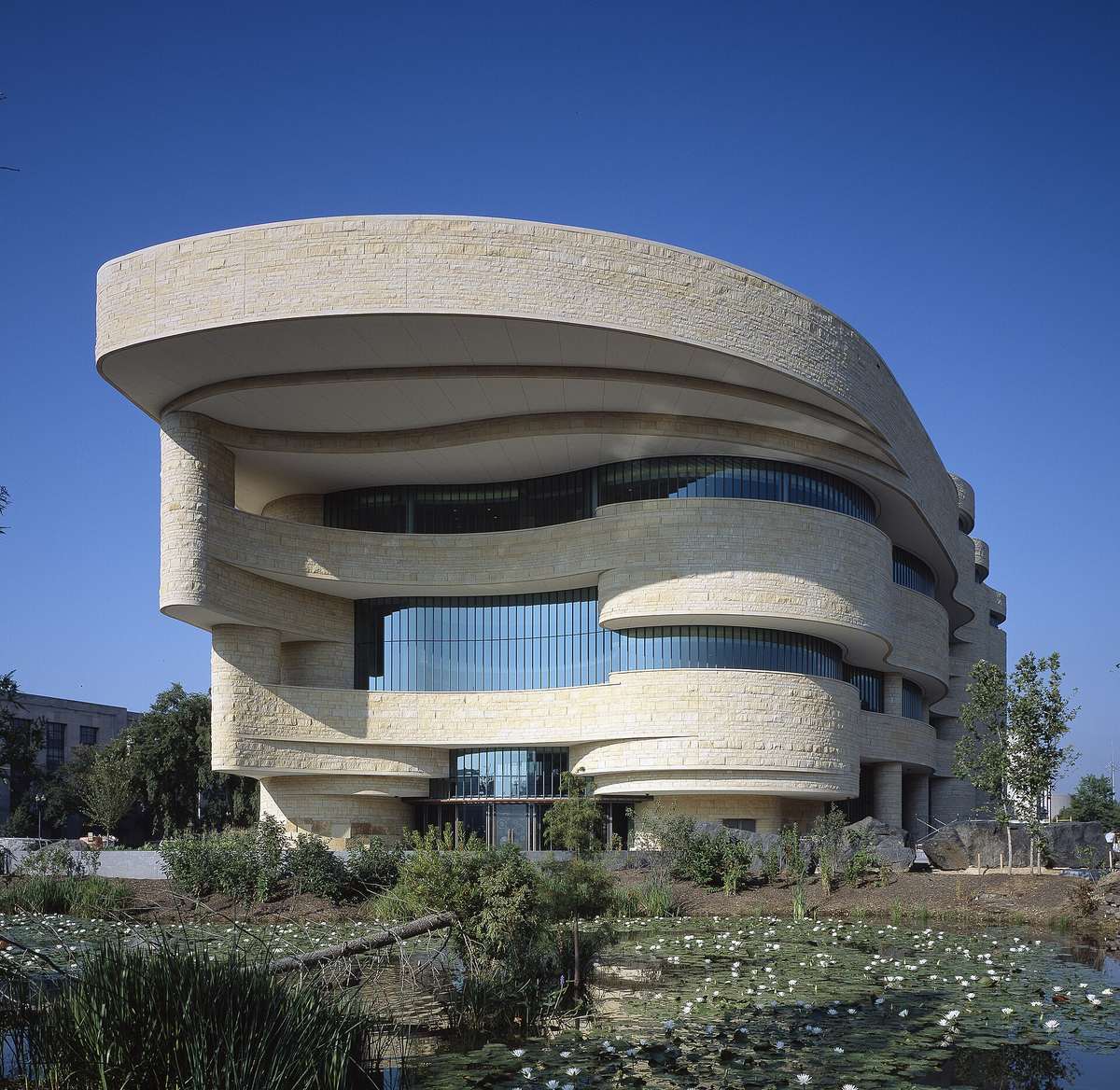
The National Museum of the American Indian (NMAI) is a Smithsonian museum on the south side of the National Mall in Washington, at Fourth Street & Independence Avenue SW. Admission is free, no tickets are needed, and it is open every day except December 25. People come for the curving building of golden stone, designed together with Native communities, for exhibitions on the Native peoples of the whole Western Hemisphere, and for grounds planted with wild rice, corn and tobacco. More of the city is on our Washington, DC page.
History of the museum, from 1989 to 2004
Congress created the museum by law in 1989, and the law was amended in 1996. The museum says it was 15 years in the making: the building on the Mall opened to the public on September 21, 2004. It describes itself as the first national museum in the country dedicated only to Native Americans, and the first to present all its exhibitions from a Native point of view.
The NMAI runs three sites. The museum on the Mall holds exhibitions, performances, lectures and education programs. The George Gustav Heye Center opened in 1994 in the Alexander Hamilton U.S. Custom House in lower Manhattan. The collections, conservation labs and repatriation program sit at the Cultural Resources Center in Suitland, Maryland. The collection covers the whole hemisphere, from the Arctic Circle to Tierra del Fuego; the museum's 2015 fact sheet put it at about 836,100 items.
The design started with people, not plans. In the early 1990s the museum met with Native communities across the Americas, and in 1993 those meetings produced The Way of the People, a document asking for a building that feels alive rather than formal and quiet, connects to the natural world and reflects the sky, with an east-facing entrance and a dome open to the sky. The early design team, GBQC and Douglas Cardinal, Ltd., included architect Douglas Cardinal (Blackfoot), Johnpaul Jones (Cherokee/Choctaw), Donna House and Ramona Sakiestewa; Jones & Jones, SmithGroup and Polshek Partnership joined later.
The five-story, roughly 250,000-square-foot building is clad in Kasota limestone, its curves modeled on rock shaped by wind and water. It is aligned with the cardinal directions and with the center of the Capitol dome. It earned LEED Silver in 2011 and LEED Gold in 2016, the first Smithsonian museum to be LEED certified.
What to see inside
The main interior space is the Potomac Atrium, 120 feet high under the dome, with a window of eight prisms. Two long-running exhibitions are listed by the museum as ongoing:
- Americans looks at how American Indian images, names and stories run through the whole country's life, from butter packaging and sports mascots to Westerns, cartoons, state and city names and the Tomahawk missile. It looks closely at three stories: Pocahontas, the Trail of Tears and the Battle of Little Bighorn.
- Return to a Native Place: Algonquian Peoples of the Chesapeake introduces the Native peoples of what is now DC, Maryland, Virginia and Delaware, and the history of the Nanticoke, Powhatan and Piscataway from the 1600s to today.
Other shows change; see Exhibitions: Washington, DC for what is on. The museum has a Highlights of the Museum audio guide in English and Spanish.
With children, head to the imagiNATIONS Activity Center on the third level, meant for ages 10 and under, where play-based exhibits show Indigenous inventions that millions of people use every day. Entry is first come, first served, and space is limited. The Mitsitam Native Foods Cafe serves food from regions across the Americas; "Mitsitam" means "Let's eat!" in the Delaware and Piscataway languages. The espresso bar next to it serves bison chili and Three Sisters soup.
The grounds, the rocks and the veterans memorial
The 4.25-acre site is part of the museum. It recreates the Chesapeake Bay country as it was before European contact: a hardwood forest on the north side, wetlands, a meadow and croplands, with more than 27,000 trees, shrubs and plants of 145 species. The croplands grow the "Three Sisters" (corn, beans and squash) and tobacco, and the wetlands wild rice and swamp milkweed.
Forty uncarved boulders, the Grandfather Rocks, greet visitors. They came from a quarry in Alma, Canada, and were blessed by the Montagnais First Nations before the trip. Four Cardinal Direction Markers come from Hawai'i, the Northwest Territories of Canada, the Monocacy Valley in Maryland and Puerto Williams, Chile. On the north side, a stone waterfall recalls Tiber Creek, an old tributary of the Potomac.
Near the south entrance stand the Always Becoming sculptures by Nora Naranjo Morse (Santa Clara Pueblo), made of earth, straw, clay, wood and moss and meant to change over time. In the northwest of the grounds stands the sculpture We Were Always Here by Rick Bartow (Mad River Band Wiyot). The National Native American Veterans Memorial opened on the grounds on November 11, 2020: a raised stainless-steel circle on a carved stone drum, with water for ceremonies, benches and lances where cloths may be tied for prayers and healing.
How to get there
The museum sits between the National Air and Space Museum and the U.S. Botanic Garden, across from the National Gallery of Art East Building. The entrance is at Third Street and Maryland Avenue SW, facing the Capitol.
| Metro station | Metrorail lines |
|---|---|
| L'Enfant Plaza | Green, Yellow, Blue, Silver, Orange |
| Federal Center SW | Blue, Silver, Orange |
Several bus routes stop nearby; plan the trip on wmata.com. The museum has no parking of its own: there is metered street parking and several commercial garages. Two spaces for vehicles with a disability placard are at the northeast corner of Jefferson Drive and Fourth Street SW. Nearby sights are on our places to see in Washington page.
Hours and admission
| What | Details |
|---|---|
| Hours | daily, 10 AM to 5:30 PM |
| Closed | December 25 |
| Admission | free, no tickets or passes |
| imagiNATIONS Activity Center | daily, 10 AM to 5 PM, subject to change |
| Parking | none at the museum |
Hours and prices checked November 18, 2026 on americanindian.si.edu.
Cafe hours vary by day of the week, and the espresso bar keeps its own hours; check the Dining page before you go.
Tips before you go
Everyone walks through a metal detector, and bags are checked by hand or X-ray. The Smithsonian asks visitors to bring fewer bags to get through faster. Firearms, knives (pocket knives included), scissors, screwdrivers, pepper spray, and placards, signs or banners are not allowed; the full list is on the Entry and Guidelines page at si.edu.
The building has ramps at the entrances and elevators to every level. Wheelchairs are lent first come, first served at the security desks near both entrances. Blind and low-vision visitors can use the free Aira app over the museum's Wi-Fi. If you bring a class to imagiNATIONS, check in at its desk on the third level; student groups need one adult per five children.
Questions people ask
Do you need tickets for the American Indian museum in DC?
No. The National Museum of the American Indian on the National Mall is free, and no tickets or timed passes are needed. It is open daily from 10 AM to 5:30 PM except December 25. Every visitor goes through security screening with a metal detector and a bag check.
What Metro stop is closest to the National Museum of the American Indian?
The nearest Metrorail stations are L'Enfant Plaza, served by the Green, Yellow, Blue, Silver and Orange lines, and Federal Center SW on the Blue, Silver and Orange lines. The museum entrance is on the east side, at Third Street and Maryland Avenue SW, facing the Capitol.
Is there parking at the museum?
The National Museum of the American Indian has no parking of its own. Visitors use metered street parking or nearby commercial garages. Two spaces for vehicles with a disability placard are at the northeast corner of Jefferson Drive and Fourth Street SW.
When did the museum open and who designed it?
Congress created the museum in 1989, and the building on the National Mall opened on September 21, 2004. It was designed together with Native communities; the early design team included Douglas Cardinal (Blackfoot) and Johnpaul Jones, and Jones & Jones, SmithGroup and Polshek Partnership joined later.
What is there for kids at the museum?
The imagiNATIONS Activity Center on the third level is meant for children 10 and under and shows Indigenous inventions through hands-on play. Entry is free and first come, first served, with limited space. Outside, children can see the corn and tobacco fields, the wetlands, 40 giant boulders and sculptures of clay and straw.
Places on the map
Sources
- National Museum of the American Indian
- NMAI: Visit Washington, DC (hours, admission, getting here, parking, accessibility)
- NMAI: Architecture & Landscape
- NMAI: About the Museum
- NMAI: Fact Sheet, National Museum of the American Indian on the National Mall (June 2015)
- NMAI: Exhibitions in Washington, DC
- NMAI: Americans
- NMAI: Return to a Native Place: Algonquian Peoples of the Chesapeake
- NMAI: imagiNATIONS Activity Center
- NMAI: Dining
- Smithsonian: National Museum of the American Indian
- Smithsonian: Entry and Guidelines (security screening, prohibited items)
- WMATA: L'Enfant Plaza station
- WMATA: Federal Center SW station