RussiansInUSA editorial team · Facts checked November 18, 2026 · Official site
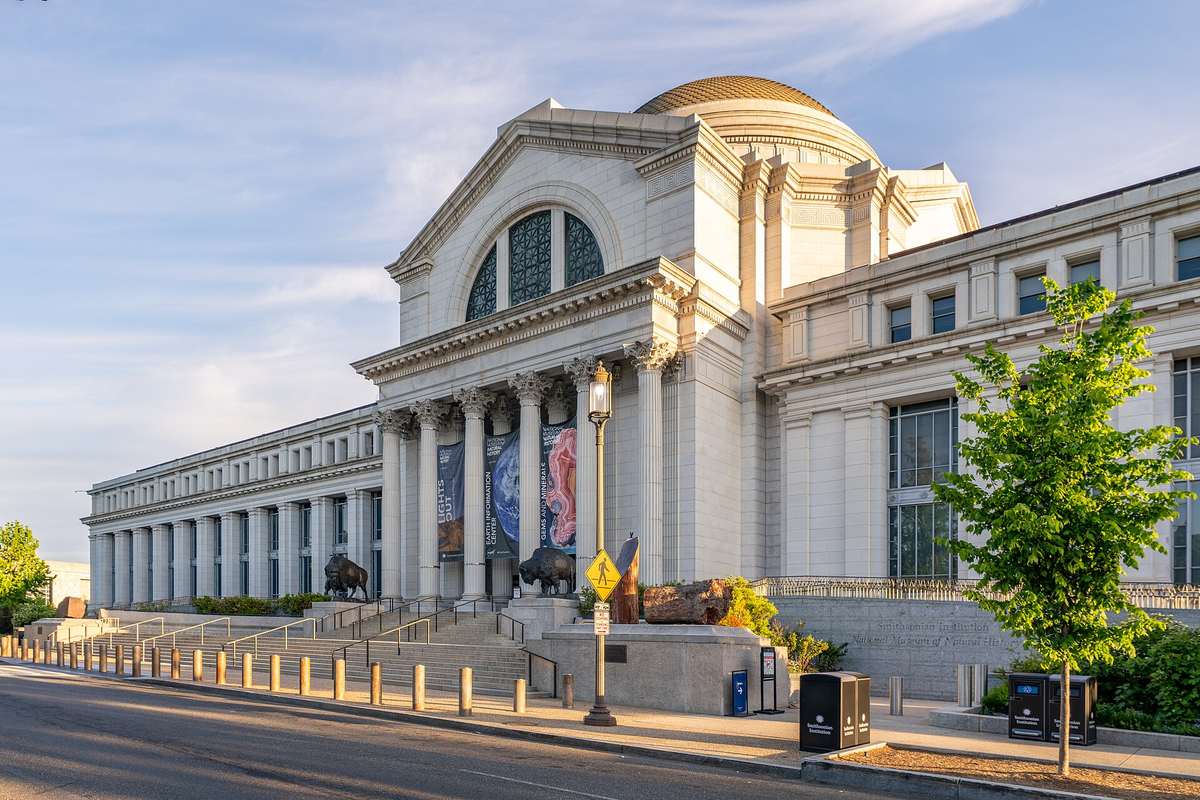
The Smithsonian's National Museum of Natural History in Washington DC stands on the north side of the National Mall, at 10th Street and Constitution Avenue NW. It is open every day except December 25, admission is free, and no tickets are needed. Inside are the Hope Diamond, a Tyrannosaurus and Triceratops locked in a fight, a huge African elephant in the Rotunda and an ocean hall with a coral reef fish tank. For the rest of the city, see our Washington DC page and the list of places to see.
History of the museum
The 1846 law that founded the Smithsonian already provided for a National Museum. Its early collections, the museum says, came from the United States Exploring Expedition of 1838 to 1842 and the great surveys of the American West in the 1850s, 1860s and 1870s. They were first kept in the Smithsonian Castle and moved in 1881 to the first National Museum building, today the Arts and Industries Building. By 1882 director G. Brown Goode was already asking for more space.
Congress funded a new building on January 30, 1903. The local firm Hornblower and Marshall designed it, and ground was broken on June 15, 1904. In 1905 Secretary Samuel P. Langley halted the work: the Smithsonian disliked the ornate French baroque entrance. Charles Follen McKim of McKim, Mead, and White drew a plainer Roman dome and central pavilion.
By August 11, 1909 staff had begun moving in, hauling some 10 million objects by horse-drawn cart. The museum opened to the public on March 17, 1910, though the building was finished only on June 20, 1911. From 1917 to 1919 the Bureau of War Risk Insurance occupied it and it was closed to visitors. East and west wings were completed by 1965.
The building once held art and history as well. The history collections left in 1964 for what is now the National Museum of American History, the art collections in 1968, and on March 24, 1969 the museum took its present name. The museum's About page says it cares for 148 million specimens and artifacts, part of them at the Museum Support Center in Suitland, Maryland, open since 1983.
What to see
The Rotunda elephant. Since 1959 an African bush elephant, 11 tons and 13 feet tall, has stood in the Rotunda. Its hide was donated by a Hungarian hunter named Fénykövi. Its platform holds a visitor information desk.
David H. Koch Hall of Fossils - Deep Time, first floor. Some 700 fossils trace the history of life, from a Tyrannosaurus fighting a Triceratops to a woolly mammoth, a giant deer, a saber-toothed cat and a palm tree from Alaska.
Janet Annenberg Hooker Hall of Geology, Gems, and Minerals, second floor. Home of the Hope Diamond, a 45.5-carat blue diamond given to the Smithsonian by Harry Winston in 1958, plus the Mackay emerald necklace with its 168-carat emerald, the Carmen Lúcia ruby and the Whitney Flame Topaz. You can touch meteorites and watch a real-time display of earthquakes around the world.
Sant Ocean Hall, first floor. A coral reef fish tank and megalodon jaws. A 52-foot model of a female mega-toothed shark hangs above the Ocean Terrace Café.
More halls. Human Origins, the Kenneth E. Behring Family Hall of Mammals, Bones Hall, Eternal Life in Ancient Egypt with four mummies over 2,000 years old, African Voices, Birds of the District of Columbia and the Q?rius learning center on the ground floor. The museum's site currently marks the O. Orkin Insect Zoo on the second floor as temporarily closed, so check the exhibits list before you go.
How to get there
You enter from the National Mall on Madison Drive NW, between 9th and 12th Streets; the visit page says you can also enter from Constitution Avenue. The nearest Metro stations, as the museum names them, with lines from wmata.com:
| Station | Metrorail lines |
|---|---|
| Federal Triangle | Blue, Orange, Silver |
| Archives/Navy Memorial | Green, Yellow |
| Metro Center | Red, Orange, Blue, Silver |
The Smithsonian has no public parking on the Mall. Metered street spaces exist, so read the enforcement days and hours on meters and signs; there are accessible spaces and commercial lots nearby. The museum suggests public transit.
Hours and admission
| Address | 10th St. & Constitution Ave. NW, Washington, DC 20560 |
| Hours | daily 10 am to 5:30 pm, holidays included |
| Closed | December 25 |
| Admission | free |
| Tickets | not required |
Hours and prices checked November 18, 2026 on naturalhistory.si.edu.
Security, food and photos
Expect airport-style screening, though you keep shoes and belts on. Tripods, monopods and selfie sticks are never allowed. Personal photos and video are fine unless a sign says otherwise. No pets except service animals; emotional support animals are not admitted. Keep a bag lunch put away and eat it outside, as there is no refrigerated storage. No smoking, e-cigarettes included. Free Wi-Fi is on the "si-visitor" network, no password. For food inside, the Ocean Terrace Café is on the first floor.
Questions people ask
Is the Natural History Museum in DC free?
Yes. The Smithsonian's National Museum of Natural History charges no admission and needs no tickets or timed passes. It is open daily from 10 am to 5:30 pm, holidays included, except December 25. The only cost is parking if you drive, since the Smithsonian has no public parking on the National Mall.
Where is the Hope Diamond?
On the second floor, in the Janet Annenberg Hooker Hall of Geology, Gems, and Minerals. The 45.5-carat blue diamond was given to the Smithsonian by Harry Winston in 1958. The same hall shows the Mackay emerald necklace with its 168-carat emerald and meteorites you can touch.
Which Metro station is closest?
The museum names three: Federal Triangle on the Blue, Orange and Silver lines, Archives/Navy Memorial on the Green and Yellow lines, and Metro Center, which the museum lists for the Red line; per wmata.com it is served by the Red, Orange, Blue and Silver lines. The entrance faces the National Mall on Madison Drive NW, between 9th and 12th Streets.
Can I bring food or a tripod?
You can bring a bag lunch, but it must stay put away and be eaten outside the museum, which has no refrigerated storage. Tripods, monopods and selfie sticks are not allowed at any time. Personal photos and video are fine unless a sign says otherwise.
Places on the map
Sources
- Smithsonian National Museum of Natural History
- NMNH: Visit (hours, location, admission)
- NMNH: Getting Here and Parking
- NMNH: Visitor Tips (security, lunches, photography)
- NMNH: About the Museum (collection size)
- NMNH: A Brief History of NMNH
- NMNH: Exhibits
- NMNH: Hall of Geology, Gems, and Minerals
- NMNH: David H. Koch Hall of Fossils - Deep Time
- NMNH: African Bush Elephant
- WMATA: Federal Triangle station
- WMATA: Archives station
- WMATA: Metro Center station