RussiansInUSA editorial team · Facts checked November 18, 2026 · Official site
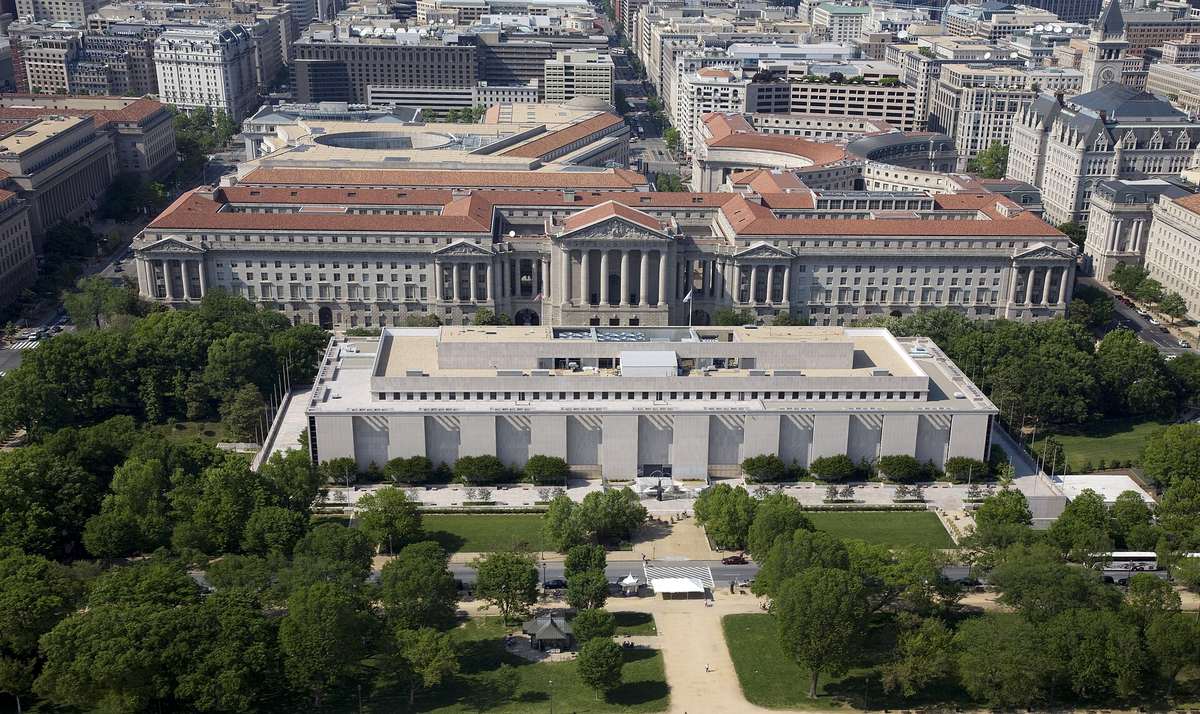
The Smithsonian's National Museum of American History stands on the north side of the National Mall in Washington DC, on Constitution Avenue between 12th and 14th Streets. It is open every day except December 25, admission is free, and no tickets are needed. Inside is the Star-Spangled Banner, the flag that inspired Francis Scott Key's anthem, along with an 1831 locomotive, Julia Child's kitchen and the Greensboro lunch counter where a famous sit-in began. For the rest of the city, see our Washington DC page and the list of places to see.
History of the museum
President Dwight D. Eisenhower signed the bill authorizing $36 million for the building on June 28, 1955, and ground was broken on August 22, 1958. The architects were McKim, Mead, and White, succeeded in 1961 by Steinman, Cain, and White. The museum calls it one of the last buildings designed by McKim, Mead, and White.
It opened in January 1964 as the Museum of History and Technology, the sixth Smithsonian building on the Mall. In 1980 it took its present name, to reflect its mission of collecting and studying objects that show the experience of the American people.
The building covers about 750,000 square feet: a basement, three exhibition levels, two collection and office levels and a mechanical penthouse. A two-year, $85 million renovation of the center core, finished in 2008, added a grand staircase, a skylight and a new gallery for the flag. The 120,000-square-foot west exhibition wing was renewed by the end of 2022. The collection now holds more than three million historical objects, and about 4 million people visit each year.
What to see
Gallery labels give the floor and wing: 1 East is the first floor, east wing.
The Star-Spangled Banner, 2 Center. The 200-year-old, 30-by-34-foot flag hangs in a climate-controlled chamber behind a 35-foot glass wall. The exhibition opens with the Battle of Baltimore in the War of 1812, which inspired Key's lyrics. The Smithsonian has cared for the flag since 1907. Photography is not permitted here.
The American Presidency, 3 Center. More than 900 objects from the Smithsonian's presidential collections, including Ulysses S. Grant's ceremonial carriage. Nearby, The First Ladies shows more than two dozen gowns worn by Frances Cleveland, Jacqueline Kennedy, Laura Bush, Michelle Obama and others.
The Price of Freedom: Americans at War, 3 East. American military history from the French and Indian Wars to today, with George Washington's sword, Custer's buckskin coat, the chairs Lee and Grant used at Appomattox, a World War II Willys Jeep and a UH-1H Huey helicopter deployed in Vietnam in 1966.
Within These Walls, 2 West. A partly reconstructed house that stood for 200 years at 16 Elm Street in Ipswich, Massachusetts, the largest object in the museum. The stories of five families who lived there show how ordinary people took part in the great events of American history.
Greensboro Lunch Counter, 2 West. On February 1, 1960, four Black college students sat down at this "whites only" Woolworth counter and stayed when refused service. Six months of protest followed, and the counter was desegregated on July 25, 1960.
Transportation and food, 1 East. America on the Move tells how transportation shaped American life from 1876 to 1999. The John Bull, built in 1831, pulled trains between Philadelphia and New York for 35 years. FOOD opens with Julia Child's home kitchen and its hundreds of tools, then follows how Americans have eaten since 1945.
Democracy, business and culture. American Democracy fills 2 West, American Enterprise 1 West and Entertainment Nation 3 West. The Smithsonian lists Washington's uniform, Jefferson's lap desk and Dorothy's ruby slippers among the museum's highlights. Displays change, so check the exhibitions list filtered to On View before you go.
How to get there
For GPS, use 1300 Constitution Avenue NW. There are two entrances: Constitution Avenue on the first floor and Madison Drive, on the National Mall side, on the second. Both are accessible for visitors using mobility devices.
The museum recommends public transit. The stations it names, with lines from wmata.com:
| Station | Metrorail lines |
|---|---|
| Federal Triangle | Blue, Orange, Silver |
| Smithsonian | Blue, Orange, Silver |
Every Metro station has an elevator. The Smithsonian has no public parking on the Mall; there are a few 3-hour on-street spaces along Jefferson and Madison Drives, and many commercial lots in the city. Tour buses drop off on Madison Drive and cannot park at the museum. Bike racks stand on both sides of the building.
Hours and admission
| Address | 1300 Constitution Avenue NW, Washington, DC |
| Hours | daily 10 am to 5:30 pm |
| Closed | December 25 |
| Admission | free |
| Tickets | not required |
| Wegmans Wonderplace | Wednesday to Sunday 10 am to 4 pm, closed Monday and Tuesday |
Hours and prices checked November 18, 2026 on americanhistory.si.edu and si.edu. Hours for Wonderplace and Draper Spark!Lab are subject to change; the museum posts them on its Visit page.
Security, photos, kids and food
Visitors walk through a metal detector here, and bags are checked by hand or X-ray; bring as little as you can. Firearms, knives including pocketknives, scissors, screwdrivers, pepper spray and placards or banners are not allowed. Personal photos and video are fine unless a sign says otherwise, but not in the Star-Spangled Banner gallery. Tripods, monopods and selfie sticks are banned in every Smithsonian museum, and so is smoking.
Wegmans Wonderplace, 1,700 square feet, is the first exhibition on the Mall designed for children 0 to 6. The LeRoy Neiman Jazz Cafe on 1 Center is open daily 10 am to 5 pm. Eat at America's Table on the lower level opens Monday to Thursday 11 am to 2 pm, and Friday to Sunday and holidays 11 am to 3 pm.
Questions people ask
Do you need tickets for the American History Museum in DC?
No. The Smithsonian's National Museum of American History charges no admission and uses no tickets or timed passes. It is open daily from 10 am to 5:30 pm, closed only on December 25. The only cost is parking if you drive, since the Smithsonian has no public parking on the National Mall.
Where is the Star-Spangled Banner in the museum?
In the center of the second floor, 2 Center, in a climate-controlled chamber behind a 35-foot glass wall. The flag is more than 200 years old and measures 30 by 34 feet. Photography is not permitted in that gallery, although personal photos are allowed elsewhere in the museum.
Which Metro station is closest to the museum?
The museum names Federal Triangle and Smithsonian, both served by the Blue, Orange and Silver lines of Metrorail. The building is on Constitution Avenue between 12th and 14th Streets and every Metro station has an elevator.
Can I bring a selfie stick or tripod?
No. The Smithsonian bans tripods, monopods, selfie sticks and similar devices in all its museums. Personal photos and video with a phone or camera are allowed unless a sign says otherwise. Everyone entering the American History Museum walks through a metal detector, and bags are checked.
Places on the map
Sources
- Smithsonian National Museum of American History
- NMAH: Visit (hours, admission, entrances)
- NMAH: Getting Here (Metro, parking, buses, bikes)
- NMAH: Food and Stores
- NMAH: History of the museum
- NMAH: Exhibitions
- NMAH: The Star-Spangled Banner
- NMAH: The American Presidency
- NMAH: The First Ladies
- NMAH: The Price of Freedom: Americans at War
- NMAH: Within These Walls
- NMAH: Greensboro Lunch Counter
- NMAH: John Bull Locomotive
- NMAH: FOOD
- NMAH: Wegmans Wonderplace
- Smithsonian: National Museum of American History (hours, closed Dec. 25, highlights)
- Smithsonian: Entry and Guidelines (security, prohibited items, photography)
- WMATA: Federal Triangle station
- WMATA: Smithsonian station