RussiansInUSA editorial team · Facts checked November 18, 2026 · Official site
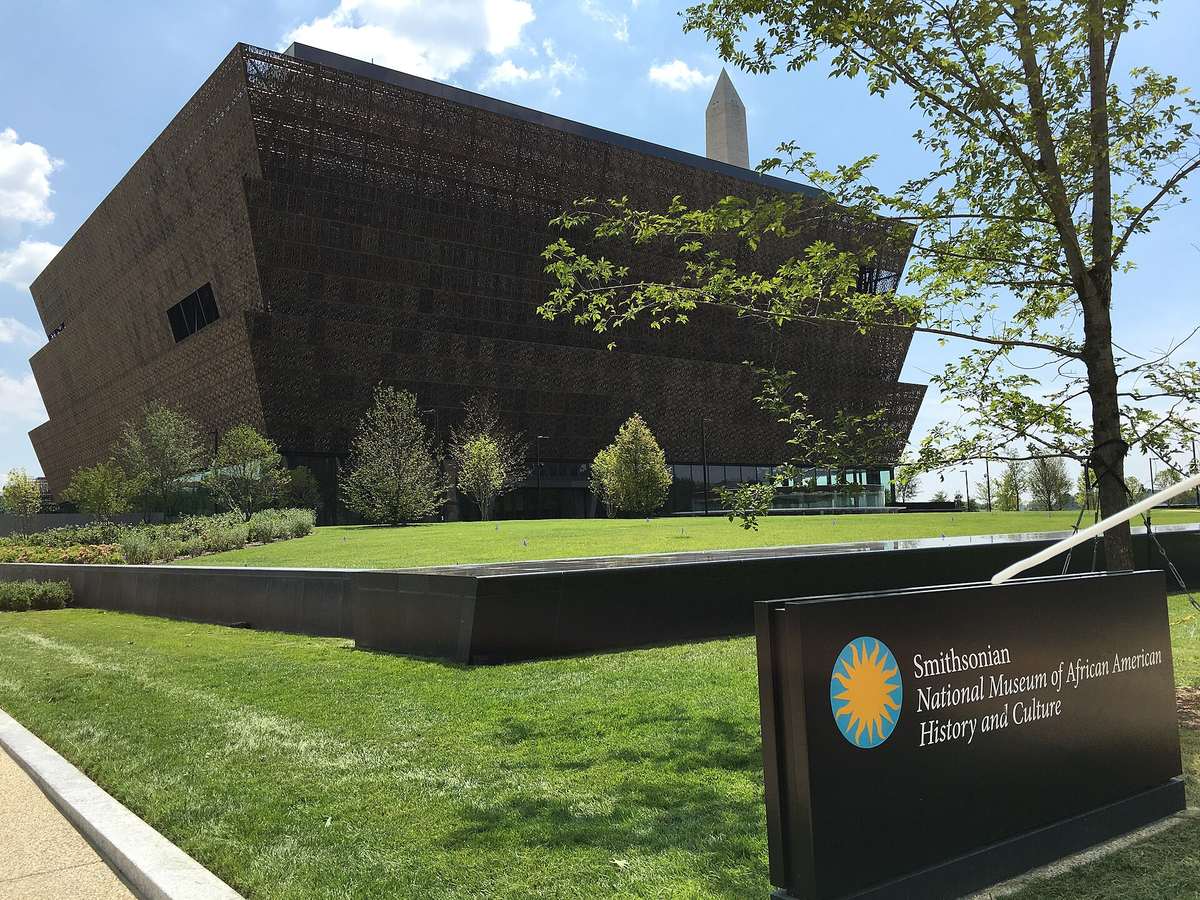
The Smithsonian's National Museum of African American History and Culture (NMAAHC) stands on the National Mall in Washington DC at 1400 Constitution Ave NW, next to the Washington Monument. It is the only national museum devoted entirely to African American life, history and culture. Admission is free, but every visitor, children included, needs a free timed-entry pass. The museum is open daily except December 25. For the rest of the city, see our Washington DC page and the list of places to see.
History: from 1915 to the 2016 opening
The museum calls its story a century in the making. From 1915 to 2003, individuals and groups pushed for a national monument and building in Washington dedicated to African American contributions to the nation. An Act of Congress established the museum in 2003.
In April 2009, lead designer David Adjaye and lead architect Philip Freelon, with the team Freelon Adjaye Bond/SmithGroup, won the international design competition. Their partner J. Max Bond Jr. died in February 2009. Ground was broken on the five-acre site in February 2012, and the museum opened on September 24, 2016, as the 19th museum of the Smithsonian. Its founding director was Lonnie G. Bunch III. The museum says it has collected more than 45,000 artifacts, and nearly 300,000 people have become members.
The building
The bronze-colored corona rises in three tiers, inspired by the three-tiered crowns of Yoruba art from West Africa. The main entrance is a porch, a form the museum traces to Africa and the African Diaspora, especially the American South and the Caribbean. The lattice wrapping the building honors the ironwork made by enslaved African Americans in Louisiana, South Carolina and elsewhere, and it lets in daylight and views of the White House to the north and the Capitol to the east. On the plaza, the Oculus filters light into the Contemplative Court below ground. It was the first museum on the Mall designed to sustainability standards and earned LEED Gold certification in 2018.
What to see
Floors are labeled C1 to C3 for the concourse levels below ground and L2 to L4 above. There are 105,000 square feet of exhibition space.
History Galleries, C1 to C3. Slavery and Freedom (1400 to 1877, C3) holds the Point of Pines slave cabin from Edisto Island, South Carolina, built in the 1850s and lived in by Black families until the 1980s, along with Charleston slave hire badges and a palm-sized 1862 copy of the Emancipation Proclamation issued to Union soldiers. Defending Freedom, Defining Freedom: The Era of Segregation (1876 to 1968) is on C2, and A Changing America: 1968 and Beyond on C1. The museum says the full History Galleries take about 2 hours and about a mile of walking.
The Smithsonian lists among the highlights Harriet Tubman's shawl, Nat Turner's Bible, a guard tower from Angola Prison, Chuck Berry's red Cadillac convertible and works by Charles Alston, Elizabeth Catlett, Romare Bearden and Henry O. Tanner.
Community Galleries, L3. Making a Way Out of No Way, Double Victory (military service from the Revolutionary War on), Power of Place and Sports.
Culture Galleries, L4. Cultural Expressions, Musical Crossroads and Taking the Stage.
Explore More!, L2. An interactive learning space. The building also has the Sweet Home Café, a 2017 James Beard Award nominee, and the museum store.
How to get there
The museum recommends public transportation. The nearest Metrorail stations are Federal Triangle and Smithsonian (Mall exit), both on the Blue, Orange and Silver lines. The accessible entrance at Federal Triangle is on the west side of 12th St NW between Pennsylvania and Constitution Avenues.
Enter at 15th Street and Madison Drive or at 14th Street and Constitution Avenue NW. The Madison Drive entrance is accessible, serves as the bus drop-off and lends free manual wheelchairs. Everyone exits on Constitution Avenue. There is no Smithsonian parking on the Mall; the nearest public garage is at the Ronald Reagan Building and International Trade Center, with ramps on 14th Street NW.
Hours and free timed-entry passes
| Day | Hours |
|---|---|
| Monday | 12 pm to 5:30 pm |
| Tuesday to Sunday | 10 am to 5:30 pm |
| Monday federal holidays | 10 am to 5:30 pm |
| December 25 | Closed |
| Last entry | 4 pm |
| Admission | Free, timed-entry pass required |
Hours and prices checked November 18, 2026 on nmaahc.si.edu.
Advance passes are released 30 days ahead on a rolling basis, and a limited number of same-day passes go online each morning. One person can reserve up to nine; groups of 10 or more book group passes. A pass is good only for its date; you can enter after your time until 4 pm if there is room, and your stay is not limited. Veterans, active-duty personnel and first responders need no advance pass: show a military or work ID and fill in a short form at the door. Book on the museum's Plan Your Visit page.
Tips
The busiest time is 12 pm to 4 pm, Friday through Sunday, when lines for the History Galleries can be long. Do not arrive before the time on your pass. Everyone goes through bag checks and a metal detector; tripods, monopods, selfie sticks, knives, scissors, aerosols including pepper spray, tools, pets, signs and open food are not allowed, but a bottle of water is. Noncommercial photography is allowed unless posted, except of fine art. Lockers take a backpack but not luggage. Children under 18 need an adult, and one adult may bring up to 10 children. The museum suggests eating before the History Galleries; Dine and Shop passes, released seven days ahead, give entry to only the café and store.
Questions people ask
Is the African American history museum in DC free?
Yes. Admission to the National Museum of African American History and Culture is free, but every visitor of any age needs a free timed-entry pass from nmaahc.si.edu. Passes are released 30 days ahead on a rolling basis, and a limited number of same-day passes go online each morning.
Can I visit without a timed-entry pass?
Usually not, and the museum says it cannot always take walk-up visitors. Veterans, active-duty personnel and first responders can enter by showing a military or work ID and filling in a short form. Free Dine and Shop passes cover only the Sweet Home Café and the museum store.
How long does a visit take?
The History Galleries alone take about 2 hours and about a mile of walking, and the museum has 105,000 square feet of exhibition space in all. Your pass sets only the entry time, last entry is 4 pm, and you can stay until closing at 5:30 pm.
Which Metro station is closest?
Federal Triangle and Smithsonian (Mall exit), both served by the Blue, Orange and Silver lines of Metrorail. Enter the museum at 15th Street and Madison Drive or at 14th Street and Constitution Avenue NW. There is no Smithsonian parking on the National Mall.
Places on the map
Sources
- National Museum of African American History and Culture
- NMAAHC: Plan Your Visit (passes, hours, entrances)
- NMAAHC: Frequently Asked Questions (getting here, parking, security)
- NMAAHC: About the Museum
- NMAAHC: The Building
- NMAAHC: Exhibitions
- NMAAHC: A Century in the Making
- NMAAHC: Slavery and Freedom
- NMAAHC: Museum Maps
- Smithsonian: NMAAHC (hours, highlights, Metro, parking)
- WMATA: Federal Triangle station
- WMATA: Smithsonian station