RussiansInUSA editorial team · Facts checked November 18, 2026 · Official site
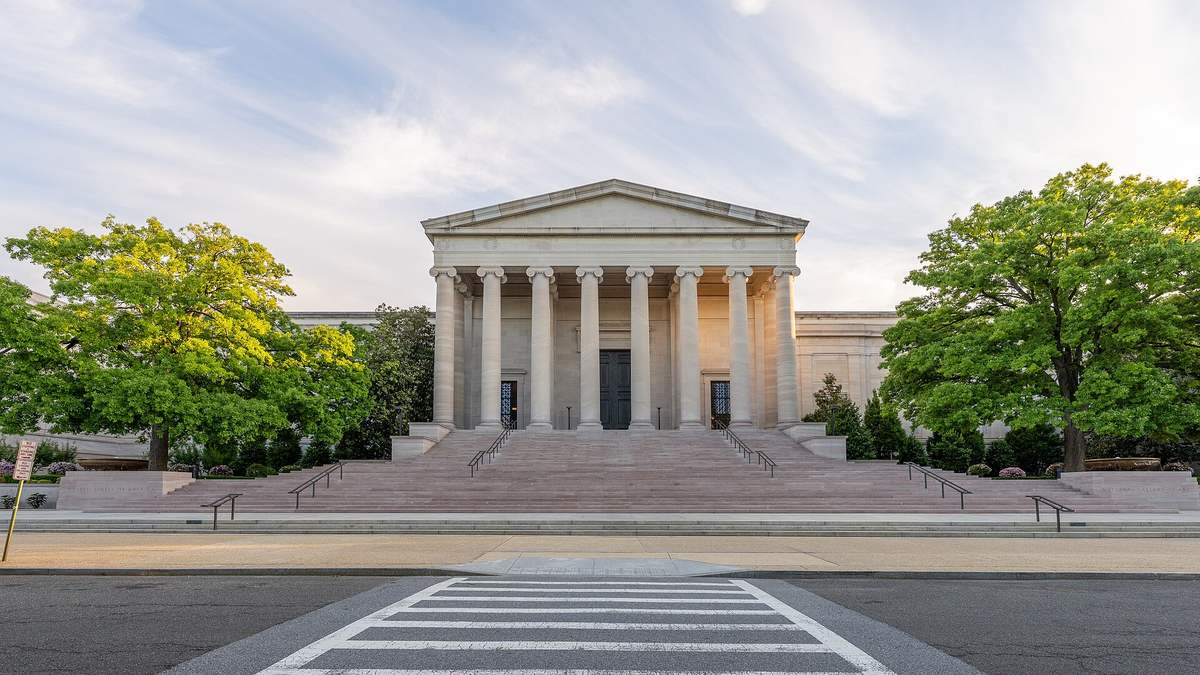
The National Gallery of Art in Washington, DC is the national art museum of the United States, and admission is always free. It sits on the north side of the National Mall, along Constitution Avenue NW between 3rd and 9th Streets. The campus has two buildings and a garden: the West Building for art from the 11th to the early 20th century, the East Building for modern and contemporary art, and an outdoor Sculpture Garden. It holds the only painting by Leonardo da Vinci in the Americas and a Raphael Madonna that hung for nearly a century in the Hermitage in Saint Petersburg.
For the rest of the city, see our Washington, DC city guide and the list of places to see in Washington.
National Gallery of Art history
The museum was conceived and given to the country by Andrew W. Mellon, a financier and collector who served as secretary of the treasury under three presidents from 1921 to 1932. In 1936 he wrote to President Franklin D. Roosevelt offering his paintings and sculpture for a new national museum that he would build with his own money. Roosevelt endorsed the offer, and Congress accepted the gift in 1937.
Mellon chose the architect John Russell Pope. His neoclassical West Building echoes his National Archives and Jefferson Memorial, is faced with Tennessee pink marble, and has skylights over almost its entire three-acre roof. Mellon and Pope died within 24 hours of each other in August 1937, soon after excavation began, but the building went up as they planned it. The National Gallery was dedicated on March 17, 1941, when Paul Mellon presented it to Roosevelt on behalf of his father.
Mellon insisted the museum not carry his name, so that it would be a truly national institution filled by gifts from many donors. It started with 126 paintings and 26 sculptures from his collection; today it has more than 150,000 works.
One detail matters to Russian-speaking visitors. Raphael's Alba Madonna was bought in 1836 for Czar Nicholas I and kept in the Imperial Hermitage in Saint Petersburg. In April 1931 Mellon bought it through dealers in Berlin, London and New York, and it came to the Gallery with his collection. The painting's provenance on nga.gov lays out that chain.
In 1967 Mellon's children, Paul Mellon and Ailsa Mellon Bruce, funded a second building, designed by I. M. Pei. The site between Pennsylvania Avenue and the Mall is a trapezoid, so Pei split the building into two triangles, one for the library and research center and one for galleries, and clad it in the same Tennessee pink marble. Construction began in 1971, and Paul Mellon and President Jimmy Carter dedicated the East Building on June 1, 1978.
The Sculpture Garden between 7th and 9th Streets NW opened to the public on May 23, 1999. The idea of a public garden there goes back to Pierre L'Enfant's 1791 plan for the capital.
What to see at the National Gallery of Art
The two buildings and the garden cover about 25 acres. The Gallery's own short list of must-sees is a good start if you only have an hour.
West Building
The domed rotunda at the center is modeled on the Pantheon in Rome. Around it are galleries of Italian Renaissance painting, Dutch and Flemish art of the 1600s, French, Spanish, British and American painting, and the Impressionists.
- Leonardo da Vinci, Ginevra de' Benci: his only painting in the Americas and one of three surviving portraits of women by him.
- Raphael, The Alba Madonna, the painting that came from the Hermitage.
- Jan van Eyck, The Annunciation, where Mary's reply is painted upside down, to be read from above.
- Giovanni Bellini and Titian, The Feast of the Gods.
- Augustus Saint-Gaudens, The Shaw 54th Regiment Memorial, honoring one of the first African American regiments raised in the North in the Civil War.
- Mary Cassatt, Woman with a Sunflower, the flower then a symbol of the women's suffrage movement.
From mid-November through April the rotunda holds flower displays by the Gallery's horticulture staff.
East Building
Modern and contemporary art. Alexander Calder's mobile in the atrium spans just over 85 feet but weighs only 920 pounds and moves on air currents alone. In the galleries are Picasso's Family of Saltimbanques, Jackson Pollock's Number 1, 1950 (Lavender Mist) with his handprints along the top, Alma Thomas's Pansies in Washington (she taught art in DC public schools for over 35 years), and Georgia O'Keeffe's Shell No. 1. On the Roof Terrace stands Katharina Fritsch's 14-foot blue rooster, Hahn/Cock.
Sculpture Garden
About six acres of trees, paths and large modern sculpture around a central fountain, with Louise Bourgeois's Spider, Claes Oldenburg and Coosje van Bruggen's Typewriter Eraser, and Barry Flanagan's hare in the pose of Rodin's Thinker. There is a cafe, and picnics are welcome.
How to get there by Metro
The Gallery recommends public transportation. The nearest Metro station is Archives-Navy Memorial-Penn Quarter, on the Green and Yellow lines according to wmata.com, a 6-minute walk from the West Building. Metrobuses stop along Constitution Avenue NW, and there is a Capital Bikeshare station by the East Building at 4th Street and Madison Drive NW.
| Building | Address |
|---|---|
| West Building | 6th Street and Constitution Avenue NW, Washington, DC 20565 |
| East Building | 4th Street and Constitution Avenue NW, Washington, DC 20565 |
| Sculpture Garden | 7th Street and Constitution Avenue NW, Washington, DC 20565 |
There is no parking garage on the campus; a few spaces are kept for vehicles with disability permits or tags. The two buildings are linked by an underground concourse with a moving walkway.
Hours and tickets
| Item | What the site says |
|---|---|
| Hours | daily, 10:00 a.m. to 5:00 p.m. |
| Closed | December 25 and January 1 |
| Admission | always free |
| Tickets or passes | not needed for galleries, exhibitions or guided tours |
| Events | some require free registration |
Hours and prices checked November 18, 2026 on nga.gov. Look at the Plan Your Visit page before you go in case anything changes. The Gallery also has a getting-here page in Russian.
Security, bags and other rules
Everyone entering the East or West Building walks through a screening machine, and bags may be inspected. The Gallery asks visitors to bring as little as possible. The main points from its guidelines and policies:
- Bags larger than 12 x 17 x 8 inches are checked for free; items larger than 17 x 26 inches are not allowed.
- Carry bags on the side or front of your body, not on your back (baby bags and medical supplies are exempt).
- No food or drink in spaces with art; water bottles must stay closed. Outside food can be eaten outdoors or in the Sculpture Garden. No outside alcohol.
- Personal photography is welcome except where noted. Tripods only in the Sculpture Garden; drones are prohibited.
- Sketching in pencil only, in sketchbooks up to 12 x 17 inches.
- Children 12 and under must be with an adult. Front baby carriers are fine, backpack carriers are not.
- No pets; service dogs are welcome. Manual wheelchairs and strollers can be borrowed at any entrance, first come, first served.
Questions people ask
Do you need tickets for the National Gallery of Art?
No. Admission to the National Gallery of Art is always free, and you do not need passes or tickets for the galleries, exhibitions or guided tours. Only some events ask for free registration. The Gallery is open daily from 10:00 a.m. to 5:00 p.m. and closed on December 25 and January 1.
What Metro stop is closest to the National Gallery of Art?
The nearest station is Archives-Navy Memorial-Penn Quarter on the Green and Yellow lines of the Washington Metro, about a 6-minute walk from the West Building. The Gallery has no parking garage and recommends public transportation, including Metrobuses that stop along Constitution Avenue NW.
Is there a Leonardo da Vinci painting in Washington, DC?
Yes. Ginevra de' Benci by Leonardo da Vinci hangs in the West Building of the National Gallery of Art. The Gallery says it is the only painting by Leonardo in the Americas and one of only three surviving portraits of women by him. Seeing it is free on any day the museum is open.
Can I bring a backpack to the National Gallery of Art?
A small backpack is allowed, but you must carry it on the front or side of your body, not on your back. Bags larger than 12 by 17 by 8 inches must be checked for free, and items larger than 17 by 26 inches are not allowed. Everyone goes through security screening at the entrances.
Places on the map
Sources
- National Gallery of Art
- National Gallery of Art: Plan Your Visit
- National Gallery of Art: Our History
- National Gallery of Art: Must-Sees at the National Gallery
- National Gallery of Art: Explore the Campus
- National Gallery of Art: Guidelines and policies
- National Gallery of Art: Как добраться
- National Gallery of Art: The Alba Madonna, Raphael (provenance)
- WMATA: Archives station