RussiansInUSA editorial team · Facts checked November 18, 2026 · Official site
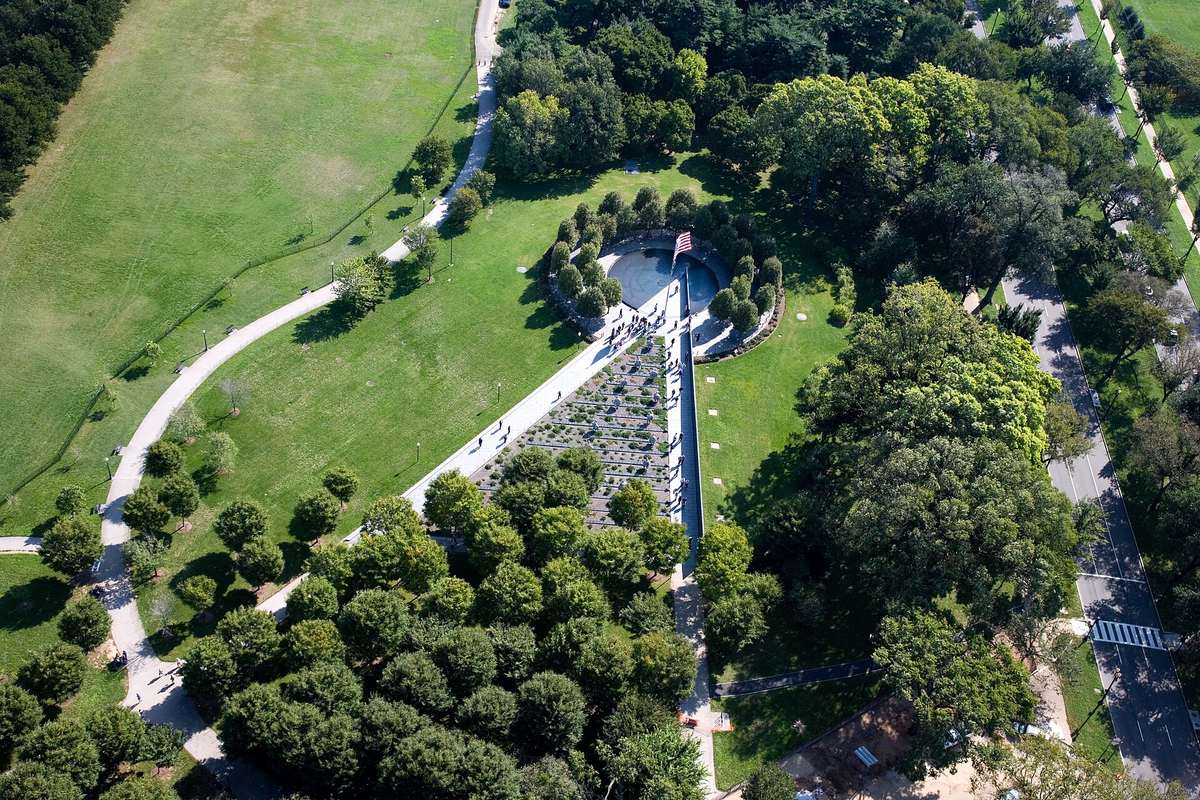
The Korean War Veterans Memorial stands on the National Mall in Washington, DC, just southeast of the Lincoln Memorial. The National Park Service (NPS) gives its address as 10 Daniel French Dr SW, near the corner of Independence Avenue and Daniel Chester French Drive SW. It honors the Americans who served in Korea from 1950 to 1953: 19 steel figures of a squad on patrol, a granite wall of etched faces and a newer Wall of Remembrance with the names of the dead. It is free and open around the clock. More of the city is on our Washington, DC page.
Korean War Veterans Memorial history, from 1986 to the 2022 Wall of Remembrance
According to the NPS, the war began on June 25, 1950, when the North Korean army crossed the 38th parallel. The armistice was signed on July 27, 1953, after 37 months of combat. About 1.5 million Americans served, and 131 received the Medal of Honor. The NPS says the country was reluctant to view the war as something to memorialize, and its overview of the war is titled "The Forgotten War."
Thirty-three years after the armistice, on October 28, 1986, Congress authorized the American Battle Monuments Commission to build a memorial in Washington. President Ronald Reagan appointed an advisory board to recommend a site and design and to raise construction funds.
An open design competition was announced on September 26, 1988, and on June 1, 1989, a team of four architects from Penn State won. The Commission of Fine Arts approved the concept but asked for more study. The firm Cooper-Lecky Associates produced the working drawings, and architect Kent Cooper revised the design. The original winners declined to work with Cooper, sued the federal government and lost. The National Capital Planning Commission gave final approval on March 5, 1992.
The NPS design page says President George H. W. Bush turned the first shovel of dirt on June 14, 1992, and dates the groundbreaking to November 1993. Frank Gaylord was the principal sculptor, and Louis Nelson made the mural of faces. President Bill Clinton and South Korean President Kim Young Sam dedicated the memorial on July 27, 1995, the 42nd anniversary of the armistice.
The memorial had no names at first. A 2016 law allowed them to be added; construction of the Wall of Remembrance began in March 2021, and it was dedicated on July 27, 2022.
What to see at the memorial
From above, the memorial is a circle crossed by a triangle.
On Patrol. In the triangular Field of Service stand 19 stainless steel statues by Frank Gaylord: 15 Army, 2 Marine Corps, 1 Navy and 1 Air Force. Windblown ponchos, strips of granite and juniper bushes recall the rough terrain and harsh weather of Korea. Gaylord, a World War II veteran, modeled several figures on his wartime comrades, often from their high school photos, and statue number 5 is a self-portrait.
The Mural Wall. On the south side is a wall of polished California Academy black granite etched with more than 2,400 period photographs from the National Archives. They show the support troops of every branch, with no insignia or name tapes, so they stand for everyone who served. The statues reflect in the stone, so the 19 look like 38, a reference to the 38th parallel that divides North and South Korea. From a distance the etchings resemble Korean mountain ranges.
The United Nations Wall. A low granite curb north of the statues lists the 22 UN countries that sent troops or medical support to defend South Korea.
The Wall and Pool of Remembrance. A round pool 128 feet across sits in a grove of 40 linden trees with 9 benches. Water rises from the bottom and spills over a stepped weir. The wall carries the names of 36,574 American service members and of members of the Korean Augmentation to the United States Army (KATUSA): 7,114 on the NPS Wall of Remembrance page, "more than 7,200" on the memorial's main NPS page. They are arranged by branch of service, then rank, then alphabetically. Casualty figures are cut into the stone nearby, and opposite them a separate wall reads "Freedom is Not Free."
How to get there
| Option | What the NPS and WMATA say |
|---|---|
| Metro | the memorial's own page names no station; for the neighboring Lincoln Memorial the NPS names Foggy Bottom-GWU (Blue, Orange, Silver lines), about 0.8 miles on foot |
| Metro | Smithsonian (Blue, Orange, Silver lines), about 1.2 miles from the Lincoln Memorial |
| Car | general parking on West Basin Drive, Ohio Drive SW and the Tidal Basin lot along Maine Avenue SW |
| Car | metered street parking also on Parkway Drive NW and Constitution Avenue NW |
| Accessible parking | Home Front Drive SW, reached from southbound 17th Street; the bus loading zone is there too |
| Bike | Capital Bikeshare stations |
Amtrak, MARC and VRE trains serve Union Station and/or L'Enfant Plaza. The NPS calls public transit the best option for reaching the Mall's memorials and says parking near the Lincoln Memorial is limited. Plan a route on wmata.com.
Hours and entry
| What | Details |
|---|---|
| Memorial | every day, 24 hours |
| Entry | free, no reservation |
| Rangers | 9:30 a.m. to 10:00 p.m., talks on request |
| Weddings, commercial photography, demonstrations | may need an NPS special permit |
| Park phone | 202-426-6841 |
Hours and prices checked November 18, 2026 on nps.gov. The memorial's alerts page lists no closures, but it has not been updated in years, so call the park before you go.
Tips for your visit
- The NPS says early morning and early evening are the quiet times to visit.
- Do not toss coins into the pool: the NPS says they damage the pumps and stain the stone floor.
- The soldiers are dressed differently on purpose: each wears the uniform of his branch.
- A kiosk here hands out free same-day tickets to the Lincoln Memorial undercroft exhibit every day from 8:45 a.m.
The Lincoln Memorial is right next door, to the northwest. For more places nearby, see what to see in Washington, DC.
Questions people ask
Why are there 19 statues at the Korean War Veterans Memorial?
The 19 stainless steel statues by sculptor Frank Gaylord form a squad on patrol: 15 Army, 2 Marine Corps, 1 Navy and 1 Air Force. According to the National Park Service, they reflect in the polished black granite wall so that they appear as 38, a reference to the 38th parallel that divides North and South Korea.
Does the Korean War Veterans Memorial have the names of the dead?
Yes, since July 27, 2022. The Wall of Remembrance by the pool lists 36,574 American service members killed in Korea and the Korean soldiers of the KATUSA program who served with the US Army: 7,114 according to the NPS Wall of Remembrance page, more than 7,200 according to the memorial's main NPS page, arranged by branch of service, then rank, then alphabetically.
Do you need a ticket for the Korean War Veterans Memorial?
No. The National Park Service says the memorial is open 24 hours a day, every day, with no fee and no reservation. Rangers are on duty from 9:30 a.m. to 10:00 p.m. and give talks on request. A special permit may be needed for activities such as weddings, commercial photography or demonstrations.
What is the closest Metro station to the Korean War Veterans Memorial?
The memorial is just southeast of the Lincoln Memorial. For the Lincoln Memorial, the National Park Service names Foggy Bottom-GWU on the Blue, Orange and Silver lines as closest, about 0.8 miles on foot, and Smithsonian station on the same lines at about 1.2 miles.
Places on the map
Sources
- Korean War Veterans Memorial (NPS)
- Korean War Veterans Memorial history and features (NPS)
- The Design Process (NPS)
- On Patrol (NPS)
- Mural Wall (NPS)
- Features of the Memorial (NPS)
- Wall and Pool of Remembrance (NPS)
- The Forgotten War, Korean War overview (NPS)
- Operating Hours and Seasons, Korean War Veterans Memorial (NPS)
- Fees and Passes, Korean War Veterans Memorial (NPS)
- Directions, Korean War Veterans Memorial (NPS)
- Alerts and Conditions, Korean War Veterans Memorial (NPS)
- Basic Information, Korean War Veterans Memorial (NPS)
- Frequently Asked Questions, Korean War Veterans Memorial (NPS)
- Directions and Transportation, Lincoln Memorial (NPS)
- Explore the Lincoln Memorial Undercroft (NPS)
- Foggy Bottom-GWU station (WMATA)
- Smithsonian station (WMATA)