RussiansInUSA editorial team · Facts checked November 18, 2026 · Official site
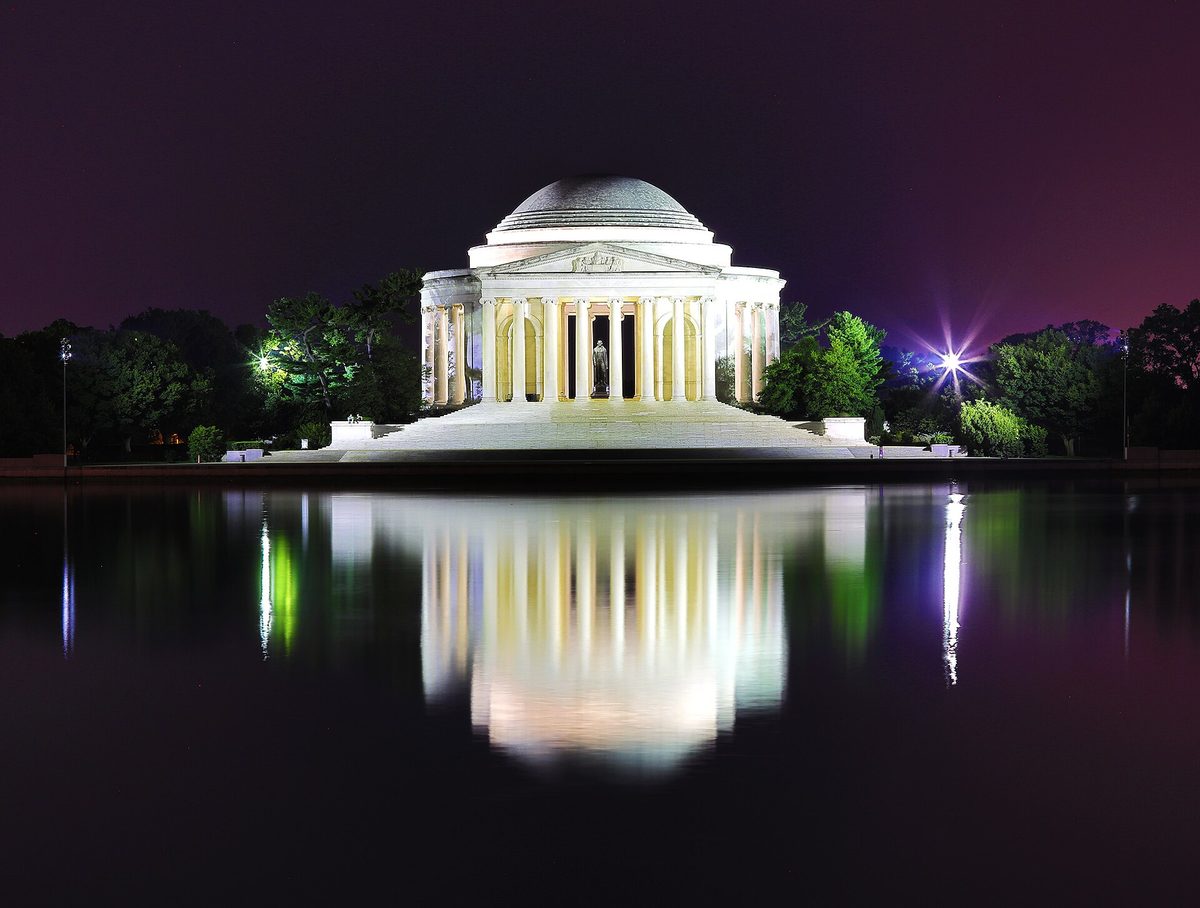
The Thomas Jefferson Memorial stands on the south bank of the Tidal Basin in West Potomac Park, at the southern end of the National Mall in Washington, DC. It is a round, open-air pavilion of white marble around a bronze statue of Thomas Jefferson, author of the Declaration of Independence and the third US president. The memorial is open 24 hours a day and free, with no tickets or reservations. Its mailing address, per the National Park Service (NPS), is 1100 Ohio Drive SW. Below: its history, what to see, how to get there and what to know before you go. More of the city is on our Washington, DC page.
History of the Jefferson Memorial, from the 1902 plan to the 1943 dedication
According to the NPS construction timeline, the 1902 McMillan Plan set this site aside for a future memorial. The land itself is reclaimed: Army engineers dredged and filled the Potomac Flats by 1882, and in 1897 Congress made the area West Potomac Park. The first Japanese cherry trees, a gift from the city of Tokyo, were planted on the Tidal Basin in 1912.
Congress first saw a resolution for a Jefferson memorial in 1926. On June 26, 1934 it created the Thomas Jefferson Memorial Commission, which first chose a site near the National Archives and in 1935 hired John Russell Pope, the architect of the Archives building. In 1936 President Franklin D. Roosevelt found that site too small, and in 1937 the commission picked the south bank of the Tidal Basin, in line with the White House. Part of the basin had to be filled and the seawall moved. Pope died on August 27, 1937, and his partners Otto Eggers and Daniel Higgins finished the design. Frederick Law Olmsted Jr. planned the grounds and plantings.
Construction began on November 17, 1938. That day 50 women marched on the White House with a petition to save the cherry trees, and the next day they chained themselves to a tree at the site, an episode the NPS calls the "Cherry Tree Rebellion." Roosevelt laid the cornerstone on November 15, 1939, with copies of the Declaration of Independence, the Constitution and Jefferson's writings placed inside.
The memorial was dedicated on April 13, 1943, Jefferson's 200th birthday, with Roosevelt presiding. Metal was rationed during the war, so the first statue was plaster painted to look like bronze; the bronze statue arrived in 1947. The ground under the memorial kept settling for decades: it closed for stabilization in 1969, and in 1998 the lower level got exhibits, restrooms and a bookstore. In December 2025 the NPS announced it had finished rebuilding the Tidal Basin seawall near the memorial, with deeper foundations and a wider, more accessible walkway.
What to see at the Jefferson Memorial
The building. Pope drew on Jefferson's own classical designs, Monticello and the University of Virginia Rotunda. The NPS counts 54 Ionic columns, each 43 feet tall: 26 in the circular colonnade, 12 at the north portico and four in each of the four openings. The memorial is 165 feet across and the portico 102 feet wide, in white Imperial Danby marble from Vermont under a shallow dome.
The pediment. Adolph A. Weinman's sculpture over the entrance shows the five members of the drafting committee presenting the Declaration of Independence to Congress.
The statue. Rudulph Evans's bronze Jefferson, 19 feet tall, holds the Declaration in his left hand. The pedestal is black Minnesota granite carved with his dates, 1743-1826. Walk behind the statue: the NPS points to details there about Jefferson's love of land and farming.
The inscriptions. The southwest wall carries an excerpt from the Declaration of Independence. The northeast wall quotes the Virginia Act for Religious Freedom, of 1779. The northwest wall has six quotations on slavery and on educating the people, and the southeast wall a passage from an 1816 letter to Samuel Kercheval on laws and the constitution. Around the frieze runs Jefferson's line from an 1800 letter to Benjamin Rush about his "eternal hostility against every form of tyranny over the mind of man."
The stone. The NPS says the stones were chosen for meaning: the Vermont exterior marble and the Georgia marble walls stand for the original 13 states, the pink Tennessee marble floor and Indiana limestone dome for a growing Union, and the Minnesota granite for the Louisiana Purchase.
The lower level and the view. Downstairs are exhibits on Jefferson and the memorial and an NPS park store. From the steps the view runs across the basin to the White House, which stands in a straight line with the memorial, and pruning opened a narrow line of sight between the Lincoln and Jefferson memorials.
How to get to the Jefferson Memorial
The NPS calls public transportation the best way to reach the memorial.
| Option | What NPS and WMATA say |
|---|---|
| Metro | NPS names no station; Smithsonian (Blue, Orange, Silver lines) is one option |
| Bike | Capital Bikeshare stations |
| Bus | bus loading zone on Home Front Drive SW |
| Car | parking on West Basin Drive, Ohio Drive SW and the Tidal Basin lot along Maine Ave. SW |
| Metered parking | Paddle Boat parking area (from southbound Maine Ave. SW) and lots A, B and C off Ohio Drive SW |
| Train | Amtrak, MARC and VRE serve Union Station and L'Enfant Plaza |
Plan the walk from your address with the Trip Planner on wmata.com. Driving routes are on the NPS directions page.
Hours and entry
| What | Hours and terms |
|---|---|
| Memorial and grounds | every day, 24 hours |
| Entry | free, no tickets or reservations |
| Rangers on duty | 9:30 a.m. to 10:00 p.m. daily |
| Park store, lower level | the NPS lists no hours; call the park |
| Holidays | the NPS hours page lists no closed days |
Hours and prices checked November 18, 2026 on nps.gov. The memorial's hours page has not been updated in years, so call the park at 202-426-6841 before a late visit.
Accessibility and tips
- Ramps on both sides lead to the lower level, with push-button doors. An elevator past the restrooms and store goes up to the chamber, so every part of the memorial can be reached without stairs.
- Three accessible parking spaces are on East Basin Drive, behind the memorial.
- Tactile maps with braille, touchable bronze models and audio description at every exhibit panel are available. Free ASL interpretation needs at least three weeks' notice.
- Service animals may go anywhere visitors go. Other animals, emotional support animals included, are not allowed on the lower level or in the chamber.
- The NPS suggests mornings and early evenings as quiet times to visit. Rangers give talks during the day and on request.
The other memorials of the National Mall are on our Washington, DC places page.
Questions people ask
Do you need a ticket for the Jefferson Memorial?
No. The National Park Service says the Jefferson Memorial has no entrance fees or reservations. It is open 24 hours a day, every day, and rangers are on duty from 9:30 a.m. to 10:00 p.m. The only cost is parking if you use the meters at the Paddle Boat parking area or the lots off Ohio Drive SW.
How do you get to the Jefferson Memorial by Metro?
The National Park Service does not name a single Metro station but recommends public transportation or Capital Bikeshare. One option is Smithsonian station on the Blue, Orange and Silver lines, with the walking route planned in the WMATA Trip Planner. Drivers can park on Ohio Drive SW and West Basin Drive.
Why was the first Jefferson statue made of plaster?
The memorial was dedicated on April 13, 1943, during World War II, when metal was rationed. The NPS says the first statue was therefore plaster painted to look like bronze. The permanent 19-foot bronze statue by Rudulph Evans was installed in 1947.
Is the Jefferson Memorial wheelchair accessible?
Yes. The NPS says ramps on both sides lead to the lower level, which has push-button doors, and an elevator goes up to the chamber with the statue, so no part of the memorial requires stairs. Three accessible parking spaces are on East Basin Drive behind the memorial, and accessible restrooms are on the lower level.
Places on the map
Sources
- Thomas Jefferson Memorial (NPS)
- Operating Hours and Seasons, Thomas Jefferson Memorial (NPS)
- Fees and Passes, Thomas Jefferson Memorial (NPS)
- Directions and Transportation, Thomas Jefferson Memorial (NPS)
- Basic Information, Thomas Jefferson Memorial (NPS)
- Accessibility, Thomas Jefferson Memorial (NPS)
- Alerts and Conditions, Thomas Jefferson Memorial (NPS)
- History and Culture, Thomas Jefferson Memorial (NPS)
- The Memorial (NPS)
- Memorial Construction Timeline (NPS)
- Memorial Features (NPS)
- Frequently Asked Questions, Thomas Jefferson Memorial (NPS)
- Operating Hours and Seasons, National Mall and Memorial Parks (NPS)
- National Park Service Finishes Tidal Basin Seawall Work (NPS, December 10, 2025)
- Smithsonian station (WMATA)
- History of the Cherry Trees (NPS)