RussiansInUSA editorial team · Facts checked November 18, 2026 · Official site
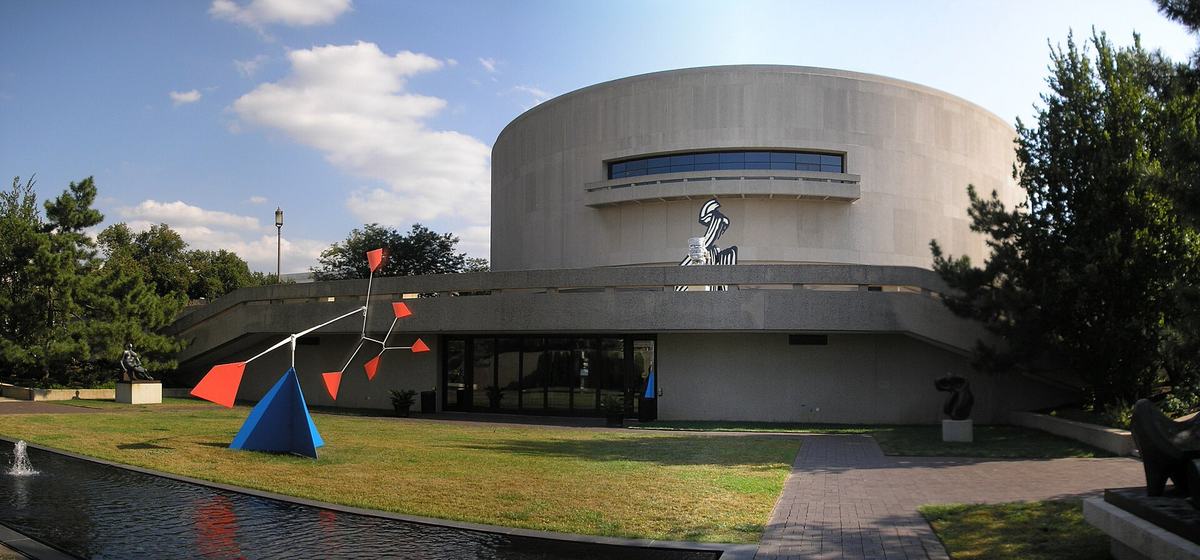
The Hirshhorn Museum and Sculpture Garden is the Smithsonian's national museum of modern and contemporary art, and admission is free. It stands on the south side of the National Mall in Washington, DC, at Independence Avenue and 7th Street SW. The campus is a raised round building, a fountain plaza and a multilevel sculpture garden on the Mall, with art from the late 19th century to today: Rodin, Matisse, Henry Moore, Picasso, Giacometti and living artists.
For the rest of the city, see our Washington, DC city guide and the list of places to see in Washington.
Hirshhorn Museum history
The idea is older than the building. In 1939 Congress mandated a Smithsonian art museum for the Mall, and Eliel and Eero Saarinen unveiled a design, but World War II shelved it. For decades the only art museum on the Mall was the National Gallery of Art, opened in 1941 and focused on Old Masters.
Joseph H. Hirshhorn (1899-1981), an entrepreneur and collector, changed that. A 1962 show of his sculpture at the Guggenheim in New York revealed the size of his holdings, and suitors from Beverly Hills, Zurich, Israel, England, Baltimore, Italy and New York State competed for the collection. President Lyndon B. Johnson and Smithsonian Secretary S. Dillon Ripley won it with the offer of a new museum in Washington. Hirshhorn donated the collection in 1966, the year an Act of Congress established the museum.
Ground was broken in 1969. The building was mostly federally funded, with a contribution from Hirshhorn. Architect Gordon Bunshaft designed it as a raised cylinder around a round courtyard; the museum itself calls it Brutalist. Founding director Abram Lerner oversaw the research, conservation and installation of nearly 6,000 objects, many brought from Hirshhorn's Connecticut estate.
The museum opened at 10 a.m. on October 4, 1974, with three floors of painting galleries, a fountain plaza and the Sculpture Garden. One million people saw the 850-work opening show in its first six months. Hirshhorn died in 1981, and his bequest of another 6,400 works doubled the collection. The same year Lester Collins revised the garden's design.
Today the collection holds about 13,000 works: painting, sculpture, works on paper, photography, film and video, and installations. Yayoi Kusama's Infinity Mirrors broke attendance records in 2017, and in 2019 collectors Barbara and Aaron Levine gave 50 works, including Marcel Duchamp readymades.
The Sculpture Garden closed for a rebuilding designed by Japanese artist and architect Hiroshi Sugimoto. Work began in November 2022, and the garden reopened to visitors on October 31, 2026.
What to see in the Sculpture Garden
The garden sits right on the Mall, and an underground passage links it to the plaza by the building. Sugimoto added his vision to Bunshaft's original 1974 design and Collins's 1981 revision, including hand-cut, dry-stacked stone walls that divide it into outdoor galleries. Nearly 60 sculptures now stand in the garden and on the plaza, 50% more than before, among almost 30,000 new trees and plants.
- East Galleries: Modernist bronzes by Auguste Rodin, Henri Matisse, five by Henry Moore and two by Barbara Hepworth, both friends of Hirshhorn's.
- Four David Smith sculptures in a central planting bed, in the welded metal he is known for.
- Central Galleries: a water feature that is filled as a reflecting pool or drained for performances and artist talks.
- Passage of Reflectance (2026) by Sugimoto: Bunshaft's long-closed underground passage, now lined in reflective stainless steel, links the garden to the plaza again.
- West Lawn: space for special presentations, ringed by recent acquisitions.
Other artists in the garden and on the plaza include Giacometti, Picasso, Miro, Willem de Kooning, Lucio Fontana, Germaine Richier, Yoko Ono and Jeff Koons.
What to see inside the museum
The circular building has about 60,000 square feet of galleries. The museum calls its modern sculpture collection one of the most comprehensive in the world. Deep holdings include Josef Albers, Francis Bacon, Alexander Calder, Joseph Cornell, Willem de Kooning, Jean Dubuffet, Thomas Eakins, Alberto Giacometti, Henry Moore, Louise Nevelson, Isamu Noguchi and Clyfford Still. Displays change, so check Collection Works on View on hirshhorn.si.edu before you go.
The Welcome Desk in the lobby has free guided tours and kids' programs; printed visitor and kids' guides are there for a $2 suggested donation.
How to get to the Hirshhorn
The address is Independence Avenue and 7th Street SW. Metro is the easiest way.
| Option | What the museum says |
|---|---|
| L'Enfant Plaza station (Blue, Orange, Silver, Green, Yellow lines) | One block north of the station |
| Smithsonian station (Blue, Orange, Silver lines) | Exit to the Mall and walk 5-10 minutes west, toward the Capitol, along Jefferson Drive |
| Metrobus D30, D60, D40, D1X | Stop nearby; schedules on wmata.com |
| Free Southwest Shuttle | Every 10 minutes between the Southwest Waterfront, L'Enfant Plaza and the museum; get off at the National Mall stop, just south of the museum |
Station lines confirmed on wmata.com.
The museum has no visitor parking. There is limited metered street parking, including accessible spaces on Jefferson Drive SW, and garages at L'Enfant Plaza (480 L'Enfant Plaza SW) and Capital Gallery (600 Maryland Ave SW). Bike racks are by the Independence Avenue entrance, and a Capital Bikeshare station is a block away on 7th Street SW.
The main entrance is the revolving door on Independence Avenue SW. Visitors with wheelchairs, strollers or other mobility devices enter on the northeast side of the Inner Plaza, near the fountain. The garden opens onto the Mall, Jefferson Drive and the plaza, with fully accessible entrances on its west side.
Hours and admission
Admission to the museum, the garden and all exhibitions, tours and programs is free. No pass is needed to enter the museum; walk-ins are welcome. Only for select exhibitions does the museum offer passes to reserve, as the exhibition page says. Groups of ten or more are encouraged, not required, to register.
| Area | Hours |
|---|---|
| Museum | Monday 12-5:30 p.m., Tuesday-Sunday 10 a.m.-5:30 p.m. |
| Plaza | Daily 7:30 a.m.-5:30 p.m. |
| Sculpture Garden | Daily 10 a.m.-5:30 p.m. |
| Dolcezza cafe | Monday 12-5 p.m., Tuesday-Sunday 10 a.m.-5 p.m. |
| Closed | December 25, Christmas Day |
| Admission | Free |
Hours and prices checked November 18, 2026 on hirshhorn.si.edu. Hours can change, so look at the Visit page before going.
Tips for your visit
- Everyone goes through a metal detector, and bags may be screened. The museum suggests traveling light, without large bags or backpacks.
- The Lower Level has restrooms, phone charging and a limited number of free lockers, first come, first served.
- Personal photos and video are fine, but no flash, tripods, monopods or selfie sticks. Some exhibitions have their own rules.
- Sketching is pencil only; pens, markers, paint and easels are not allowed.
- Food and drink stay in the lobby or outdoors, never in the galleries.
- Free Wi-Fi is si-visitor. Elevators serve every floor, and the lobby lends wheelchairs and lightweight gallery stools.
On Mondays the garden opens at 10 a.m. and the museum at noon, so start outdoors that day.
Questions people ask
How much does the Hirshhorn Museum cost?
Nothing. Admission to the Hirshhorn Museum and Sculpture Garden, and to all its exhibitions, tours and public programs, is free. No pass is required to enter the museum and walk-ins are welcome; only select exhibitions may offer passes to reserve. Groups of ten or more are encouraged to register in advance, but it is optional.
Is the Hirshhorn Sculpture Garden open?
Yes. The garden closed for a rebuilding designed by Hiroshi Sugimoto and reopened on October 31, 2026. According to hirshhorn.si.edu it is open daily from 10 a.m. to 5:30 p.m. with free entry, and nearly 60 sculptures stand in the garden and on the museum plaza.
What Metro stop is closest to the Hirshhorn?
L'Enfant Plaza, served by the Blue, Orange, Silver, Green and Yellow lines, is one block south of the museum. From Smithsonian station on the Blue, Orange and Silver lines, exit to the National Mall and walk 5 to 10 minutes west along Jefferson Drive.
Can you take photos at the Hirshhorn?
Yes, photos and video for personal use are welcome. Flash, tripods, monopods and selfie sticks are not allowed, and some special exhibitions have extra limits shown on signs or explained by staff. Sketching is allowed in pencil only.
When did the Hirshhorn open and who built it?
The museum opened on October 4, 1974. Entrepreneur Joseph H. Hirshhorn gave his collection to the Smithsonian in 1966, and architect Gordon Bunshaft designed the raised round building. Today the collection holds about 13,000 works.