RussiansInUSA editorial team · Facts checked November 18, 2026 · Official site
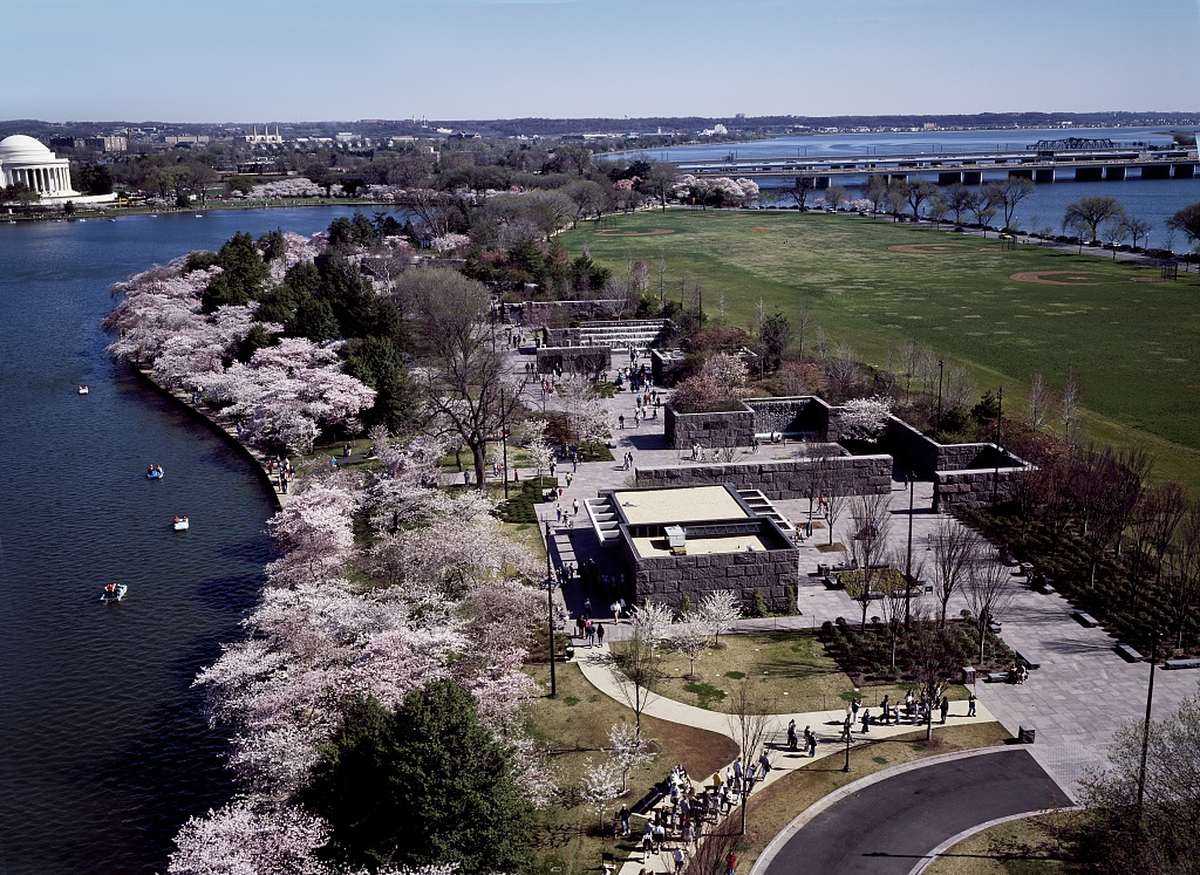
The Franklin Delano Roosevelt Memorial stands in West Potomac Park on the southwest side of the Tidal Basin in Washington, DC, about halfway between the Lincoln Memorial and the Thomas Jefferson Memorial. It is an open-air park of about 7.5 acres rather than a single building: red granite walls, bronze sculptures, waterfalls and 22 quotations from Roosevelt. It is open 24 hours a day, free, with no tickets or reservations. Its mailing address, per the National Park Service (NPS), is 1100 Ohio Drive SW. More of the city is on our Washington, DC page.
History of the FDR Memorial, from the 1955 commission to the 1997 dedication
Franklin Delano Roosevelt, the 32nd president, led the country through the Great Depression and World War II, from 1933 to 1945. He served four terms, and the memorial is laid out as four outdoor "rooms," one for each.
Planning took more than 40 years. According to the NPS, Congress set up the Franklin Delano Roosevelt Memorial Commission in 1955. The archived Clinton White House page says land in West Potomac Park was set aside in 1959, following the 1901 McMillan Plan layout for Washington's monuments. After several design competitions, the commission chose Lawrence Halprin, a designer of parks and public spaces, in 1974, and his design received final approval in 1978.
Construction began on September 16, 1991, and President Bill Clinton dedicated the memorial on May 2, 1997. Halprin brought in five sculptors: Leonard Baskin, Neil Estern, Robert Graham, Tom Hardy and George Segal. Master stone carver John Benson cut Roosevelt's words into the granite wall, roughly 800 feet long.
The original plans had no statue of Roosevelt in a wheelchair. Polio paralyzed his legs in 1921, at 39, and he hid the extent of his disability from the public. After disability advocates protested, Congress agreed to add one. Robert Graham's statue was dedicated on January 10, 2001, in a new Prologue Room, paid for with private donations raised by the National Organization on Disability.
What to see: the four rooms and the statues
The rooms follow his terms in order.
Prologue Room. A life-size bronze of Roosevelt seated in a wheelchair, set away from the wall so visitors can walk up to it. The NPS says he designed this kind of chair himself, from a kitchen chair and tricycle wheels.
Room One (first term, 1933-1937). Robert Graham's relief of the inauguration and a simple, direct waterfall. Among the first-term quotations is the best known, from March 4, 1933: "The only thing we have to fear is fear itself."
Room Two (second term, 1937-1941). The Depression and the New Deal. George Segal's The Breadline shows men waiting for free bread; nearby are a farm couple and a man listening to a fireside chat on the radio. Graham's five bronze relief panels carry braille. The waterfall stands for the Tennessee Valley Authority.
Room Three (third term, 1941-1945). World War II. The water crashes and granite blocks lie scattered as if after destruction, some carved "I hate war." Neil Estern's large statue shows Roosevelt with his dog, Fala, at his side.
Room Four (fourth term, 1945). A still pool under Leonard Baskin's low relief The Funeral Cortege, Roosevelt's procession down Pennsylvania Avenue. He died of a stroke on April 12, 1945. Estern's statue of Eleanor Roosevelt is here, which the NPS calls the only depiction of a First Lady in a presidential memorial. After his death she was the first US delegate to the United Nations and helped draft its declaration of human rights; the UN emblem is beside her. A timeline of Roosevelt's life is carved into the amphitheater steps.
Stone and water. The NPS counts 31,269 granite stones, pinkish carnelian from South Dakota and gray from Minnesota, the largest weighing 4.5 tons. More than 100,000 gallons of water run through seven fountains and pools. The water has a reason: Roosevelt swam and sailed on the Hudson as a young man, was Assistant Secretary of the Navy in World War I, and after polio founded the Warm Springs Institute in Georgia.
How to get to the FDR Memorial
The NPS calls public transportation, Metro included, the best way to reach the National Mall memorials, but names no station for this one.
| Option | What NPS and WMATA say |
|---|---|
| Metro | NPS names no station; Smithsonian (Blue, Orange, Silver lines) is one option |
| Bike | Capital Bikeshare; bike racks and bike rental at the memorial |
| Car | metered parking on Ohio Drive SW and West Basin Drive; more lots and street parking in East Potomac Park |
| Accessible parking | West Basin Drive, about 200 yards from the entrance |
| Limits | free street parking is generally limited to two hours; parking across DC is generally restricted from midnight to 6 a.m. |
Plan the walk with the Trip Planner on wmata.com. Parking and transit details are on the NPS directions page.
Hours and tickets
| What | Hours and terms |
|---|---|
| Memorial | 24 hours a day, 365 days a year |
| Entry | free, no reservations |
| Rangers on duty | 9:30 a.m. to 10:00 p.m. daily |
| Ranger programs | on request |
| Holidays | the NPS hours page lists no closed days |
Hours and prices checked November 18, 2026 on nps.gov. The hours page has not been updated in years, so call the park at 202-426-6841 before a late visit.
Tips before you go
- The whole memorial is wheelchair accessible. Bollards in the sidewalk leave about four feet of clearance.
- It is open-air and exposed to the weather, and the NPS warns that the stones can be slippery.
- The statues are meant to be touched. The NPS asks visitors not to climb or sit on them.
- Free maps and brochures are inside the building next to the bookstore, and the memorial has restrooms.
- The NPS National Mall App has a map with a "locate me" feature and labels the sites around you.
The Jefferson and Lincoln memorials and the other sights nearby are on our Washington, DC places page.
Questions people ask
Do you need a ticket for the FDR Memorial?
No. The National Park Service says there is no fee to visit the Franklin Delano Roosevelt Memorial and no reservation is needed. It is open 24 hours a day, 365 days a year, and rangers are on duty from 9:30 a.m. to 10:00 p.m. The only cost is metered parking on Ohio Drive SW or West Basin Drive.
Why is there a statue of FDR in a wheelchair?
Polio paralyzed Roosevelt's legs in 1921, but he hid the extent of his disability, and the memorial dedicated in 1997 had no wheelchair statue. After disability advocates protested, Congress agreed to add one. Robert Graham's statue was dedicated on January 10, 2001, in the Prologue Room.
How long does it take to see the FDR Memorial?
The NPS gives no visiting time. The memorial covers about 7.5 acres along the Tidal Basin: a Prologue Room and four open-air rooms, one for each of Roosevelt's terms, with 22 quotations, sculptures and waterfalls. It lies between the Lincoln and Jefferson memorials, so it fits on a walk from one to the other.
Who else is shown at the FDR Memorial?
His dog Fala sits beside him in Room Three. Eleanor Roosevelt stands in Room Four, in what the NPS calls the only depiction of a First Lady in a presidential memorial. George Segal's sculptures show people of the Depression: a bread line, a farm couple and a man listening to the radio.
Places on the map
Sources
- Franklin Delano Roosevelt Memorial (NPS)
- Operating Hours and Seasons, Franklin Delano Roosevelt Memorial (NPS)
- Fees and Passes, Franklin Delano Roosevelt Memorial (NPS)
- Basic Information, Franklin Delano Roosevelt Memorial (NPS)
- Accessibility, Franklin Delano Roosevelt Memorial (NPS)
- Alerts and Conditions, Franklin Delano Roosevelt Memorial (NPS)
- Maps, Franklin Delano Roosevelt Memorial (NPS)
- The Memorial's Story (NPS)
- In His Own Words, quotations (NPS)
- FDR Memorial, 3rd Term room (NPS)
- FDR Memorial, 4th Term room (NPS)
- Frequently Asked Questions, Franklin Delano Roosevelt Memorial (NPS)
- Franklin Delano Roosevelt Memorial, place page (NPS)
- Directions, National Mall and Memorial Parks (NPS)
- FDR Memorial Dedication (Clinton White House archive, archives.gov)
- Smithsonian station (WMATA)