RussiansInUSA editorial team · Facts checked November 18, 2026 · Official site
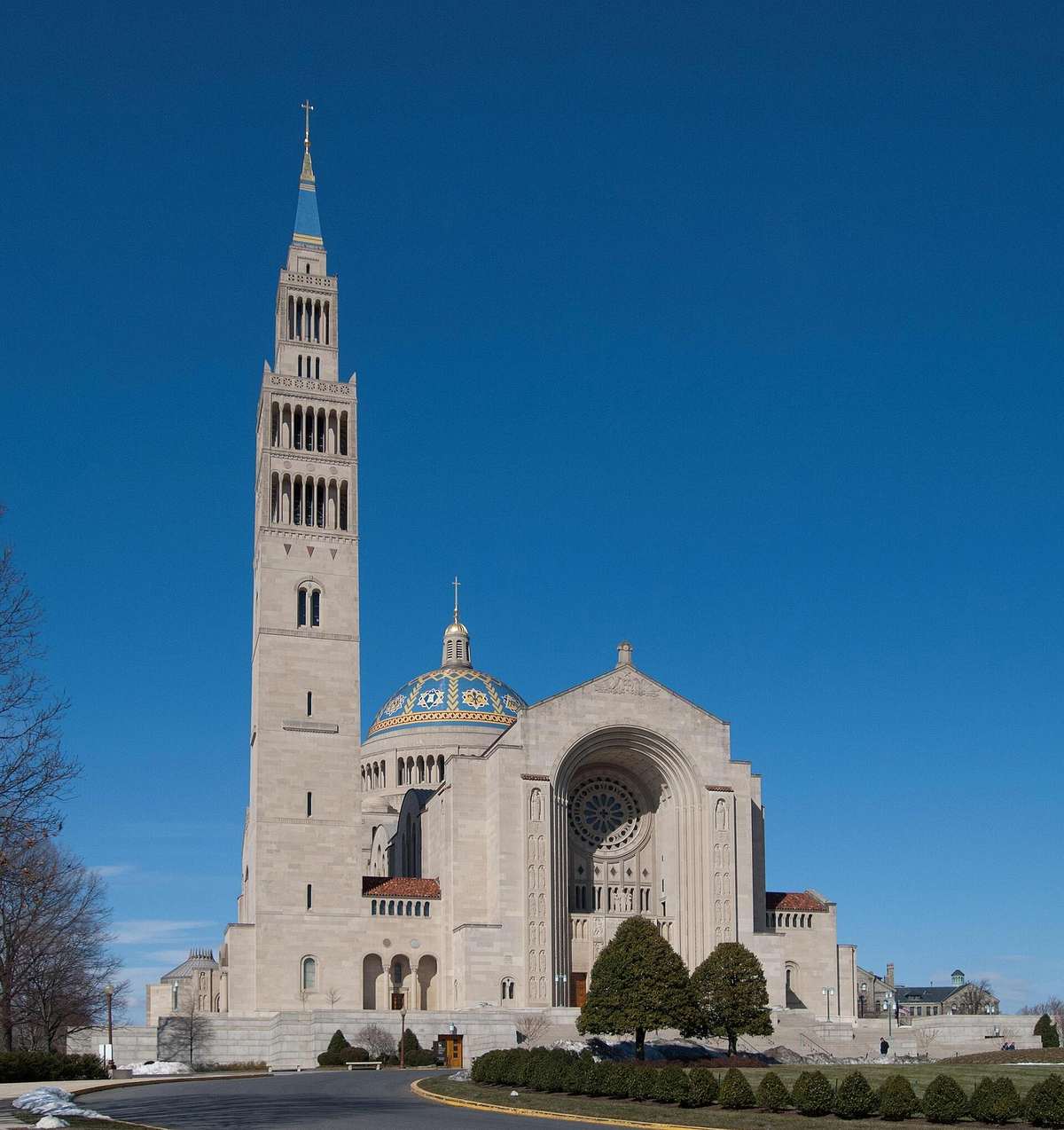
The Basilica of the National Shrine of the Immaculate Conception is the great Catholic church at 400 Michigan Avenue NE, in northeast Washington, next to the Catholic University of America. The basilica describes itself as the largest Roman Catholic church in North America and one of the ten largest churches in the world. Inside are more than 80 chapels and oratories honoring Mary, given by peoples and religious orders from around the world. It is open every day, and the nearest Metro station is less than half a mile away. For the rest of the city, see our Washington DC page.
History of the basilica, by date
The idea is almost a century older than the foundation stone. In 1846 the American bishops named Mary, under the title of the Immaculate Conception, patroness of the United States. That same year, according to the basilica, the Lowell Courier Journal in Massachusetts wrote of a great Catholic church to be built in Washington with gifts from every parish in the country.
On December 8, 1917, the first Mass in honor of the future shrine was said in Caldwell Hall at Catholic University. On September 23, 1920, Cardinal Gibbons blessed the foundation stone, four tons of New Hampshire granite trucked 1,540 miles to Washington, before a crowd of more than a thousand.
The first public Mass in the unfinished Crypt Church was on Easter Sunday, April 20, 1924, with about 3,000 people on folding chairs, lit by candles. The Crypt Church was finished in 1926 and the whole Crypt Level in 1931. Then work stopped, after the death of Bishop Shahan and with the Great Depression.
Building resumed in 1954. On November 9, 1954, John McShain of Philadelphia signed the contract for the Great Upper Church, designed by the firm Maginnis, Walsh and Kennedy. The shrine was dedicated on November 20, 1959.
Popes followed. John Paul II became the first pope to visit, on October 7, 1979. Benedict XVI led Vespers here and met the US bishops on April 16, 2008. On September 23, 2015, Pope Francis canonized Junipero Serra at an outdoor Mass on the East Portico, which the basilica calls the first canonization on American soil, before about 25,000 people. The Trinity Dome mosaic, which the basilica says brought the building of the shrine to completion, was dedicated on December 8, 2017.
What to see in the basilica
The basilica calls its style Romanesque-Byzantine. It is built of stone, brick and tile with no structural steel beams or framework. Seven main domes rise over it, their interiors covered in mosaic.
- Great Upper Church. The main church under the mosaic domes, where the Sunday Masses are held.
- Trinity Dome. The dome dedicated in 2017 that completed the building: Mary beneath the image of the Holy Trinity, in what Cardinal Wuerl called millions of pieces of colored tile.
- Crypt Church and Crypt Level. The oldest part, from the 1920s, with the daily Masses, confession, chapels and shops.
- The chapels. More than 80, from peoples and religious orders. Among the nationalities the basilica says are represented are Czech, Polish, Slovak, Lithuanian, Hungarian, Filipino, Vietnamese, Irish and many more.
- The tiara of Pope Paul VI. The silver coronation tiara with three gold bands, which the pope gave to the poor in 1964. After touring the US to raise funds, it was presented to the shrine in 1968 and is on display there.
- Rosary Walk and Garden. The garden beside the church, dedicated in 2017.
Readers from an Orthodox background may feel at home in the Byzantine-Ruthenian Chapel, dedicated on October 6, 1974. It has an iconostasis with Christ the Teacher and the Theotokos, a mosaic behind the altar of the Theotokos holding her veil (maphorion), tied to the feast of the Protection (Pokrov), and Saints Cyril and Methodius with the Carpathian Mountains on the wall.
The bell tower, Knights Tower, is not open to the public; tours visit only its base.
How to get to the basilica
Take the WMATA Metro Red Line to Brookland-CUA, less than half a mile away. Exit toward John McCormack Road NE and Michigan Avenue NE, then walk 5 to 10 minutes along Michigan Avenue NE.
Parking is free while the basilica is open. The main visitor lot is to the left of the church, next to the Rosary Garden, entered from Harewood Road NE just north of Michigan Avenue NE. A few spaces sit to the right of the main entrance along the east side, reached from Michigan Avenue NE. Accessible spaces are in the East lot beside the basilica and the West lot across Harewood Road.
Hours, Masses and tours
| What | When and how much |
|---|---|
| Basilica | daily 6:00 a.m. to 6:00 p.m., 365 days a year |
| Admission | no entry fee listed on the site |
| Guided tours | Mon to Sat at 9, 10, 11 a.m. and 1, 2, 3 p.m., just under an hour; none on Sunday |
| Gift shop and bookstore | daily 9:00 a.m. to 5:00 p.m., except Thanksgiving, lower level |
| Cafeteria | Saturday and Sunday 8:00 a.m. to 2:00 p.m. |
Hours and prices checked November 18, 2026 on nationalshrine.org.
Guided tours need a reservation through the tour page, with up to 30 people a group. The site does not list a tour price. Tours in Spanish and for hearing or visually impaired visitors are given on request, at least two weeks ahead through Visitor Services.
Mass is said every day. On weekdays it is in the Crypt Church, from morning to evening. A Sunday Vigil Mass is held in the Great Upper Church on Saturday afternoon, and on Sunday one early Mass is downstairs and several are upstairs, one of them in Spanish. Christmas, New Year's Day, Easter and Thanksgiving have special schedules. Exact times are on the Mass and confession schedule.
Before you go
- Photos and video for personal use are allowed in the areas open for touring. Filming or photographing worship services is not.
- Tripods and freestanding lights need special permission. Publishing images commercially needs the basilica's written approval.
- During some liturgies in the Crypt Church, the chapels of Our Lady of Vailankanni and Antipolo are closed to visitors.
- The basilica does not hold weddings or baptisms, as it is not a parish church.
Visitor information: 202-526-8300. More sights are on our things to see in Washington DC page.
Questions people ask
Is there an entry fee at the Basilica of the National Shrine?
The basilica's site, nationalshrine.org, lists no admission fee, and the church is open daily from 6:00 a.m. to 6:00 p.m., 365 days a year. Guided tours run Monday to Saturday and need a reservation through the tour page; the site does not list their price.
How do I get to the basilica by Metro?
Take the Red Line to Brookland-CUA, less than half a mile from the basilica. Exit toward John McCormack Road NE and Michigan Avenue NE, then walk 5 to 10 minutes along Michigan Avenue NE to 400 Michigan Avenue NE. Free parking is also available while the basilica is open.
When was the National Shrine built?
The foundation stone was blessed on September 23, 1920, and the Crypt Church was finished in 1926. Work stopped during the Great Depression and resumed in 1954. The shrine was dedicated on November 20, 1959, and the Trinity Dome mosaic that completed the building was dedicated in 2017.
Is there an Eastern rite chapel in the basilica?
Yes, the Byzantine-Ruthenian Chapel, dedicated on October 6, 1974, honoring the Ruthenian Catholic tradition. It has an iconostasis with Christ the Teacher and the Theotokos, a mosaic of the Theotokos holding her veil (maphorion), and images of Saints Cyril and Methodius.
Places on the map
Sources
- Basilica of the National Shrine of the Immaculate Conception
- Visit, Basilica of the National Shrine of the Immaculate Conception
- Hours and Location, National Shrine
- History, National Shrine
- Art and Architecture, National Shrine
- Past Events, National Shrine
- The Laying of the Foundation Stone, National Shrine
- First Mass in the Crypt Church, National Shrine
- Anniversary of the Dedication, National Shrine
- Pope Benedict XVI Visits the Basilica, National Shrine
- Pope Francis's Visit, National Shrine
- The Trinity Dome Dedication, National Shrine
- The Coronation Tiara of Pope Paul VI, National Shrine
- The Byzantine-Ruthenian Chapel, National Shrine
- Tours, National Shrine
- FAQ, National Shrine
- Mass and Confession Times, National Shrine
- Photo Policy, National Shrine
- Brookland-CUA station, WMATA
- Dedication of the Rosary Walk and Garden, National Shrine
- The Remarkable History of America's Catholic Church, National Shrine