RussiansInUSA editorial team · Facts checked November 11, 2026 · Official site
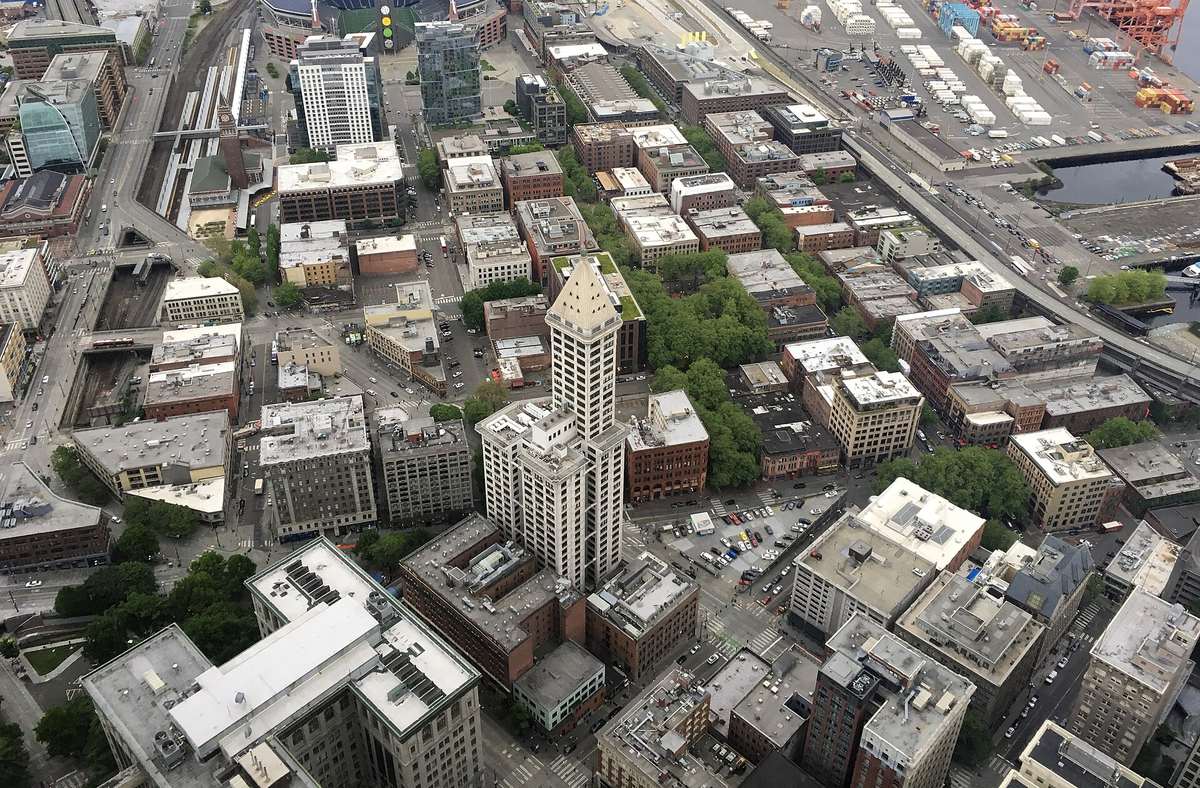
Pioneer Square is Seattle's first neighborhood, just south of downtown between Elliott Bay and the streets around Yesler Way and First and Second Avenues. It has brick and stone buildings put up after the Great Fire of 1889, old sidewalks buried under the streets, the 1914 Smith Tower, galleries and small parks. The neighborhood itself needs no ticket: these are city streets, open at any hour. Only some places inside charge admission; their hours and prices are below. The Seattle city page has the short version; this page goes further.
Pioneer Square history, year by year
Long before settlers came, this was a seasonal village of the ancestors of today's Duwamish and Suquamish people. The neighborhood's site, pioneersquare.org, gives its name as Djijila'letc, "little crossing-over place": a village amid a lagoon and tidal flats, in an area people had lived in for about 10,000 years.
The Denny Party landed at Alki Point in 1851 and in spring 1852 moved across Elliott Bay to this spot. The Seattle Department of Neighborhoods says it was the only flat area along the deep, protected harbor. In 1853 Henry Yesler started a steam sawmill near today's Yesler Way and First Avenue South.
On June 6, 1889, glue boiled over in a shop at Front and Madison streets and started the Great Seattle Fire. It destroyed about 25 blocks of mostly wooden buildings. The City Council then required brick or stone construction and raised the streets. As the Underground Tour tells it, crews built retaining walls eight feet or higher along the streets, filled the space between them and paved it over. Old first floors became basements, and the gaps under the new sidewalks, up to 35 feet high in places, became the Seattle Underground.
Almost the whole district was rebuilt within two years, mostly in the Richardsonian Romanesque style: heavy masonry bases, round arches, different details on each floor. The city calls it one of the nation's best surviving collections of Romanesque Revival urban architecture. The heyday came with the gold rush that began in July 1897; the Underground Tour says about 100,000 travelers passed through Seattle.
In the early 1900s the business district moved north along Second Avenue, and until the 1970s Pioneer Square was a district of taverns, entertainment houses and hotels. In the 1960s a city plan proposed a ring road that would have demolished many historic buildings. Architect Ralph Anderson began restoring buildings, and Victor Steinbrueck inventoried the architecture. In May 1965 publicist Bill Speidel first led people under the streets; about 500 came that day.
In May 1970 Pioneer Square became Seattle's first preservation district, with its own Pioneer Square Preservation Board. The boundaries grew in 1973 and 1987. Today the district covers about 88 acres, and certain changes to buildings need the board's approval.
What to see in Pioneer Square
Iron Pergola and the Tlingit totem pole
At First Avenue and Yesler Way stands the iron pergola, built in 1909 as a cable car stop to a design by Seattle architect Julian Everett and restored in 1972. Next to it is a Tlingit totem pole. The first pole was taken from Alaska in 1899 by Seattle Chamber of Commerce members; the tribe sued, the court fined the men $500 for theft, and the city kept the pole. After arson damaged it in 1938, Tlingit carvers made the replacement.
The Underground Tour
Bill Speidel's Underground Tour starts at 614 1st Avenue, between Cherry and James Streets. It is a 75-minute guided walk through buried 19th-century storefronts and sidewalks, and the tour calls itself the only way to see these tunnels.
Smith Tower
This tower at 506 2nd Ave opened on July 4, 1914. Lyman Cornelius Smith bought the lot, and Edwin H. Gaggin was the architect. It is 469 feet tall, 522 feet to the top of the pinnacle. The 35th-floor observatory has an open-air deck and a bar.
Occidental Square
The park at 117 S Washington St is the heart of the district, built in 1971 on what had been asphalt. It has London plane trees, bocce courts, ping pong tables, a 2019 play area, totem poles by carver Duane Pasco and Hai Ying Wu's 1995 Seattle Fallen Firefighters Memorial. Open 6 am to 10 pm.
Waterfall Garden Park
A small park at 219 2nd Ave S with a 22-foot waterfall, on the site of the first UPS headquarters, opened in 1907. It was completed in August 1978.
Last Resort Fire Department Museum and the Klondike park
At 301 2nd Ave S, the free Last Resort Fire Department Museum shows vintage fire equipment; since 2008 part of its collection has been in Seattle Fire Department Headquarters. Nearby, at 319 2nd Ave S in the old Cadillac Hotel, is the free National Park Service visitor center on the Klondike Gold Rush.
How to get to Pioneer Square
The Underground Tour advises skipping the car and taking the bus or light rail.
- Link light rail. Pioneer Square Station is at 3rd Ave and James St, served by the 1 Line and 2 Line. The neighborhood site says Link runs here from Sea-Tac Airport with no transfer. International District/Chinatown Station is the one the NPS lists as closest to the Klondike visitor center.
- Buses. More than 20 bus routes stop at Pioneer Square Station; see the station page.
- Trains. Sounder commuter trains and Amtrak stop at King Street Station.
- Streetcar. The nearest First Hill Streetcar stop is S Jackson St & Occidental Ave.
- Ferry and water taxi. The Washington State Ferry terminal is at Pier 52, the West Seattle Water Taxi at Pier 50.
- Car. Street parking is pay-to-park with a two-hour limit, and there are private paid lots and garages nearby (nps.gov).
Hours and tickets
| Place | Hours | Price |
|---|---|---|
| Neighborhood streets | any time | free |
| Occidental Square | 6 am-10 pm | free |
| Waterfall Garden Park | daily 8 am-5:45 pm | free |
| Underground Tour | on the hour, daily 10 am-6 pm; June to September also every half hour, 10:30 am-5:30 pm | on the tour's ticket site |
| Smith Tower observatory | Mon-Tue 12-7 pm, Wed-Thu 12-8 pm, Fri-Sat 12-9 pm, Sun 12-8 pm | $10-25; with tour $25-30 |
| Last Resort Fire Department Museum | Thursday 11 am-3 pm, except holidays | free |
Hours and prices checked November 11, 2026 on pioneersquare.org, seattle.gov, undergroundtour.com and smithtower.com.
Smith Tower notes that observatory hours change for private events, and Washington residents can get tickets from $10. The Underground Tour runs a different schedule around holidays, so check the neighborhood site or each place's own page before you go.
Tips for your visit
The Underground Tour describes itself as moderately rugged: flights of stairs, uneven ground and spotty lighting. Wear comfortable shoes, no high heels, and dress for the weather. Tickets are first come, first served; online and phone sales (206-682-4646) close two hours before a tour, after that only the box office sells them. Groups of more than 10 adults book a private tour by phone.
For galleries, come on the first Thursday of the month. The neighborhood site calls its First Thursday Art Walk the longest-running art walk in the nation. It is free and self-guided; check gallery hours with each gallery. The site says participating garages offer free parking from 5 pm to 10 pm during the art walk.
For a walk, start at the pergola at First Avenue and Yesler Way, go on to Occidental Square, then down 2nd Ave S to the waterfall at number 219. More Seattle sights are on the Seattle places page.
Questions people ask
What is the Seattle Underground and how do you visit it?
After the Great Fire of June 6, 1889, Pioneer Square's streets were raised, leaving old first floors and sidewalks below ground. You see them on Bill Speidel's Underground Tour, a 75-minute guided walk that starts at 614 1st Avenue. Tours leave on the hour from 10 am to 6 pm, more often from June to September.
How much does the Smith Tower observatory cost?
The 35th-floor observatory at Smith Tower, 506 2nd Ave, costs $10 to $25, or $25 to $30 with a tour. Smith Tower offers Washington residents tickets from $10. The observatory opens at noon every day, and its hours sometimes change for private events.
Which light rail station is closest to Pioneer Square?
Pioneer Square Station on the Link light rail is at 3rd Ave and James St, served by the 1 Line and 2 Line. International District/Chinatown Station is also close, and Sounder and Amtrak trains stop at nearby King Street Station.
When did Pioneer Square become a historic district?
Seattle made Pioneer Square its first preservation district in May 1970 and created the Pioneer Square Preservation Board to oversee it. The boundaries were expanded in 1973 and 1987, and the district now covers about 88 acres.
Places on the map
Sources
- Pioneer Square, official neighborhood site (Alliance for Pioneer Square)
- About Pioneer Square, Alliance for Pioneer Square
- Getting Here, Pioneer Square
- Art Walks, Pioneer Square
- Iron Pergola and Tlingit Totem, Pioneer Square
- Waterfall Garden Park, Pioneer Square
- Pioneer Square Preservation District, Seattle Department of Neighborhoods
- Occidental Square, Seattle Parks and Recreation
- Pioneer Square Station, Sound Transit
- Directions, Klondike Gold Rush NHP Seattle, NPS
- Bill Speidel's Underground Tour
- A Brief History, Bill Speidel's Underground Tour
- What to Expect, Bill Speidel's Underground Tour
- Smith Tower
- History, Smith Tower
- FAQ, Smith Tower
- Last Resort Fire Department Museum, Pioneer Square
- Museum, Last Resort Fire Department
- Fees, Klondike Gold Rush NHP Seattle, NPS