RussiansInUSA editorial team · Facts checked November 11, 2026
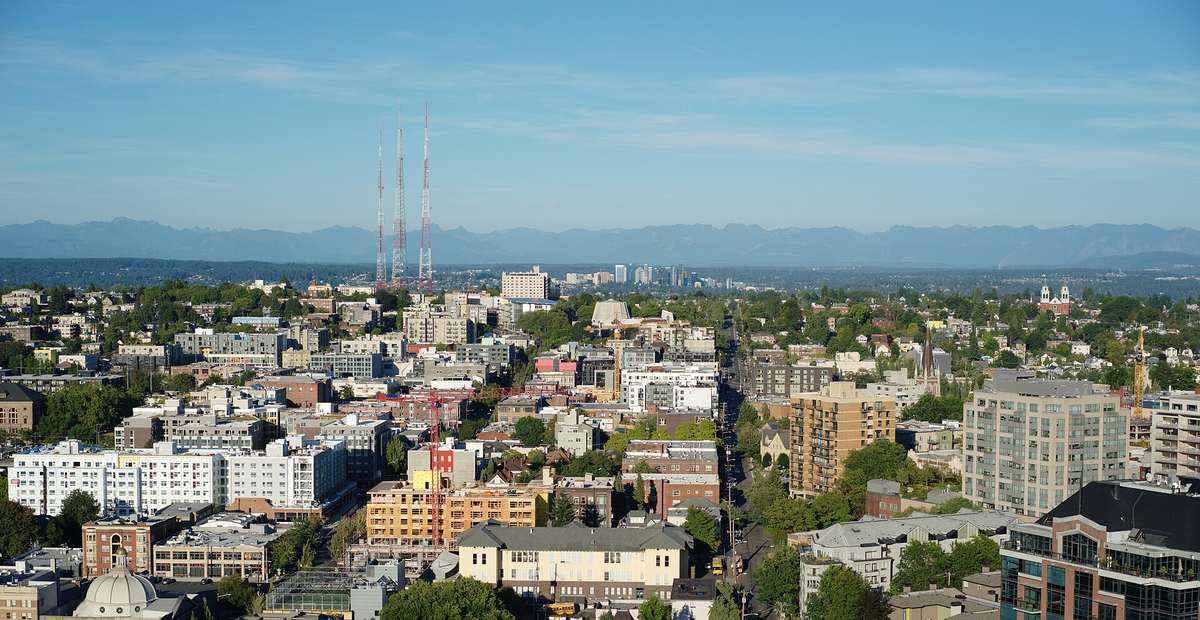
Capitol Hill in Seattle is an old residential neighborhood on a long ridge above downtown, east of Interstate 5. People come for Volunteer Park with its water tower and conservatory, the Seattle Asian Art Museum, the historic Lake View Cemetery and Broadway, the main street with a light rail station. You can walk the neighborhood in half a day, and most of its parks are free.
The Seattle Department of Neighborhoods describes the hill as bounded by Fuhrman Avenue East to the north, I-5 to the west, East Pike Street to the south and 24th Avenue East and Boyer Avenue East to the east. For the city as a whole, see our Seattle city guide.
Capitol Hill history: from Broadway Hill to today
Before 1901 the ridge was called Broadway Hill. A wagon road ran through the forest to a cemetery on the hilltop, later named Lake View Cemetery. In 1901 James Moore, the neighborhood's main developer, gave the hill its current name and marketed it as an exclusive district close to the growing city.
It worked. According to the Department of Neighborhoods, Capitol Hill was an expensive, fashionable district by 1908, and by 1913 so many mansions lined 14th Avenue that it earned the nickname "Millionaire's Row". Well-known architects designed the houses in styles from Tudor Revival to Craftsman.
Streetcars shaped the hill. Lines reached North Capitol Hill by 1906, the city bought the streetcar lines in 1919, and on May 12, 1940 the route along Broadway and 10th Avenue was abandoned and replaced with trolley buses.
Construction of the Seattle Freeway, later part of I-5, began in 1958 with the Ship Canal Bridge, and the freeway opened in 1962. The freeway cut Capitol Hill and First Hill off from downtown, and apartment buildings went up on the slopes facing the city view.
Today early mansions, apartment buildings and new construction stand side by side, and Broadway has a light rail station.
What to see on Capitol Hill
Volunteer Park
The neighborhood's main park, at 1247 15th Ave. E. The city bought the 40 acres in 1876 for $2,000 from J. M. Colman. The land was set aside for a cemetery in 1885, then turned into a park in 1887. The Olmsted Brothers drew formal plans between 1904 and 1909, all completed by 1912. The Landmarks Preservation Board made the park a Seattle Landmark on November 2, 2011. Look for the water tower and the dahlia beds, planted every year since 1984 and in bloom from July to the first frost.
Seattle Asian Art Museum
An Art Deco building inside Volunteer Park at 1400 East Prospect St. The museum says this is where the Seattle Art Museum started; it now holds SAM's large Asian art collection. The building was renovated and expanded in 2018 to 2020. Temporary shows rotate, and the ongoing exhibition Boundless: Stories of Asian Art has no end date.
Volunteer Park Conservatory
The glass conservatory from the Olmsted plan, at 1400 East Galer Street. Its site gives 1912 as the year it was established. The Palm House Gift Shop sits behind the tropical canopies.
Lake View Cemetery
Just north of the park at 1554 15th Ave E. It was incorporated on October 16, 1872 as the Seattle Masonic Cemetery and renamed Lake View Cemetery in 1890. Its own history names early Seattle families such as the Borens, Dennys, Terrys and Bells, and Dr. Maynard. It is a working cemetery, and it asks visitors to respect the privacy of grieving families and avoid services in progress.
Cal Anderson Park
A city park just southeast of the light rail station, at 1635 11th Ave. It has a fountain, a reflecting pool, a play area with a wading pool, tennis courts, oversize chess boards and a walking loop of about 2/3 mile around the edge. The AMP: AIDS Memorial Pathway starts at its north end.
Harvard-Belmont Landmark District
A residential district on the west slope along Harvard Avenue East and Belmont Place East, designated in 1980. Merchants, bankers, lawyers and lumber barons built homes here in the early 1900s; many use brick and half-timbering influenced by the English architect Richard Norman Shaw. The streets look out over Lake Union and Queen Anne Hill.
How to get to Capitol Hill
Take Link light rail. Capitol Hill Station is at 140 Broadway E and is served by the 1 Line and the 2 Line. The First Hill Streetcar stops at Broadway And Denny, and Sound Transit lists King County Metro routes 8, 9, 11, 43, 49 and 60 at nearby stops. Check schedules and service changes on the Sound Transit station page. Ticket machines are at street level near each entrance.
Cal Anderson Park starts right southeast of the station. Volunteer Park, the museum, the conservatory and the cemetery are farther north along 15th Avenue East.
By car: parking is free throughout Volunteer Park, including the lot in front of the museum, first come, first served. Bike racks are available in the park.
Hours and tickets
The neighborhood itself is always open. The individual places set their own hours:
| Place | Hours | Admission |
|---|---|---|
| Volunteer Park | 6 a.m. to 10 p.m. daily | free |
| Volunteer Park Water Tower | 10 a.m. to dusk | price not listed |
| Seattle Asian Art Museum | Wed-Sun 10 a.m. to 5 p.m., closed Mon-Tue | adults $14.99, seniors 65+ and military $12.99, students and teens 15-19 $9.99, children 14 and under free |
| Volunteer Park Conservatory | Tue-Sun 10 a.m. to 4 p.m., closed Mon | adults $6, ages 6-17 $4, 5 and under free, college students, seniors 65+, military $4 |
| Lake View Cemetery | gates: Nov 1 to Mar 31, 7:30 a.m. to 5:30 p.m.; Apr 1 to Oct 31, 7:30 a.m. to 7:30 p.m. | free |
| Cal Anderson Park | 4 a.m. to 11:30 p.m. | free |
Hours and prices checked November 11, 2026 on seattle.gov, seattleartmuseum.org, volunteerparkconservatory.org and lakeviewcemeteryassociation.com.
The museum is free for everyone on First Thursdays and Third Saturdays. The conservatory is free on the first Thursday of each month. The museum posts special holiday hours on its site.
Tips before you go
- The conservatory kiosks take only cards or single dollar bills, and the last passes are sold at 3:45 p.m.
- Tripods, folding chairs, bikes, scooters and rollerblades are not allowed in the conservatory.
- Backpacks and bags larger than 11 by 15 inches are not allowed in the museum galleries, and lockers are limited. Photos without flash are fine; sketch with pencils only.
- The museum does not use timed tickets.
- Lake View Cemetery does not allow dogs, biking, skating, picnics or alcohol, and children under 15 must be with an adult.
- A good walking order: Capitol Hill Station, Cal Anderson Park, then north to Volunteer Park and the cemetery.
More sights are on our Seattle places page.
Questions people ask
Why is it called Capitol Hill?
Developer James Moore, the neighborhood's main builder, named it in 1901. Before that the ridge above downtown Seattle was called Broadway Hill. Moore marketed his lots as an exclusive district, and according to the Seattle Department of Neighborhoods, Capitol Hill was an expensive, fashionable area by 1908.
How much is the Seattle Asian Art Museum?
Adult admission is $14.99, seniors 65 and over and military pay $12.99, students and teens 15 to 19 pay $9.99, and children 14 and under get in free. Admission is free for everyone on First Thursdays and Third Saturdays. The museum is open Wednesday through Sunday, 10 a.m. to 5 p.m.
Which light rail station serves Capitol Hill?
Capitol Hill Station at 140 Broadway E, served by the 1 Line and 2 Line of Link light rail. The First Hill Streetcar stops nearby at Broadway And Denny, and King County Metro routes 8, 9, 11, 43, 49 and 60 stop around the station.
Is there parking at Volunteer Park?
Yes. The museum and the conservatory both say parking is free throughout Volunteer Park, including the lot in front of the Seattle Asian Art Museum. Spaces, including accessible ones, are first come, first served. The park itself is open daily from 6 a.m. to 10 p.m.
Places on the map
Sources
- Seattle Historical Sites: historic context of Capitol Hill (Department of Neighborhoods)
- Harvard-Belmont Landmark District, Seattle Department of Neighborhoods
- Volunteer Park, Seattle Parks and Recreation
- Cal Anderson Park, Seattle Parks and Recreation
- Capitol Hill Station, Sound Transit
- Visit the Seattle Asian Art Museum
- Visiting the Volunteer Park Conservatory
- Lake View Cemetery Association
- First Hill Streetcar line, Seattle Department of Transportation
- Volunteer Park Conservatory