RussiansInUSA editorial team · Facts checked November 5, 2026 · Official site
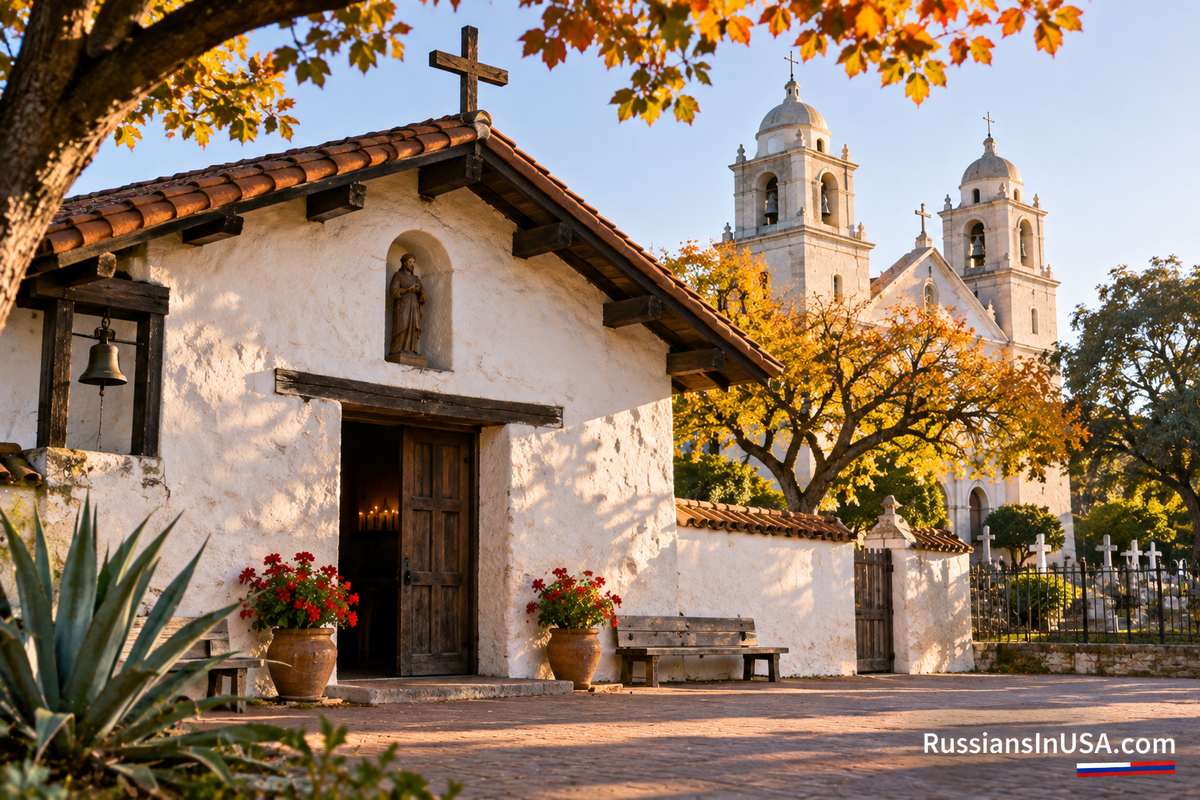
Mission Dolores, officially Misión San Francisco de Asís, is the Spanish mission founded in San Francisco in 1776, at 16th and Dolores Streets (3321 16th Street). The Mission says its adobe church is the oldest building in the city and the only intact mission chapel among the 21 founded under Father Junípero Serra. Next to it stand a large basilica and the last cemetery inside the city limits. Self-guided visits need no reservation. For the rest of the city, start with our San Francisco city guide.
Mission Dolores history by date
The mission is named for St. Francis of Assisi, founder of the Franciscan order. Its everyday name comes from a nearby creek, the Arroyo de los Dolores, or "Creek of Sorrows." The Mission's home page gives June 29, 1776 as the founding date; its Old Mission page gives October 9, 1776 without saying what each date marks. The San Francisco Chronicle wrote in 2019 that October 9, 1776 is the day the first, temporary mission was finished, to cannon fire and bells.
| Year | What happened |
|---|---|
| 1776 | Capt. Juan Bautista de Anza's party reaches San Francisco on March 27 (San Francisco Chronicle); the mission is founded in the Ohlone village of Chutchui (CyArk) |
| 1782 | In spring, California Indians begin building the adobe church, overseen by Padre Benito Cambon (CyArk) |
| 1791 | The church is dedicated on August 2, nine years after work began (CyArk) |
| 1906 | The church comes through the 1906 earthquake (the Mission) |
| 1952 | Pope Pius XII makes the church next door a Minor Basilica on February 8 (the Mission) |
The Chronicle puts the start of construction in 1783, so the sources differ by a year; both give 1791 for the dedication. The Chronicle says it was the sixth of the 21 missions Spain built in Alta California. The city Planning Department lists it as San Francisco Landmark No. 1, since 1968. The Mission calls itself the birthplace of modern San Francisco and says it saw the Gold Rush and the 1906 earthquake. Today it is a working Catholic parish that, by its own count, receives more than 200,000 visitors a year.
The Ohlone, the Yelamu and what the mission cost them
California Indians built the church. CyArk says the mission deeply affected the Bay Area tribes, the Ohlone (or Yelamu), Patwin, Miwok and Wappo, and that about 1,000 native people lived there at any one time in the Spanish era. The fullest account is historian Gary Kamiya's 2019 column in the San Francisco Chronicle.
He writes that about 300 Yelamu, part of the larger Ohlone people, lived in what is now San Francisco. In 1777 a 20-year-old Ohlone man named Chamis became the first adult Indian baptized at the mission. Baptized Indians were not allowed to return to their old life, and those who ran away were tracked down and punished. In 1796 at least 200 of the mission's 872 neophytes fled; soldiers blamed too much work, too much punishment and too much hunger.
Deaths were higher here than at other missions because of cold and poor food, and 200 replacement neophytes were sent every year from 1800 to 1820. In 1825 the mission held 1,252 Indians, only 90 of them Ohlone speakers and only 18 Yelamu. Most of the rest had died of measles, tuberculosis, syphilis and other European diseases. By 1847 only 34 Indians were found on the whole San Francisco Peninsula.
There is a Russian thread too. The artist Louis Choris, who came to San Francisco in 1816 with a Russian expedition, wrote that he never saw the mission Indians laugh, as the same Chronicle column quotes.
What to see: the Old Mission, cemetery and basilica
The Old Mission. The small white adobe church is the reason to come. Mass is said here at 8:00 a.m. Monday through Saturday, so mornings belong to worship. The museum and gift shop keep the same hours as the church.
The cemetery and gardens. They sit beside the Old Mission. The Mission says some 5,000 Ohlone, Miwok and other First Californians, who built the mission and were its first members, are buried here. So are Luis Antonio Arguello, the first Mexican governor, Lieutenant Moraga, first commandant of the Presidio, and Cora, Casey and Sullivan, victims of the Committee of Vigilance. The markers date from 1830 to about 1898. The gardens are planted with trees, shrubs and flowers of the 1791 period, plus a rose garden given and tended weekly by the Golden Gate Rose Society and an Ohlone ethno-botanic garden.
The Basilica. The Mission's curator explains that the large church earned its Minor Basilica title on two counts: a historic event took place here, and it holds unique art. That art is the stained glass made in Munich, showing all 21 Alta California missions. To the right of the High Altar, near the altar of St. Joseph, is the umbraculum of yellow and red silk, one of the two marks a pope gives a minor basilica. The tintinnabulum, a bell, is to the left, near the altar of Our Lady of the Miraculous Medal.
How to get to Mission Dolores
The church stands at 16th and Dolores, where the Mission, Castro, Lower Haight, Noe Valley and Upper Market neighborhoods meet. The Mission recommends transit (directions on its site).
| Option | Where to get off |
|---|---|
| Muni bus 22 Fillmore | 16th St & Dolores St, at the front door |
| Muni J Church streetcar | Church St & 16th St, one block west |
| BART | 16th St Mission station, 2000 Mission Street, three blocks east |
| Car | free Mission lot, weekends only, entrance on the east side of Church Street between 16th and 17th |
The 22 runs along 16th Street between Mission Bay and Church Street; the J runs from Embarcadero Station to Balboa Park through the Market Street Subway (routes on sfmta.com). Four BART lines stop at 16th St Mission, and the station has no parking (station page on bart.gov).
Hours and admission
| What | Open |
|---|---|
| Old Mission, museum, cemetery, basilica, gift shop | Monday to Friday, 10 a.m. to 4 p.m. |
| Same | Saturday and Sunday, 10 a.m. to 5 p.m. |
| Parish office | Monday to Friday, 8:30 a.m. to noon and 1 to 5 p.m. |
Hours and prices checked November 5, 2026 on missiondolores.org.
The Mission's site lists no admission price for individual visitors. The only figure it gives is a suggested donation for school field trips: $5 per student and $10 per adult. Self-guided visits are always available without a reservation. Guided tours, the Mission says, are unavailable until further notice; its tour form is only for school and large groups.
Mass follows a standing schedule: 8:00 a.m. Monday through Saturday in the Old Mission, a 5 p.m. Saturday vigil there, and Sunday Masses at 8 and 10 a.m. in English and noon in Spanish. Check the Mission's home page before you go, where hours and notices are updated.
Tips before you go
To see the Old Mission quietly, come after the morning Mass; visiting opens at 10 a.m. On weekends the site stays open an hour later, until 5 p.m., and that is also when the free lot is open; on weekdays there is no parking on site. A small group, the Mission says, needs no form and can simply walk in. The parish phone is (415) 621-8203. More sights are on our things to see in San Francisco page.
Questions people ask
How much does it cost to visit Mission Dolores?
The Mission's site, missiondolores.org, lists no admission price for individual visitors. The only figure it gives is a suggested donation for school field trips of $5 per student and $10 per adult. Self-guided visits to the Old Mission, museum, cemetery and Basilica need no reservation and run from 10 a.m. daily.
What is the nearest BART station to Mission Dolores?
The nearest BART station is 16th St Mission, at 2000 Mission Street, three blocks east of the Mission. Walk west along 16th Street to Dolores Street, or take the Muni 22 Fillmore bus, which has a 16th St & Dolores St stop at the Mission's front door.
Who is buried in the Mission Dolores cemetery?
The Mission says some 5,000 Ohlone, Miwok and other First Californians who built the mission are buried there, along with Luis Antonio Arguello, the first Mexican governor, Lieutenant Moraga, the first commandant of the Presidio, and Cora, Casey and Sullivan, victims of the Committee of Vigilance. It is the only cemetery left inside San Francisco's city limits.
When was the Mission Dolores church built?
CyArk says California Indians began the adobe church in the spring of 1782, overseen by Padre Benito Cambon, and that it was dedicated on August 2, 1791. The San Francisco Chronicle gives 1783 as the start of construction. The Mission calls the church the oldest building in San Francisco, and it survived the 1906 earthquake.
Places on the map
Sources
- Mission Dolores Basilica, home page: brief history, hours, Mass times
- Mission Dolores: Old Mission, cemetery and gardens, visitor information
- Mission Dolores: directions
- Mission Dolores: Restoring the Mission
- CyArk: Mision de Nuestro Padre San Francisco de Asis (Mission Dolores)
- San Francisco Chronicle, Gary Kamiya: Mission Dolores' dark legacy for Indians (2019)
- SFMTA: 22 Fillmore
- SFMTA: J Church
- BART: 16th St./Mission Station
- San Francisco Planning Department: Article 10 landmarks list (Mission Dolores, Landmark No. 1, effective 4/11/68)