RussiansInUSA editorial team · Facts checked November 11, 2026
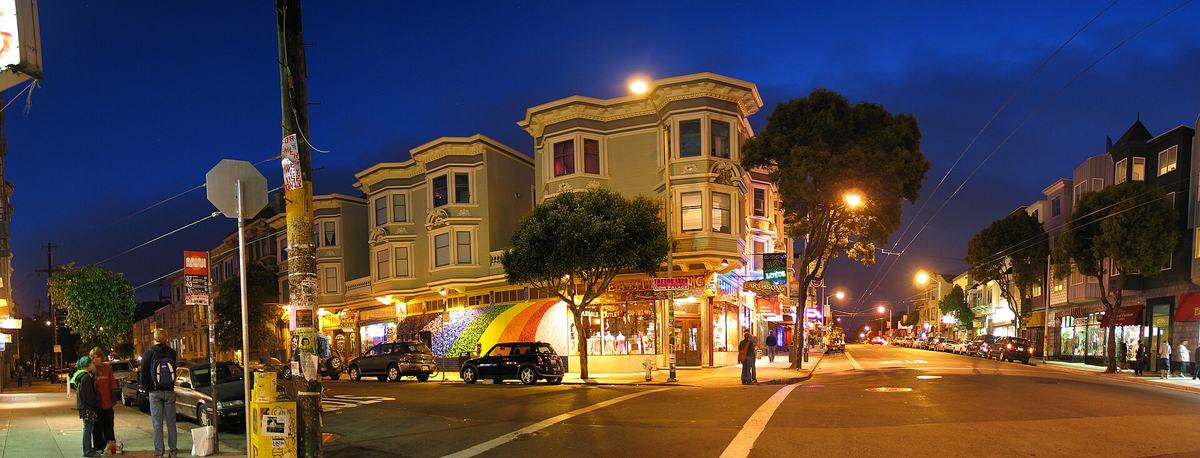
Haight-Ashbury is the San Francisco neighborhood around the corner of Haight and Ashbury streets, at the eastern edge of Golden Gate Park. In the summer of 1967, the Summer of Love, more than 100,000 people came here, according to the city's visitor bureau, San Francisco Travel, and the area became the symbol of the 1960s counterculture. Today people come for Victorian houses, vintage shops, record stores and the new Counterculture Museum right on the famous corner. For the rest of the city, see our San Francisco city guide.
Haight-Ashbury history: from park gateway to the Summer of Love
According to the Museum of the City of San Francisco, Haight Street is named for Henry Haight, manager of the banking house Page, Bacon & Co. The museum adds that this is hard to prove, since four Haights lived in the city in the early 1850s.
In the late 1800s the area lived on weekend visitors. Haight was the main entrance to Golden Gate Park, and in 1887 the California League baseball grounds opened here. The first shops clustered near the cable car turnaround at Haight and Stanyan. Around 1900 The Chutes amusement park was taken down, its lake drained and Belvedere Street extended to Haight. Developers then bought whole blocks, subdivided them and built rows of identical houses, more and more of them three-story flats. Many of the neighborhood's Victorian houses, some painted in bright colors, still stand.
In the 1960s Haight-Ashbury became the center of the youth counterculture. The underground paper San Francisco Oracle was printed on Haight Street, and in 1966 the Grateful Dead played the Trips Festival. The peak came in the summer of 1967.
Decline followed. San Francisco Heritage, the city's preservation group, reports that Haight Street's commercial vacancy rate was 4 percent in 1965. The neighborhood recorded no murders in 1967, but in 1968 a dozen businesses closed in three months, and by 1971 vacancy reached 35 percent. Recovery began in 1972, when vacancy fell to 24 percent and major crime dropped below the city average. That year residents won what San Francisco Heritage calls the largest down-zoning in city history, which blocked large buildings along the Golden Gate Park Panhandle. The neighborhood is still associated with free expression, political activism and bohemian fashion.
What to see in Haight-Ashbury
The Haight and Ashbury corner. The street sign at this intersection has long been the neighborhood's emblem and is a good place to start.
Counterculture Museum. Opened in May 2025 at 1485 Haight St, on the Haight and Ashbury corner, by Estelle and Jerry Cimino, the team behind the Beat Museum in North Beach. It fills about 4,000 square feet on the ground floor of a three-story Victorian. Rooms cover civil rights, LGBTQ+ rights, the psychedelic era and the Summer of Love, Vietnam War protests, concert posters and the underground press.
Grateful Dead house, 710 Ashbury St. The band's former home and a long-standing draw. It is a private home, so view it from the street.
Jefferson Airplane house, 2400 Fulton St. Another band's former home, also a private residence.
Upper Haight. The western stretch of Haight Street: loud clothing shops, tattoo and piercing studios and long-running stores such as Love on Haight. A giant pair of fishnet-clad legs hangs from the window of Piedmont Boutique.
Amoeba Music, 1855 Haight St. One of the city's best-known music stores, in the former Park Bowl bowling alley. Down the street at 1556 Haight St is Mendel's, a fabric store whose owner Mendel Herscowitz sold house paint and linoleum from 1960 and renamed it Mendel's Far Out Fabrics in 1969.
Lower Haight. The downhill, eastern part of Haight Street, with dive bars, consignment stores and vinyl shops.
Golden Gate Park. Haight Street runs straight into the park's 1,017 acres. More sights are on our San Francisco places page.
How to get to Haight-Ashbury
Muni, run by the city's transit agency SFMTA, is the easiest way in.
| Route | Board at | Get off at | Service |
|---|---|---|---|
| Bus 7 Haight/Noriega | Salesforce Transit Center or any Market Street stop | Haight St at Masonic Ave, Clayton St or Stanyan St | daily, about 5 a.m. to midnight |
| Bus 6 Hayes/Parnassus | Civic Center (Hyde St and Grove St) | Masonic Ave and Haight St | daily, about 5 a.m. to midnight |
| N Judah light rail | Embarcadero, Montgomery, Powell, Civic Center or Van Ness stations under Market Street | Carl St and Cole St, or Carl St and Stanyan St | 24 hours, with the N bus late at night |
The 7 runs along Market Street and then along Haight Street itself, so it is the most direct ride from downtown. The N Judah works well from BART, since Embarcadero, Montgomery, Powell and Civic Center are shared BART and Muni Metro stations. From Carl and Cole, walk north on Cole Street to Haight. The N's eastern end is the Caltrain station at King St and 4th St. Check routes and times on sfmta.com before you go.
Hours and tickets
The neighborhood is ordinary city streets: you can walk it at any time for free. Only the Counterculture Museum charges admission.
| Counterculture Museum | What the museum's site says |
|---|---|
| Open | Wednesday to Sunday, 11 a.m. to 6 p.m. |
| Closed | Monday and Tuesday |
| General admission | $10 |
| Students, teachers, seniors, military | $8 |
| Guided tour | Sundays, 11:30 a.m. to 1 p.m., $25 |
| Address | 1485 Haight St, San Francisco, CA 94117 |
Hours and prices checked November 11, 2026 on counterculturemuseum.org.
A ticket is good all day from purchase until closing, so you can step out and come back. No reservation is needed; you can buy ahead on the museum's site.
Tips before you go
- Plan a full day: San Francisco Travel suggests the neighborhood for an unhurried day of window shopping.
- The Grateful Dead and Jefferson Airplane houses are private. Take photos from the sidewalk and stay off the steps.
- Visit the museum Wednesday through Sunday; it is closed Monday and Tuesday.
- A simple route: ride the 7 to Stanyan St, walk into Golden Gate Park, then head east on Haight to the Ashbury corner and the museum at 1485 Haight St.
Questions people ask
How much is the Counterculture Museum on Haight Street?
General admission to the Counterculture Museum is $10, and $8 for students, teachers, seniors and military. A guided tour on Sundays costs $25. Tickets are valid all day until closing and no reservation is needed. Prices were checked on November 11, 2026 on the museum's own site.
Can you go inside the Grateful Dead house at 710 Ashbury?
No. The former Grateful Dead house at 710 Ashbury Street is a private residence where people live, and San Francisco Travel notes that it is private. View it only from the sidewalk, stay off the steps and do not disturb the residents. The same goes for the former Jefferson Airplane house at 2400 Fulton Street.
Which bus goes to Haight-Ashbury from downtown San Francisco?
The most direct ride from downtown is Muni bus 7 Haight/Noriega. It runs along Market Street and then Haight Street, stopping at Masonic Ave, Clayton St and Stanyan St. You can also take the N Judah to Carl St and Cole St and walk north.
Why is Haight-Ashbury called the birthplace of the hippies?
In the 1960s the neighborhood became the center of the youth counterculture, and the underground paper San Francisco Oracle was printed on Haight Street. In the summer of 1967, the Summer of Love, more than 100,000 people came here, according to San Francisco Travel.
Places on the map
Sources
- San Francisco Travel: Haight-Ashbury
- Counterculture Museum: Visit (hours and tickets)
- San Francisco Travel: Your guide to San Francisco's Counterculture Museum
- SFMTA: 7 Haight/Noriega
- SFMTA: 6 Hayes/Parnassus
- SFMTA: N Judah
- Museum of the City of San Francisco: Haight Ashbury
- Museum of the City of San Francisco: San Francisco street names
- San Francisco Heritage: Haight Street Renaissance
- San Francisco Recreation and Parks: Golden Gate Park