RussiansInUSA editorial team · Facts checked November 11, 2026 · Official site
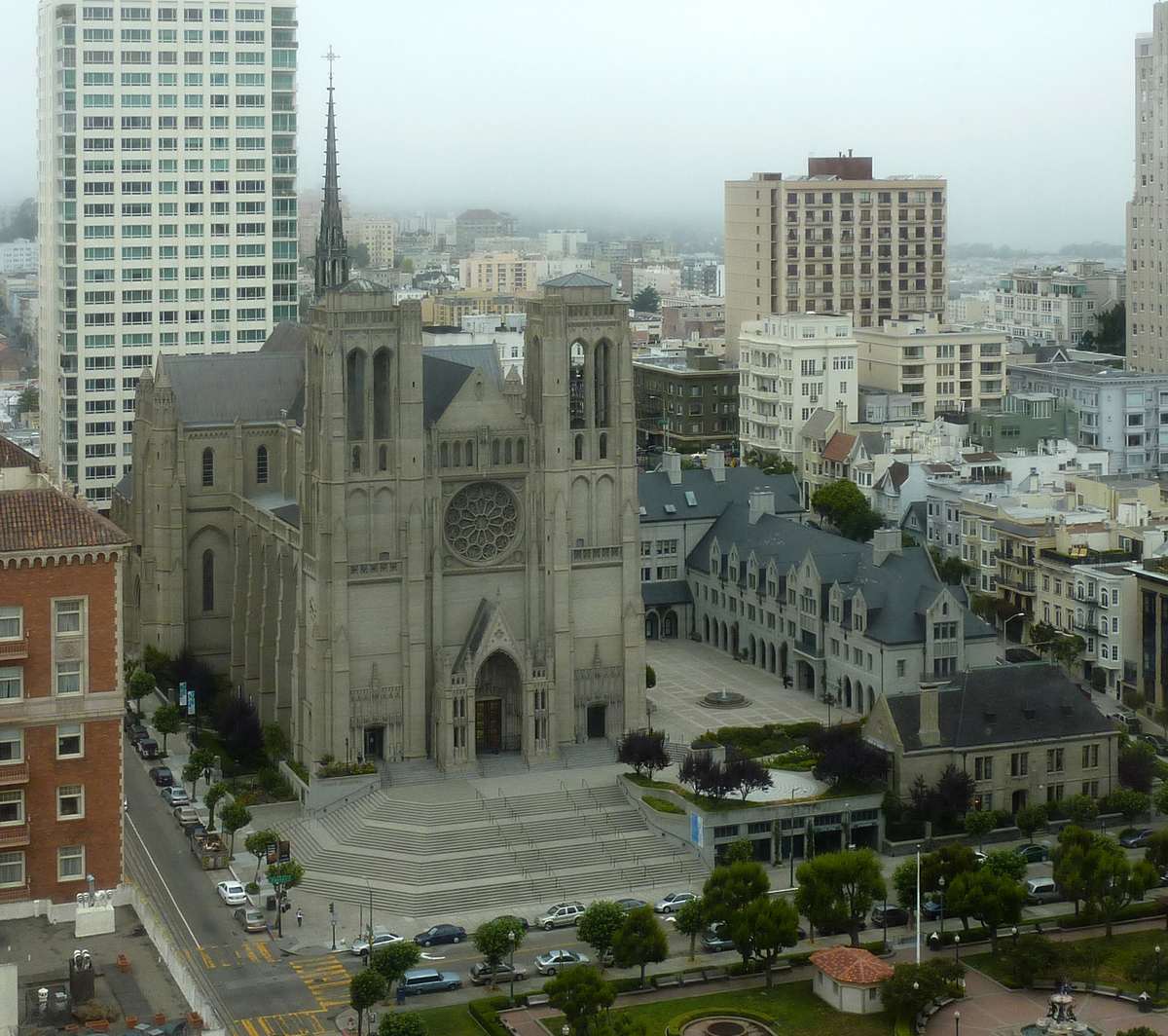
Grace Cathedral in San Francisco is the cathedral of the Episcopal Diocese of California, a concrete and steel Gothic church on top of Nob Hill at 1100 California Street. The cathedral calls itself the third largest Episcopal cathedral in the country, after New York and Washington. People come for the bronze Doors of Paradise, cast from Ghiberti's doors in Florence, the stained glass, two labyrinths and the AIDS Interfaith Memorial Chapel with its Keith Haring altarpiece. For the city as a whole, see our San Francisco page.
History of Grace Cathedral
The cathedral's own history starts with a small Gold Rush chapel. Grace Chapel was built in 1849 on Powell Street near Jackson, founded by the Rev. John Ver Mehr. Most of the people at the first service were miners, and the collection was gold dust.
In 1862 the parish opened a brick Gothic church at California and Stockton Streets. Leland Stanford and the younger Crockers belonged to it, and Mark Twain came to see it. In 1906 the earthquake was followed by a city-wide fire, and the church burned.
The fire also destroyed the mansions on top of Nob Hill. The banker William H. Crocker and his wife, whose house had burned too, gave their block to the diocese as a cathedral site. The cornerstone was laid in 1910, and Lewis Hobart became the architect and redesigned an earlier English plan.
Work on the present building began in 1927. By 1934 the cathedral, about two-thirds built, was in use, but the Depression stopped construction. A north tower went up from 1936 to 1943, and work did not resume until 1960. The largely completed cathedral was consecrated in 1964. Martin Luther King Jr. and Duke Ellington were among its visitors. In 1984 it became San Francisco City Landmark #170, together with the Crocker walls and Diocesan House.
The concrete was a choice. The cathedral says the 1906 earthquake made structural strength necessary, so concrete was poured around a steel frame. Hobart chose French Gothic because Mrs. Crocker loved French art, drawing on Amiens, Chartres and Notre Dame in Paris. The building is 329 feet (100 m) long, and the nave vaulting rises to 91 feet (27 m).
What to see at Grace Cathedral
The Doors of Paradise
The front doors facing downtown are replicas of Lorenzo Ghiberti's doors for the Baptistry in Florence (1425-1452). Bruno Bearzi, a Florentine founder, cast them from molds he made of the originals after World War II, and donors paid for them in time for the cathedral's completion in 1964. Each door is over 16 feet tall and weighs over a ton. The ten main panels tell stories from the Hebrew Bible, from Adam and Eve to Solomon and Sheba. They are opened for special services and occasions, and you can study them from outside.
Stained glass
The cathedral has some 68 named windows by five artists, covering about 7,290 square feet. The largest group, 34 windows, comes from Charles Connick's studio in Boston, known for its deep blues. The faceted-glass rose window, Canticle of the Sun, is by Gabriel Loire of Chartres (1964). The Human Endeavor windows nearby include Albert Einstein and John Glenn.
Two labyrinths
There is an indoor and an outdoor labyrinth, both in the Chartres style. The cathedral says the modern labyrinth movement began here in 1991. The indoor one is open during visiting hours; the outdoor one is open around the clock. A labyrinth has a single path with no dead ends, and people walk it slowly as a meditation.
The AIDS Interfaith Memorial Chapel
The chapel was dedicated in 2000 and restored in 2017. Its centerpiece is a cast of Keith Haring's triptych altarpiece The Life of Christ (1990), his last work before his own death from AIDS. The cathedral describes the altarpiece as shaped like a Russian icon. A panel of the NAMES AIDS Quilt hangs from the vaulting and is changed from time to time.
Murals and other treasures
The nave walls carry murals by the Polish-born John De Rosen (1949-1950) and the Bolivian-born Antonio Sotomayor (1982-1983). Sotomayor's series shows the parish's own story, including Grace Chapel in 1849 and the church's destruction in 1906. Look also for the Aragonese crucifix from 1240 near the Chapel of Grace and Benjamin Bufano's Smiling Saint Francis near the labyrinth. The 44-bell carillon rings every hour from 8 am to 9 pm.
How to get to Grace Cathedral
The cathedral faces California Street between Taylor and Jones. The cathedral's own directions:
- California Street cable car. The California St & Taylor St stop is at the foot of the Great Stairs. SFMTA lists the line as running daily from 7 am to 9 pm between the Embarcadero area and Van Ness.
- Powell-Hyde and Powell-Mason cable cars. Get off at Powell and California and walk two blocks west, uphill.
- 1 California bus. Stops at Sacramento and Mason-Taylor (outbound) or Clay and Taylor (inbound), one block from the cathedral.
- 27 Bryant bus. Stops at Leavenworth and California; walk one block east up the hill.
- BART. The closest stations are Embarcadero and Powell. Powell is nearer on foot, but the Powell Street hill is steep, so the cathedral suggests Embarcadero and a transfer to the cable car or the 1 bus.
By car, the cathedral garage entrance is on Taylor Street between California and Sacramento. It is run by SP+ and has an 8 ft 2 in height limit. Rates change, so check the current ones on the cathedral's visitor FAQ page. Daytime street parking is limited to two hours except on Sundays.
Hours and tickets
| What | Hours and price |
|---|---|
| Monday to Saturday | 10 am to 5 pm |
| Sunday | 1 pm to 5 pm |
| Adults | $15 |
| Seniors 65+ | $13 |
| Young adults 18-22 | $11 |
| Youth 12-17 | $11 |
| Children under 12 | Free |
| Guided tour, adults | $27-$37 |
Hours and prices checked November 11, 2026 on gracecathedral.org.
Admission includes a self-guided tour of 15 interactive displays, offered in Spanish, Chinese, French, Korean, Japanese, Portuguese and Italian, plus a children's map. Docent-led Highlights and Behind-the-Scenes tours take about an hour. People who come to pray or meditate are admitted free during sightseeing hours.
Before you go
Grace is a working church. You may walk in on organ practice, a rehearsal, a service or a wedding, and it occasionally closes to visitors for a specific event. Upcoming closures are posted on the Plan Your Visit page, so check it on the day.
The outdoor labyrinth is free and open at night, a quiet option if the building is closed. Groups of 10 or more can get discounts with an advance reservation. More sights are on our San Francisco places page. The cathedral's phone number is 415-749-6300.
Questions people ask
How much does it cost to visit Grace Cathedral?
Sightseeing admission at Grace Cathedral is $15 for adults, $13 for seniors 65 and over, and $11 for young adults 18 to 22 and youth 12 to 17. Children under 12 enter free. Guided tours cost $27 to $37 for adults, and people coming to pray are admitted free during sightseeing hours.
Can you walk the Grace Cathedral labyrinth for free?
Yes, the outdoor labyrinth at Grace Cathedral is open 24 hours a day and needs no ticket. The indoor labyrinth is open only during sightseeing hours, Monday to Saturday from 10 am to 5 pm and Sunday from 1 pm to 5 pm.
Which cable car goes to Grace Cathedral?
The California Street cable car stops at California and Taylor, at the foot of the cathedral's Great Stairs. The Powell-Hyde and Powell-Mason lines stop at Powell and California, two blocks downhill. From BART, the cathedral suggests getting off at Embarcadero and taking the California Street cable car.
Are the doors of Grace Cathedral the real Ghiberti doors?
No. They are bronze replicas of Lorenzo Ghiberti's Doors of Paradise in Florence, cast by Bruno Bearzi from molds made after World War II and bought for the cathedral's completion in 1964. Each door is over 16 feet tall. The restored originals are in the Florence Cathedral Museum.
Places on the map
Sources
- Grace Cathedral, official site
- Sightseeing at Grace Cathedral: hours and admission
- Grace Cathedral History
- Architecture and the AIDS Interfaith Memorial Chapel, Grace Cathedral
- The Cathedral's Treasures: stained glass, carillon, Doors of Paradise, Grace Cathedral
- Our Labyrinths, Grace Cathedral
- Visit FAQ: public transportation and parking, Grace Cathedral
- California Cable Car, SFMTA