RussiansInUSA editorial team · Facts checked November 11, 2026 · Official site
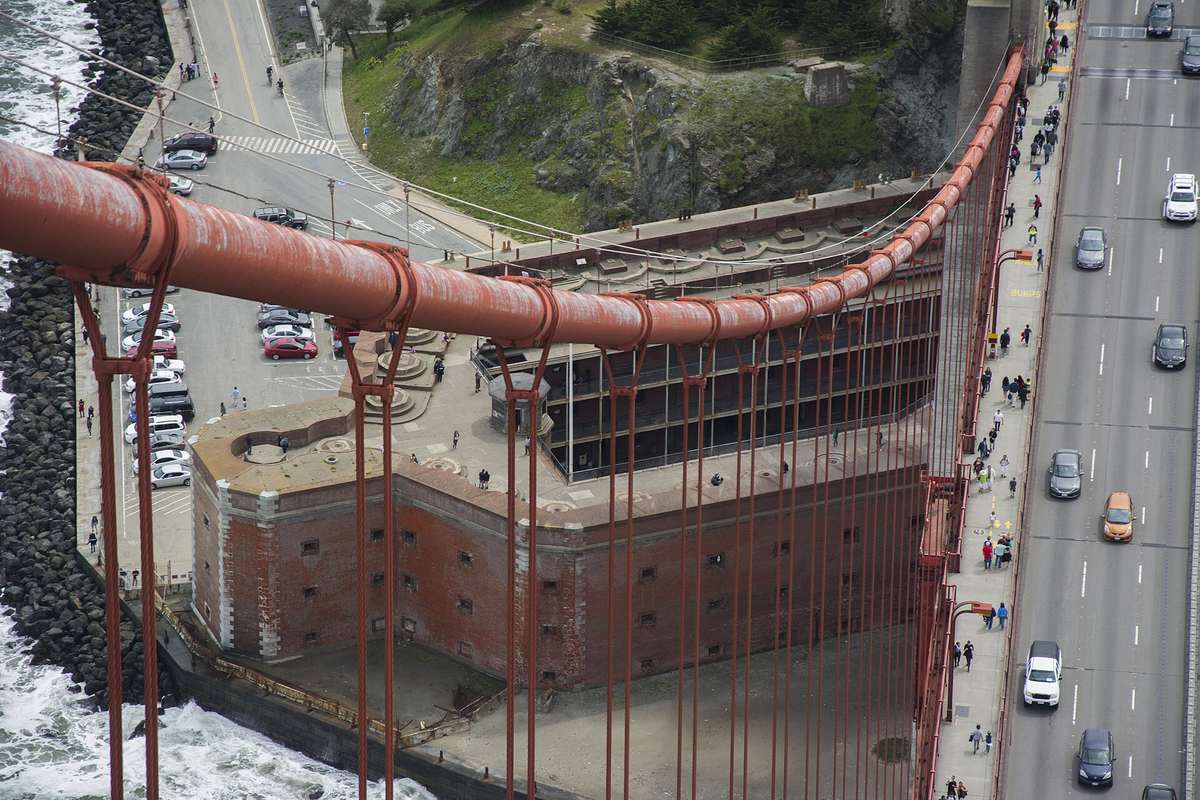
Fort Point in San Francisco is a Civil War-era brick fortress that sits directly under the south end of the Golden Gate Bridge, at the northern tip of the peninsula inside the Presidio. It is Fort Point National Historic Site, run by the National Park Service, and entry is free. People come for the three tiers of brick casemates, the view of the bridge from underneath and out across the Golden Gate strait, and the story: the fort never fired on an enemy, yet lived through almost every era of the city. For the city as a whole, see our San Francisco page.
History of Fort Point, from Spanish battery to bridge
The site was picked long before the Americans arrived. According to the Park Service's historic structure report, on March 28, 1776, Spanish Colonel Juan Bautista de Anza placed a cross on the White Cliff (Cantil Blanco), where the fort now stands, to mark the spot for a fortification. In 1794 the Spanish built the Castillo de San Joaquin there, an adobe battery with walls ten feet thick and eight 12-pounder cannon. An 1813 earthquake nearly destroyed it, it was rebuilt in 1816, and after Mexican independence in 1821 it was gradually abandoned.
After the Gold Rush, the U.S. Army set out to close the harbor entrance in earnest. Work began in 1853. Crews blasted the 90-foot cliff down to 15 feet above sea level, taking what was left of the Spanish battery with it. The U.S. Army Engineers built the fort between 1853 and 1861 in the "Third System" style of coastal forts. The Park Service calls it the only fort of its type built on the West Coast. It has 7-foot-thick walls, three casemated tiers and an open gun deck on the roof. The same report says Lt. Danville Leadbetter drew the plans, the bricks came from the Army's own brickyard on the bluff, and the foundation was laid with granite slabs from China.
The plans called for 141 guns, a number the fort never reached. The first 55 went in during 1861, there were 69 in and around the fort by October 1861, and 102 at the peak. Colonel Albert Sidney Johnston ordered the first garrison, then resigned to join the Confederacy and was killed at Shiloh in 1862. Up to 500 men served here during the Civil War, and they never had to fire. Battles in the East showed that brick walls could not stand up to rifled artillery, so the fort was obsolete almost as soon as it was finished. Its granite seawall was completed in 1869, and by 1900 the fort was fully disarmed.
In the 1930s the fort was slated for demolition to make way for the Golden Gate Bridge. The bridge's chief engineer, Joseph Strauss, toured the empty fort and changed his mind, designing a special steel arch to carry the bridge over it. In a 1937 memo he called the fort "a fine example of the mason's art" and argued it should be kept as a national monument. In World War II soldiers on the roof guarded the harbor entrance against Japanese submarines. In 1959 retired officers and engineers formed the Fort Point Museum Association, and on October 16, 1970, Fort Point became a National Historic Site.
What to see at Fort Point
You enter through the sally port into a courtyard ringed by the arches of the casemates. Exhibits on the fort's history fill the first three floors, and there is a small bookstore. On every day the fort is open, a theater off the courtyard shows two short films on the fort and the bridge.
Stairs lead up through the tiers. The roof looks out over the strait with the bridge arch right overhead. The lighthouse stands on top. According to the 2006 report, the first light on this site was torn down by the Army in 1853 because it was in the way of construction. A second went into service in March 1855 in front of the fort, and in January 1864 an iron tower on the roof took over. Keeper James Rankin pulled 18 people out of the water during his 41 years here. The station was shut down in 1934, when the new bridge towers blocked its light.
Rangers give 15-minute history talks at 11:30 am, 1:30 pm and 2:30 pm on open days. There is no fixed schedule for guided tours; they run when staffing allows, so check the program board at the entrance. In winter the park holds after-hours Candlelight Tours, with tickets announced on its social media. Twice a year there are living history days with Civil War reenactors; dates are on the Fort Point site. Kids can do the free Junior Ranger program and earn a wooden badge.
How to get there
The fort is at the end of Marine Drive, at the foot of the bluffs.
- By car from the city or the south: take Highway 101 north and exit right at the bridge toll plaza before getting on the bridge. Turn right at the end of the ramp, then left onto Lincoln Boulevard, take the first left onto Long Avenue and follow it onto Marine Drive.
- By car from the north: cross the bridge on 101, stay in the right lane and exit just past the toll plaza. Turn right at the end of the ramp and loop under the plaza, turn left onto Lincoln Boulevard, then Long Avenue to Marine Drive.
- Parking is free but limited and first come, first served. There are ADA spaces. Cars parked outside marked spaces get reported.
- Bus: Muni's 28 19th Avenue runs between Daly City BART and Fisherman's Wharf daily from 5 am to midnight. Get off at Golden Gate Bridge/Parking Lot by the toll plaza and follow the trail signs northeast down to the fort.
- On foot or by bike: from Crissy Field, head west along the shoreline. From the bridge, take the Battery East trail and stairs down to the Warming Hut and walk along Marine Drive.
The free PresidiGo shuttle does not stop near the fort.
Hours and tickets
| What | Current schedule |
|---|---|
| Inside the fort | Thursday to Monday, 10 am to 5 pm |
| Roof access | closes at 4:30 pm on open days |
| Outside grounds | open 7 days a week |
| Closed | Thanksgiving, Christmas and New Year's Day |
| Admission | free, no pass needed |
Hours and prices checked November 11, 2026 on nps.gov. The park says open days change by season, so check its hours and alerts pages before you go. The fort's bookstore sells America the Beautiful annual passes for parks that do charge a fee.
Tips before you go
- It is almost always cool, damp and windy at the fort, especially in summer. Bring a warm layer in any season.
- The first floor is wheelchair accessible with a raised boardwalk, but there is no elevator to the upper tiers. Each level has tactile maps, and assistive listening devices are available for tours and films. An accessible restroom is on your left as you arrive.
- Dogs are not allowed inside the fort but are allowed on the grounds outside. Service animals are welcome.
- There is no food at the fort. The Warming Hut at the foot of Long Avenue and the bridge plaza both sell food.
For the rest of the city's sights, see places to see in San Francisco.
Questions people ask
How much does it cost to visit Fort Point?
Fort Point is free to enter, and no national park pass is required. Parking next to the fort is free as well, though spaces are limited and go first come, first served. The only things you pay for are items in the fort's bookstore and, if you want one, an America the Beautiful annual pass.
What days is Fort Point open?
The National Park Service opens the fort Thursday through Monday from 10 am to 5 pm, with roof access ending at 4:30 pm. It is closed inside on Tuesdays and Wednesdays, but the grounds outside are open every day. The fort is also closed on Thanksgiving, Christmas and New Year's Day.
Can you walk to Fort Point from the Golden Gate Bridge?
Yes. From the plaza at the south end of the bridge, where the Muni 28 bus stops, a signed trail leads northeast down to the fort. You can also take the Battery East trail and stairs down to the Warming Hut and walk along Marine Drive to the end of the road.
Why is there an arch over Fort Point?
In the 1930s the fort was set to be demolished for a Golden Gate Bridge footing. Chief engineer Joseph Strauss chose to save the brick fortress and designed a special steel arch to carry the bridge over it. The bridge was dedicated in May 1937, and the fort became a National Historic Site in 1970.
Places on the map
Sources
- Fort Point National Historic Site, National Park Service
- Operating Hours and Seasons, Fort Point NHS
- Fees and Passes, Fort Point NHS
- Directions, Fort Point NHS
- Basic Information, Fort Point NHS
- Things To Do, Fort Point NHS
- Accessibility, Fort Point NHS
- Frequently Asked Questions, Fort Point NHS
- History and Culture, Fort Point NHS
- Fort Point, Golden Gate National Recreation Area
- American Third System Period, Golden Gate NRA
- Abbreviated Fort Point Historic Structure Report, National Park Service, 2006
- 28 19th Avenue, SFMTA
- Albert Sidney Johnston, National Park Service