RussiansInUSA editorial team · Facts checked November 11, 2026 · Official site
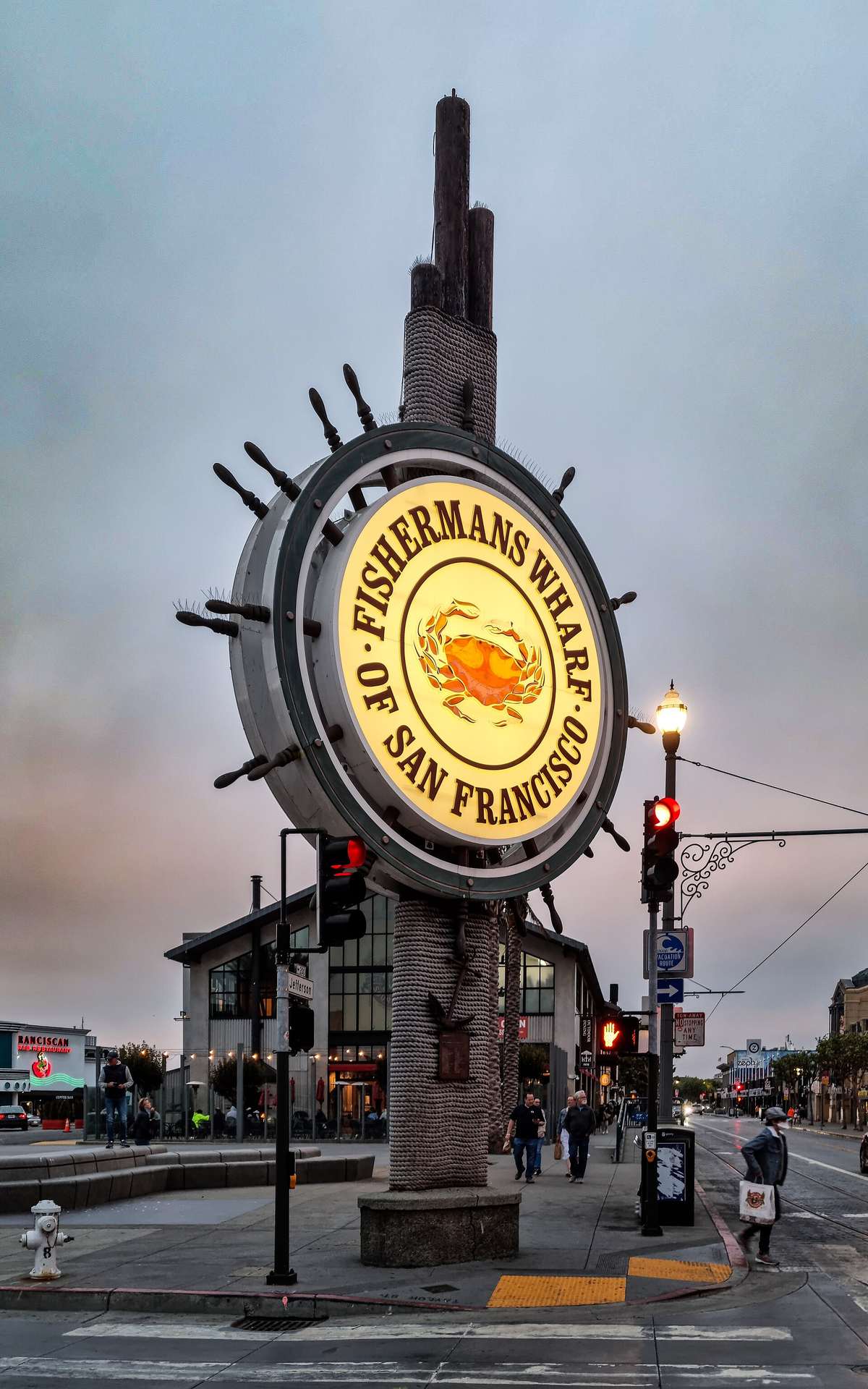
Fisherman's Wharf in San Francisco is the city's old fishing harbor on the northern waterfront, running from Ghirardelli Square on Beach Street to PIER 39 on the Embarcadero. It takes in the piers from PIER 39 through Pier 45 plus Hyde Street Pier, and its heart is the corner of Jefferson and Taylor Streets. The waterfront itself is open around the clock. People come for the sea lions, fresh crab, bay cruises and a World War II submarine.
Fisherman's Wharf history: from Meiggs Wharf to PIER 39
The Port of San Francisco says about 2,000 Ramaytush Ohlone lived on the peninsula before the Spanish arrived in 1769. In the early 1800s this shore was salt marsh, beach and mudflat, filled in during the Gold Rush.
The National Park Service calls Henry Meiggs the builder of Fisherman's Wharf. On the night of October 3, 1854 he slipped away from San Francisco on the bark American. The Wharf's merchant association says both Chinese and Italian fishermen worked at the original Meiggs Wharf.
In the late 1800s immigrants from Guangdong Province ran a shrimp industry from flat-bottom junks. Italians from the Genoa coast built feluccas between 1850 and 1900, mostly green sailboats each named for a patron saint. In the early 1900s Giuseppe Camillone, a fisherman from Tuscany, fitted a one-cylinder Hicks gasoline engine to a felucca, creating the first powered fishing boats.
Around 1900 the City built a new seawall and cargo piers, and the fleet moved from Italy Harbor near Green Street to today's Wharf. The Port built the three-mile seawall between 1878 and 1916. Sightseeing tours on the bay began in 1915, during the Panama-Pacific International Exposition.
In 1925 Nunzio Alioto, a Sicilian immigrant, opened fish stall #8 on Taylor Street, and in 1932 he put up the first building on the Wharf. His widow Rose Alioto is widely credited with the cioppino recipe, the fish stew now served up and down the Wharf.
Tourism took over in the second half of the 20th century. Ghirardelli Square, the old chocolate works on the site of the Pioneer Woolen Mills, opened as a retail and dining complex on November 29, 1964 and was listed on the National Register in 1982. PIER 39 was built from August 1977 and opened in October 1978, using 1910 timber from Piers 34 and 3.
Fishing never left. The Port says the Pier 45 sheds house more than a dozen fish handling and processing companies.
What to see at Fisherman's Wharf
- Sea lions at PIER 39. California sea lions began hauling out on K-Dock shortly after the Loma Prieta earthquake of October 1989. PIER 39 counted a record of over 2,100 in May and June 2024. The Wharf association says watching them is 100% free.
- PIER 39. Shops, restaurants and attractions. PIER 39 lists Aquarium of the Bay and the Blue & Gold Fleet bay cruises separately, with their own hours.
- USS Pampanito at Pier 45. A National Historic Landmark World War II submarine that made six Pacific patrols, sank six Japanese ships and damaged four others.
- The fishing harbor and Harbor Walk. The Port has placed 67 numbered history signs around the Inner Harbor, each with a QR code for translated text. The Fishermen's and Seamen's Memorial Chapel was built by the local fleet in 1979.
- Ghirardelli Square. The brick chocolate factory complex at the western end. Founder Domingo Ghirardelli was born in Rapallo, Italy, in 1817.
- Maritime Museum and Hyde Street Pier. Part of San Francisco Maritime National Historical Park. The museum fills the 1939 Aquatic Park Bathhouse, with West Coast maritime exhibits, original murals and mosaics. Hyde Street Pier is the home berth of the park's historic ships, but the pier and ships are sometimes closed to visitors, so check the park's page on nps.gov before you go.
How to get to Fisherman's Wharf
| Transit | How |
|---|---|
| F Market & Wharves streetcar | from Castro along Market and the Embarcadero to Jones St & Beach St; stops at Embarcadero & Stockton (PIER 39), Jefferson & Powell, Jefferson & Taylor |
| Powell/Hyde cable car | Powell and Market to Hyde & Beach |
| Powell/Mason cable car | Powell and Market to Bay & Taylor |
| Muni buses | 8, 30, 39, 49 (per PIER 39) |
| Car | PIER 39 Garage, Hyde & Beach garage; over 6,000 off-street spaces in the area |
The historic F line runs daily from 7 am to midnight (route on sfmta.com). At the Powell & Market, Bay & Taylor and Hyde & Beach cable car terminals you must buy your fare in advance from 8 am to 8 pm (SFMTA cable cars). The Wharf association says the area is easy on foot and you do not need a car.
The 24-hour PIER 39 Garage is across the street from the PIER's entrance plaza. Diners at participating full-service restaurants get one hour of validated parking; tell your server before the bill comes. The Wharf association says you do not have to reserve parking, but plan to arrive early on weekends and in peak season.
Hours and tickets
| What | When and how much |
|---|---|
| Fisherman's Wharf waterfront | open 24/7 |
| Sea lions on K-Dock | free |
| PIER 39 stores and attractions | 10 am to 8 pm (not Aquarium of the Bay or Blue & Gold Fleet) |
| PIER 39 full-service restaurants | 11 am to 9 pm |
| USS Pampanito | daily 10 am to 6 pm, last boarding 5:30 pm |
| USS Pampanito tickets | adults (14-61) $25, seniors 62+ $20, juniors 5-13 $15, students $20, family (2 adults, 2 juniors) $65, active military $10, 4 and under free |
| PIER 39 Garage | 24/7; $40 a day Monday to Thursday entering after 3 pm and leaving before 10 am |
Hours and prices checked November 11, 2026 on fishermanswharf.org, pier39.com, maritime.org and sfmta.com.
Most Wharf businesses open between 9 and 11 am and close between 8 and 10 pm, and the Wharf association says some attraction hours depend on the weather. The Pampanito hours above are from the submarine's own page on maritime.org; the same site's home page lists 9:30 am to 5:30 pm, so call (415) 775-1943 before a visit.
Tips before you go
Sea lion numbers at K-Dock tend to peak from late summer to early winter. Crab season runs from mid-November to the end of June, according to the Port.
The Wharf association calls the area safe but suggests keeping belongings close and walking with a friend at night. For more of the city, see the San Francisco city page and what to see in San Francisco. The Powell/Hyde cable car from Hyde & Beach takes you from the Wharf back to Powell and Market.
Questions people ask
Is it free to see the sea lions in San Francisco?
Yes, according to the Wharf association. The California sea lions rest on K-Dock at PIER 39 on Fisherman's Wharf, and watching them costs nothing. They arrived after the 1989 Loma Prieta earthquake. Numbers tend to peak from late summer to early winter, and PIER 39 counted a record of over 2,100 in May and June 2024.
How do I take a cable car to Fisherman's Wharf?
Board the Powell/Hyde or Powell/Mason line at Powell and Market. Powell/Hyde ends at Hyde & Beach and Powell/Mason at Bay & Taylor, both in the Fisherman's Wharf area. SFMTA requires you to buy your fare in advance at those terminals from 8 am to 8 pm.
Where can I park at Fisherman's Wharf?
The Fisherman's Wharf association says the area has over 6,000 off-street parking spaces, including the PIER 39 Garage and the garage at Hyde and Beach Streets. The PIER 39 Garage is open 24 hours. The association says reservations are not required, but arriving early helps on weekends and in peak tourist season.
How much does it cost to tour the USS Pampanito?
An adult ticket for the USS Pampanito at Pier 45 costs $25, seniors 62 and older and students pay $20, juniors 5 to 13 pay $15, and a family ticket for two adults and two juniors is $65. Children 4 and under are free. The submarine's own page lists it as open daily from 10 am to 6 pm, last boarding 5:30 pm.
Places on the map
Sources
- Fisherman's Wharf Community Benefit District & Merchants Association
- Fisherman's Wharf: Wharf History
- Fisherman's Wharf: FAQs (boundaries, hours, parking, sea lions)
- Fisherman's Wharf: Getting Around
- Port of San Francisco: Fisherman's Wharf Harbor Walk
- National Park Service: This Day in Maritime History, October (Henry Meiggs)
- San Francisco Maritime National Historical Park: Basic Information
- San Francisco Maritime National Historical Park: Maritime Museum
- SFMTA: F Market & Wharves
- SFMTA: Cable Cars
- PIER 39 (hours)
- PIER 39: History
- PIER 39: Sea Lions
- PIER 39: Directions and Parking
- San Francisco Maritime National Park Association: USS Pampanito
- Ghirardelli Square: History
- Fisherman's Wharf: Cable Cars (turnarounds)