RussiansInUSA editorial team · Facts checked November 11, 2026 · Official site
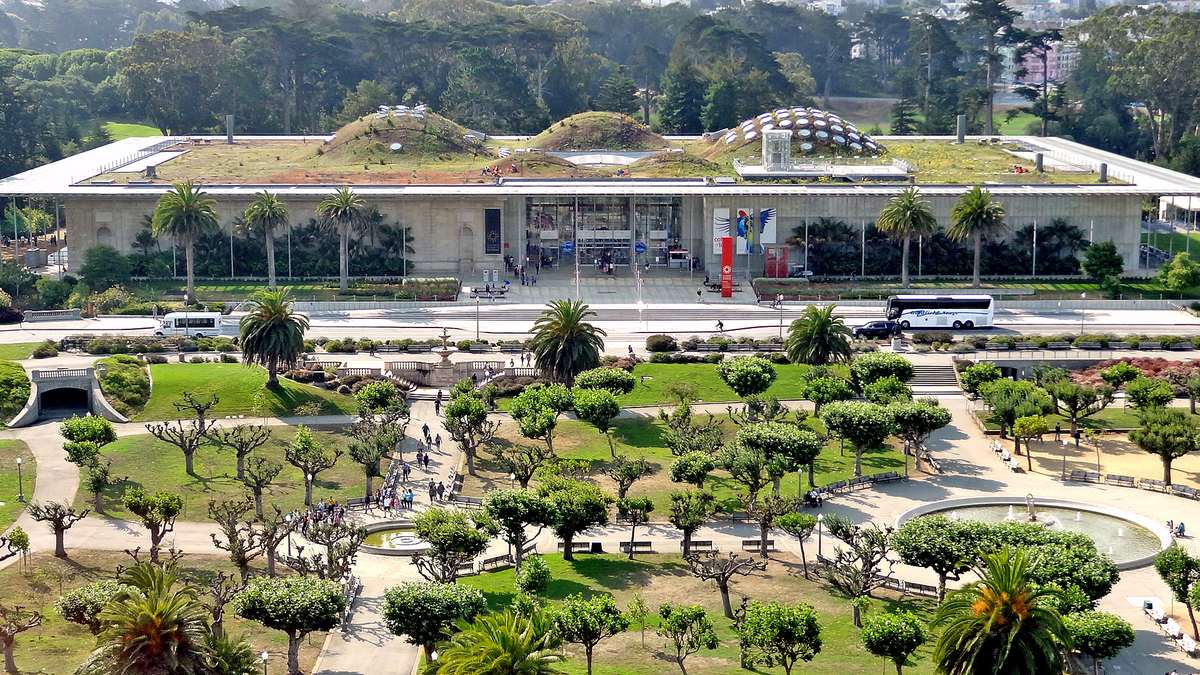
The California Academy of Sciences in San Francisco is an aquarium, a planetarium, a rainforest under a glass dome and a natural history museum in one building. It stands in Golden Gate Park at 55 Music Concourse Drive, across the plaza from the de Young art museum. People come for the living coral reef, the penguins and the roof covered in wildflowers, and for a science institution founded in 1853.
History of the California Academy of Sciences
Seven men founded the Academy in April 1853, meeting in an office on Montgomery Street and calling it the California Academy of Natural Sciences. It was one of the first scientific institutions in the American West.
It moved often. In 1874 it took a building at California and Dupont (now Grant Avenue), and in 1891 it opened a new museum on Market Street between 4th and 5th. The 1906 earthquake and fire destroyed that museum and all but a handful of its specimens. A two-year Academy expedition was in the Galapagos Islands at the time, and its material became the core of the new collections.
In 1916 the Academy opened a new museum in Golden Gate Park. Steinhart Aquarium followed in 1923 and Morrison Planetarium in 1952. The 1989 Loma Prieta earthquake caused major structural damage, and the Academy used it to rethink the whole museum.
In 2003 the Academy moved to a temporary site at 875 Howard Street. Construction of a new building designed by Renzo Piano began in the park in 2005, and it opened on September 27, 2008. It earned double LEED Platinum ratings from the U.S. Green Building Council, and the Academy calls it the world's first Double Platinum LEED-certified museum.
Today it is both a museum and a research institute. The Academy says its research collections hold nearly 46 million specimens, and nearly 60,000 animals live in Steinhart Aquarium. In 1883 botanist Mary Katharine Curran became its first paid curator, and in 1884 Rosa Smith became the first female curator of ichthyology at any natural history museum.
What to see
- Steinhart Aquarium. Nearly 60,000 animals from more than 800 species. Highlights are the Philippine Coral Reef, with reef fish and giant rays, and the 100,000-gallon California Coast tank.
- Osher Rainforest. A living rainforest four stories tall under a glass dome, with free-flying butterflies and birds and large Amazonian fish below.
- Morrison Planetarium. A 75-foot all-digital dome, one of the largest in the world.
- Tusher African Hall. African wildlife dioramas and a live colony of African penguins.
- Kimball Natural History Museum. Specimens, hands-on exhibits and the research of Academy scientists.
- Shake House. An earthquake simulator that recreates the 1906 and 1989 quakes.
- Living Roof. A 2.5-acre roof with seven hills edged by solar panels and an estimated 1.7 million plants, which the Academy calls the densest concentration of native wildflowers in San Francisco.
Children have hands-on areas: Nature Lab, Wander Woods and Curiosity Grove. Temporary exhibitions change through the year and are listed on the Academy's site.
How to get there
Muni is the easiest way. The Academy lists these routes, nearest first:
| Route | Stop | Walk to the entrance |
|---|---|---|
| 44 O'Shaughnessy bus | Music Concourse Dr / Academy of Sciences | at the door (northbound) |
| 5 Fulton bus | Fulton St and 8th Ave, north park entrance | about 5 minutes |
| 7 Haight bus | Lincoln Way and 9th Ave, south park entrance | about 7 minutes |
| N Judah light rail | 9th Ave and Irving St | about 10 minutes |
The 44 runs through the park on Music Concourse Drive, per SFMTA. Show a same-day transit pass or fare receipt at the ticket window and you save $3 on a daytime ticket.
By car, the underground Music Concourse Garage is by the main entrance, entered from Fulton St and 10th Ave or from Music Concourse Dr and MLK Dr. The Academy lists $5 an hour on weekdays and $6 on weekends, open 7 a.m. to 7 p.m. daily, though hours may vary, so confirm at 415-956-8002. JFK Drive is closed to cars, but both garage entrances stay open. The Golden Gate Bandshell lot has 20 free blue zone spaces, entered from MLK Dr.
The free Golden Gate Park Shuttle runs weekdays noon to 6 p.m. and weekends and holidays 9 a.m. to 6 p.m. Bike racks are on Music Concourse Dr and Nancy Pelosi Dr; bikes, scooters and skateboards are not allowed inside.
Hours and tickets
| Item | Hours or price |
|---|---|
| Monday to Saturday | 9:30 a.m. to 5 p.m., last entry 4 p.m. |
| Sunday | 11 a.m. to 5 p.m., last entry 4 p.m. |
| NightLife (21+ only) | most Thursdays, 6 to 10 p.m., last entry 9 p.m. |
| Adult (19+) | $49, peak $55 |
| Youth (13-18) | $45, peak $49 |
| Child (3-12) | $39, peak $45 |
| Ages 2 and under | free |
| EBT cardholders | $5 (up to 4 per group) |
| Anytime Admission (any day, all ages) | $59 |
Hours and prices checked on November 11, 2026 on calacademy.org.
Peak prices apply during spring break, the summer months, holiday weekends and the November and December holiday period. The Academy sometimes closes to the public for private events and lists those days on the hours and admission page, so check it before you go. The Academy recommends buying in advance, especially for weekends and holidays. Membership includes free daytime admission for a year.
Other discounts the Academy lists: active-duty military save $3 on daytime admission year-round, and military and veterans with ID get free daytime admission on Veterans Day and during Fleet Week. Library cardholders 14 and older can borrow free admission passes at participating libraries from San Francisco to Sacramento.
Tips before you go
- Planetarium. Each show needs a pass, first come, first served, reserved through a QR code in the lobby. Children under 4 are not admitted, and shows may not suit children under 7. Reserve as soon as you arrive.
- Rainforest hours are shorter: 10 a.m. to 4:45 p.m. Monday to Saturday, from 11 a.m. on Sunday, last entry 4:30 p.m.
- Scent-free. The Academy asks guests to skip perfume and scented lotions.
- Bags. Rental lockers are in the lobby. Strollers are welcome away from main pathways.
- Food. Outside food is not allowed in the restaurant or cafe; eat it in the East and West Garden seating areas.
- Re-entry. A hand stamp at the exit lets you come back the same day. Children 12 and under must be with an adult at all times.
The de Young is across the Music Concourse. For the rest of the city, see our San Francisco city guide and places to see in San Francisco.
Questions people ask
How long do you need at the California Academy of Sciences?
The Academy is open 9:30 a.m. to 5 p.m. Monday to Saturday and from 11 a.m. on Sunday, with last entry at 4 p.m. Steinhart Aquarium, Osher Rainforest, Morrison Planetarium and the penguins in Tusher African Hall are all in one building, so most visitors plan most of a day and book a planetarium show on arrival.
Is there a cheaper way to visit the Academy of Sciences?
According to calacademy.org, EBT cardholders pay $5, children 2 and under are free, members get free daytime admission for a year, and library cardholders 14 and older can borrow free passes at participating libraries. Showing a same-day Muni pass or fare receipt at the ticket window takes $3 off a daytime ticket at the California Academy of Sciences.
Does the Morrison Planetarium cost extra?
A planetarium show at the California Academy of Sciences needs its own pass, but you reserve it on site through a QR code in the lobby, first come, first served. Children under 4 are not admitted to Morrison Planetarium shows, and the Academy says shows may not suit children under 7.
What is NightLife at the Academy of Sciences?
NightLife is an adults-only evening for ages 21 and over, held most Thursdays from 6 to 10 p.m. with last entry at 9 p.m. The California Academy of Sciences offers live music, cocktails and access to its exhibits after regular visitors have left.
Places on the map
Sources
- California Academy of Sciences: official site
- California Academy of Sciences: plan your visit
- California Academy of Sciences: hours and admission
- California Academy of Sciences: directions and parking
- California Academy of Sciences: our history
- California Academy of Sciences: exhibits
- California Academy of Sciences: Living Roof
- California Academy of Sciences: museum guest guidelines
- SFMTA: 44 O'Shaughnessy
- California Academy of Sciences: free and reduced admission
- California Academy of Sciences: Osher Rainforest
- California Academy of Sciences: membership