RussiansInUSA editorial team · Facts checked November 18, 2026 · Official site
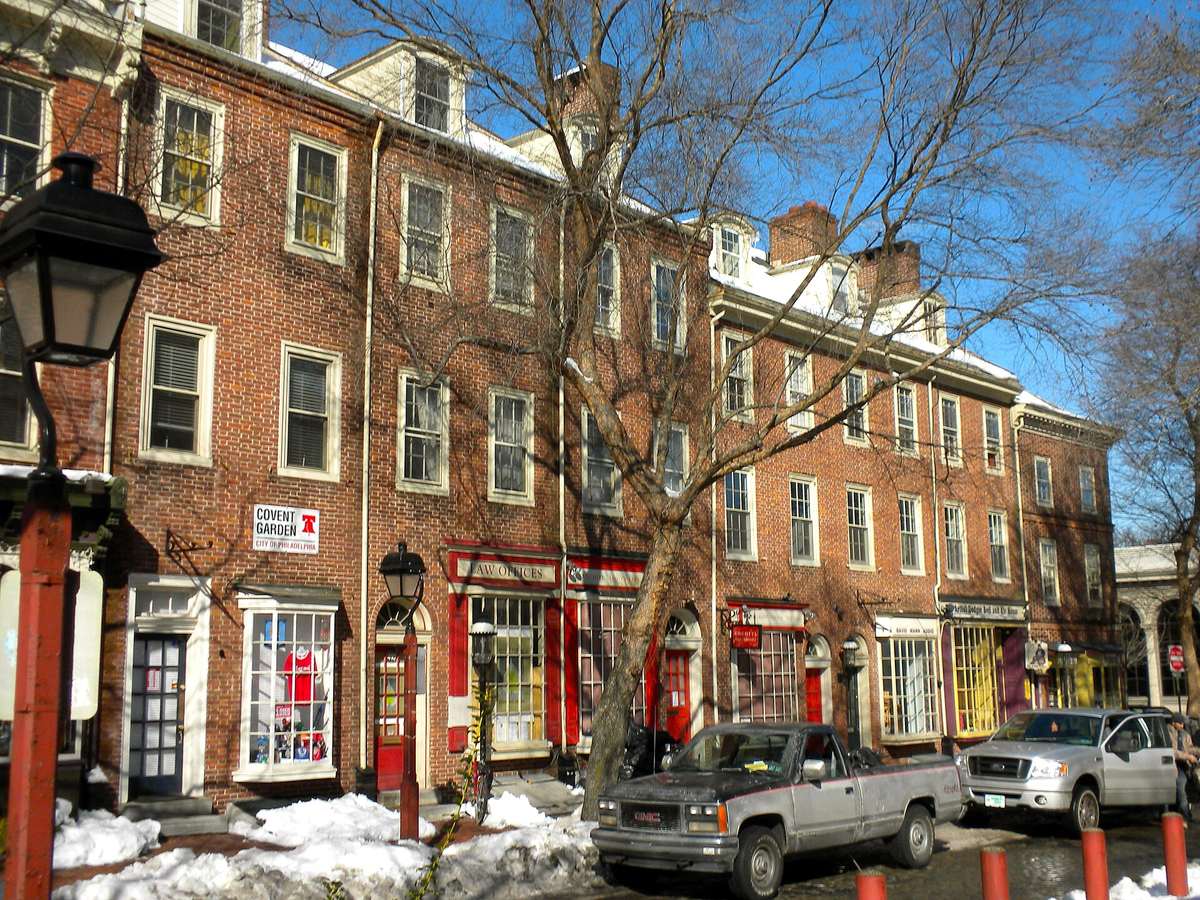
Society Hill is a historic residential neighborhood in Center City East, Philadelphia. Visit Philadelphia, the city's tourism bureau, places it from Walnut Street to Lombard Street and from 8th Street to the Delaware River, between Old City and the South Street Headhouse District. Expect cobblestone streets, leafy blocks and red-brick houses from the 18th and 19th centuries. Walking around is free at any hour; a few old houses run paid tours. Below: the history of Society Hill, what to see, how to get there on SEPTA and when the museums are open. More of the city is on the Philadelphia city page.
History of Society Hill: from "the Society's Hill" to urban renewal
The name comes from the Free Society of Traders, a London company that owned the land. According to the Society Hill Civic Association, the company's flag flew on the high ground above Dock Creek, and the area became known as "the Society's Hill."
The Encyclopedia of Greater Philadelphia (essay by George W. Dowdall) says William Penn landed in 1682 where Dock Creek met the Delaware. Merchants built warehouses along the creek to unload ships. A market with shambles opened on Second Street in 1745 and gained its Head House in 1804. In 1784 the city filled in the creek and created Dock Street. By the Revolution, the civic association writes, this was one of the most desirable residential sections of the prosperous city. The encyclopedia adds that the elite built freestanding mansions here, with tradesmen's homes farther inland.
Visit Philadelphia notes that the neighborhood was part of the former 7th Ward, a center of Black culture, and for much of the 18th and 19th centuries one of the nation's largest free Black communities. In the late 1800s, the encyclopedia says, Jewish immigrants settled in the southern half, with synagogues and community institutions.
By the mid-20th century the area had decayed into neglected houses mixed with factories and warehouses. Renewal began in 1957 under the plan of Edmund Bacon, head of the City Planning Commission: old houses were restored and new buildings needed the Redevelopment Authority's approval. The Dock Street market was torn down in 1959, and Society Hill Towers went up in its place: three 30-story towers by I.M. Pei with 720 apartments. The encyclopedia also records the cost: most African American renters were displaced and 31 acres of buildings were razed.
The district was listed on the National Register of Historic Places in 1971, and the Philadelphia Historical Commission designated Society Hill a historic district in 1999.
What to see in Society Hill
Powel House
Built in 1765 at 244 S. 3rd Street, it is one of the finest examples of Georgian architecture in the US, according to PhilaLandmarks, which owns it. Samuel Powel bought it in 1769; he was the last mayor under the British Crown and the first of the new republic. The Washington and Adams families were frequent guests, and "the house where George Washington danced" became the rallying cry that saved it.
Hill-Physick House
Built in 1786 at 321 S. 4th Street by Madeira wine importer Henry Hill, it is the only free-standing Federal townhouse left in Society Hill, PhilaLandmarks says. Surgeon Philip Syng Physick, "the father of American surgery," Pennsylvania Hospital's first Chief of Surgery and inventor of the stomach pump, lived here until his death in 1837.
Thaddeus Kosciuszko National Memorial
Kosciuszko fought in the American Revolutionary War and led the Polish uprising of 1794. The National Park Service says he was wounded, captured and imprisoned in the Peter and Paul Fortress in St. Petersburg on December 10, 1794. Tsar Paul I freed him and other Polish prisoners on condition of loyalty to Russia. He sailed from England for Philadelphia on August 18, 1797, took a room at Mrs. Relf's boarding house at 3rd and Pine late that year, and on May 5, 1798 boarded a ship at New Castle, Delaware, to return to Europe. The house at 301 Pine Street is now a small national memorial.
Washington Square and Mother Bethel
Washington Square, on Walnut Street between 6th and 7th, is part of Independence National Historical Park. NPS signage tells its past as a burial ground and gathering place, and it holds the Tomb of the Unknown Soldier of the American Revolution, designed by G. Edwin Brumbaugh in the 1950s. Mother Bethel AME Church at 419 S. 6th Street traces its story to 1791, when the congregation bought a small piece of land; the church runs the Richard Allen Museum.
The streets are the sight too: Visit Philadelphia suggests looking for hidden courtyards and pocket parks. For more ideas, see what to see in Philadelphia.
How to get there
- SEPTA's L (Market-Frankford Line): 2nd St and 5th St/Independence Hall stations on Market Street, a couple of blocks north of Walnut Street, where the neighborhood begins.
- Several SEPTA bus routes run through the area, with stops on Spruce and Pine Streets near 4th Street.
- By car: metered street parking, and a lot on Front Street between Lombard and South Streets, per Visit Philadelphia.
Schedules and station alerts are on septa.org.
Hours and tickets
The neighborhood itself has no gate and no tickets. Only the house tours charge.
| Place | Open | Price |
|---|---|---|
| Streets, Washington Square | 24 hours, every day | free |
| Powel House, Hill-Physick House | April to November, Thursday to Saturday, tours on the hour 11 am to 3 pm, Sundays from noon (last tour 3 pm); weekends only in March, a few days in December, by appointment in January and February | $10 adults, $8 students and seniors, $25 family, under 6 free |
| Kosciuszko Memorial, 301 Pine St | typically weekends only, spring through fall (NPS lists no hours) | free |
| Richard Allen Museum at Mother Bethel | first Saturdays 10 am to 3 pm, Sundays 11 am to 1 pm, tours also by appointment | tickets on the church's site |
Hours and prices checked November 18, 2026 on philalandmarks.org, nps.gov and motherbethel.org.
PhilaLandmarks hours change with the season and with private events, so check the visitor page on philalandmarks.org or call before you go: Powel House 215-627-0364, Hill-Physick House 215-925-7866. The Kosciuszko memorial keeps short hours; NPS suggests calling the Independence Visitor Center at 215-965-2305.
Tips for a walk
- Sidewalks are brick and cobblestone; Visit Philadelphia recommends comfortable shoes.
- This is a residential neighborhood. Look at the houses from the street and go inside only where tours run.
- From April to November, Thursday to Saturday is the best time: both PhilaLandmarks houses are open, on neighboring 3rd and 4th Streets.
Questions people ask
Why is it called Society Hill?
It is named for the Free Society of Traders, a London company that owned the land. According to the Society Hill Civic Association, the company's flag flew on the high ground above Dock Creek, so the surrounding area became known as "the Society's Hill."
How much does a Powel House tour cost?
According to PhilaLandmarks, admission to the Powel House at 244 S. 3rd Street is $10 for adults, $8 for students and seniors and $25 for a family, with children under 6 free. The Hill-Physick House charges the same, and tours run mainly from April to November.
What is the Russian connection in Society Hill?
Thaddeus Kosciuszko. The National Park Service says that after the Polish uprising of 1794 he was held in the Peter and Paul Fortress in St. Petersburg until Tsar Paul I freed him, and in 1797 and 1798 he lived at a boarding house at 3rd and Pine. It is now a free national memorial.
What is the closest SEPTA station to Society Hill?
The 2nd St and 5th St/Independence Hall stations on SEPTA's L (Market-Frankford Line), both on Market Street. From either one it is a short walk south to Walnut Street, the neighborhood's northern edge. SEPTA buses also run through the area.
Places on the map
Sources
- Society Hill Civic Association
- Society Hill history (Society Hill Civic Association)
- Society Hill (Visit Philadelphia)
- Society Hill, George W. Dowdall (Encyclopedia of Greater Philadelphia)
- Powel House (PhilaLandmarks)
- Hill-Physick House (PhilaLandmarks)
- Visitor info and hours (PhilaLandmarks)
- Kosciuszko biography (National Park Service)
- Plan your visit, Thaddeus Kosciuszko National Memorial (NPS)
- Fees, Thaddeus Kosciuszko National Memorial (NPS)
- Washington Square (Independence National Historical Park, NPS)
- Mother Bethel AME Church
- L stops, including 2nd St and 5th St/Independence Hall (SEPTA API)
- Bus stops near 3rd and Spruce, including Spruce St & 4th St and 4th St & Pine St (SEPTA API)