RussiansInUSA editorial team · Facts checked November 18, 2026 · Official site
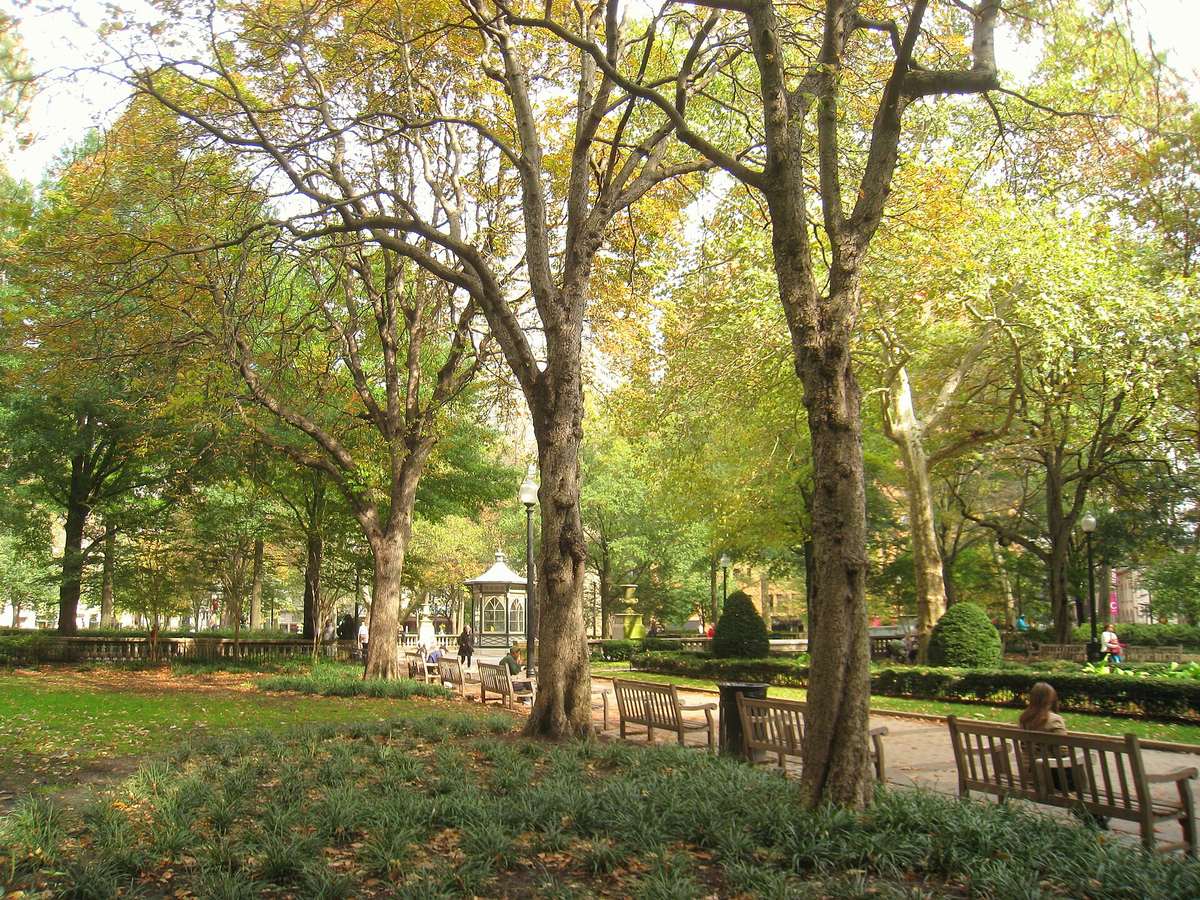
Rittenhouse Square is a six-acre public park in Center City Philadelphia, between 18th and 19th Streets, with Walnut Street along its north side. It is one of the squares laid out in William Penn's plan for the city and the best known park downtown: lawns, old trees, benches and bronze sculptures from the 19th and 20th centuries. Entry is free and there are no tickets. Below: its history, what to look for, how to get there on SEPTA and the city's park rules. More of the city is on the Philadelphia city page.
History of Rittenhouse Square: from Penn's plan to Cret's design
According to the Friends of Rittenhouse Square, the nonprofit that looks after it today, the square first appears in 1682 on William Penn's Plan of the City of Philadelphia. In the 18th century the land was part of a dense forest known as the Governor's Woods, cleared in the years before independence.
In 1816 neighbors began improving it with new lawns and a wooden fence to keep grazing animals out. In 1825 City Council named the square after David Rittenhouse, astronomer, inventor and the first Director of the U.S. Mint.
In the mid-19th century large mansions went up around the square, while immigrant and Black families lived on the narrow streets nearby. In the early 20th century the Rittenhouse Square Improvement Association formed to pay for a new design. In 1913 it hired architect Paul Philippe Cret, who had just completed the Benjamin Franklin Parkway. The Friends say his design remains largely unchanged today.
After the war, condominiums and co-operatives replaced most of the mansions. In the 1960s and 1970s the square became a gathering place for hippies, gay people and others pushed to the margins, alongside high society. Jane Jacobs praised its mix of people and uses in The Death and Life of Great American Cities (1961).
The Friends of Rittenhouse Square was founded in 1976, after renovations for the Bicentennial. The square is part of the Fairmount Park System and is run by Philadelphia Parks & Recreation in partnership with the Friends, who make yearly upgrades such as hanging flower baskets, benches and lighting.
What to see: the sculptures
The square itself is the sight: Cret's paths, lawns, trees and benches. For a visitor, the sculptures are the highlights. The details below come from the Association for Public Art.
Lion Crushing a Serpent
By French sculptor Antoine-Louis Barye. The model dates to 1832; this bronze was cast in 1891 and installed in 1892, the first sculpture placed in Rittenhouse Square. King Louis Philippe read the lion crushing a serpent as the monarchy defeating evil and made Barye a knight of the Legion of Honor in 1833. Auguste Rodin later studied with Barye.
Billy the goat
A bronze goat by Albert Laessle, 1914, modeled on a family goat. Eli Kirke Price II gave it to the city, and it has stood in the square since 1919. After a century of children climbing on it, the bronze wore thin, and a new cast was installed in September 2018.
Duck Girl
Paul Manship's 1911 bronze of a young woman in a Greek-style dress holding a duck. It won the Widener Gold Medal at the Pennsylvania Academy of the Fine Arts in 1914. It was first installed in Cloverly Park in 1916, damaged and put in storage in 1956, and moved to Rittenhouse Square in 1960 by the Rittenhouse Square Improvement Association.
The Friends' sculpture map marks every sculpture in the square, with the history of each. For other sights, see places to see in Philadelphia.
How to get to Rittenhouse Square on SEPTA
- T trolley lines (T1 and T3 among them) run in the tunnel under Market Street. The nearest stop is 19th St; from there walk a few blocks south on 19th Street.
- B1 (Broad Street Line): Walnut-Locust station on Broad Street. Walk west on Walnut Street to 18th Street.
SEPTA posts schedules and station alerts on septa.org.
Hours and entry
Rittenhouse Square is an open city park. There are no tickets, ticket desks or timed entries.
| What | Details |
|---|---|
| Entry | free |
| Hours | Philadelphia Parks & Recreation rules set a 10 pm curfew throughout the city park system |
| Dogs | on a leash no longer than 6 feet |
| Gatherings of 50 or more | need a city permit |
Hours and rules checked November 18, 2026 on phila.gov and friendsofrittenhouse.org.
The Friends hold their own events in the square, such as a holiday tree lighting; dates are on the event calendar on their site. Phone: 267-586-5675.
Park rules: what is not allowed
The Philadelphia Parks & Recreation rules apply here as in every city park:
- no alcohol, except at permitted events;
- no amplified sound without a special permit;
- no removing plants, animals or rocks;
- picnics, family reunions and other events need a permit from the Special Events Office, and fees apply;
- any meeting or assembly of 50 people or more needs a large event or festival permit;
- bikes stay on sidewalks and paths, never on the grass.
Planning a birthday on the lawn or a large group photo shoot? Start with an event permit from the city's Special Events Office; fees apply.
Questions people ask
Does it cost anything to visit Rittenhouse Square?
No. Rittenhouse Square in Philadelphia is an open city park in the Fairmount Park System, with free entry and no tickets. You pay only for a permit if you hold a picnic, party or event there, issued by the city's Special Events Office.
Who is Rittenhouse Square named after?
David Rittenhouse, the astronomer and inventor who was the first Director of the U.S. Mint. Philadelphia City Council gave the square his name in 1825. The square itself already appears on William Penn's 1682 plan of the city.
What is the closest SEPTA station to Rittenhouse Square?
The 19th St stop on SEPTA's T trolley lines, in the tunnel under Market Street, is a few blocks north of the square. From Walnut-Locust station on the B1 Broad Street Line, walk west on Walnut Street to 18th Street.
Can I bring my dog to Rittenhouse Square?
Yes, on a leash. Philadelphia Parks & Recreation rules require every dog in a city park to be on a leash no longer than 6 feet at all times, and off-leash pets are prohibited in all parks, Rittenhouse Square included.
Who designed Rittenhouse Square as it looks today?
Architect Paul Philippe Cret, who had just completed the Benjamin Franklin Parkway. The Rittenhouse Square Improvement Association hired him in 1913, and according to the Friends of Rittenhouse Square, his design remains largely unchanged today.
Places on the map
Sources
- Friends of Rittenhouse Square: about the square, events, contact
- History of Rittenhouse Square (Friends of Rittenhouse Square)
- Sculptures map (Friends of Rittenhouse Square)
- Rittenhouse Square, 18th and Walnut Streets (Visit Philadelphia)
- Lion Crushing a Serpent, Antoine-Louis Barye (Association for Public Art)
- Billy, Albert Laessle (Association for Public Art)
- Duck Girl, Paul Manship (Association for Public Art)
- Rules and regulations (Philadelphia Parks & Recreation)
- T1 stops, including 19th St (SEPTA API)
- B1 stops, including Walnut-Locust (SEPTA API)