RussiansInUSA editorial team · Facts checked November 18, 2026 · Official site
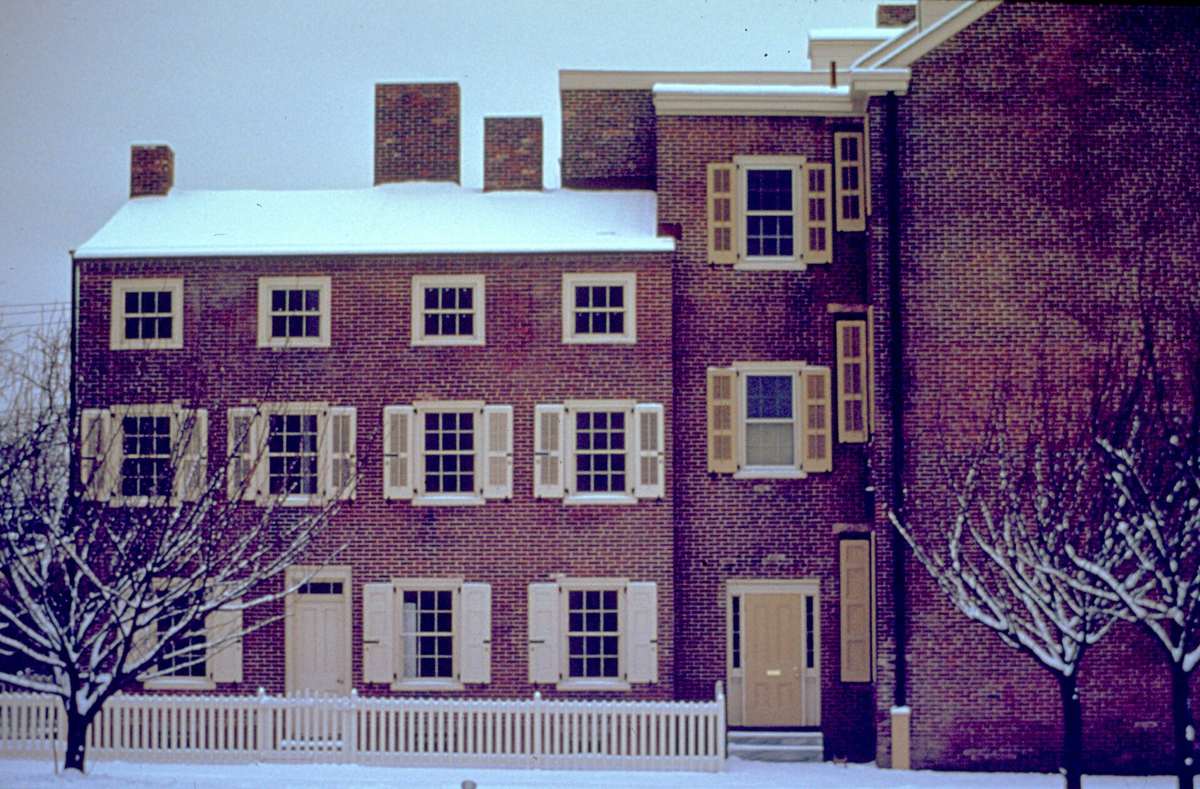
The Edgar Allan Poe National Historic Site in Philadelphia is the brick house at 532 N. 7th Street, between Spring Garden and Green Streets, about a mile north of Independence Hall. Poe lived here with his family in 1843 and 1844. He had five homes in Philadelphia, and this is the only one that survives. Entry is free, but the site is closed now: as of November 18, 2026, nps.gov says it is closed for a utilities improvement project and gives no reopening date. Below is the house's story, what is inside, how to get there and what the Park Service says about hours. More of the city is on our Philadelphia page.
History of the Poe house in Philadelphia
Poe moved to Philadelphia in 1838, after failing to find work in New York during the Panic of 1837. The National Park Service calls his six Philadelphia years his most productive and perhaps his happiest. He worked as an editor and critic at Graham's Magazine, one of the largest magazines in the country. "The Fall of the House of Usher" (1839), "The Murders in the Rue Morgue" (1841), "The Masque of the Red Death" (1842) and "Ligeia" (1838) all came out here, along with about 60 reviews.
In 1842 his wife Virginia was found to have tuberculosis. In spring 1843 the family rented a bright three-story brick house in Spring Garden, hoping the airy rooms would help her. Virginia's mother Maria Clemm, "Muddy" to the family, lived with them, and so did a cat named Catterina. The family left for New York on April 6, 1844. "The Raven" came out there a year later.
While Poe lived here, "The Gold-Bug" (1843, which won a $100 prize from the Dollar Newspaper), "The Black Cat" (1843) and "The Spectacles" (1844) were published. Money stayed short: failed magazine plans and Virginia's medical bills pushed him into bankruptcy.
The house passed through many owners. The Richard Gimbel Foundation for Literary Research bought it in 1933 and had the whole lot by 1937. The Park Service declared the house a National Landmark on January 4, 1963. After Gimbel died in 1970 the city accepted the house, and in November 1978 Congress established the national historic site. The Park Service took over in March 1980 and dedicated the site that June. New exhibits on Poe's life opened for his bicentennial in 2009. Independence National Historical Park runs the site today.
What to see at the Poe house
The rooms are left unfurnished. Instead of restoring them, the Park Service hung large painted canvases that show how each room may have looked. When the site is open you can tour it on your own or with a ranger, and there is an exhibit area and a shop.
| Where | What to look for |
|---|---|
| Beside the house | A bronze raven with an 8-foot wingspan on a 12-foot steel pedestal, sculpted by David Caccia in 1980 |
| Parlor, first floor | The original floor, a marble mantel and the word "death" carved into the plaster by the kitchen door (nobody knows who carved it) |
| Poe's room, second floor | Where he may have written "The Gold-Bug" |
| Muddy's room, third floor | A loose floorboard that recalls "The Tell-Tale Heart" |
| Cellar | A false chimney; the Park Service asks whether it inspired the walled-up victim in "The Black Cat" |
| Reading room | A re-creation of the room Poe describes in his satirical 1840 essay "The Philosophy of Furniture" |
The house had no electricity or running water, like most middle-class Philadelphia homes of the 1840s; Muddy cooked on a wood stove. In the parlor Poe tried to win backers for The Stylus, the magazine of his own he never managed to launch.
How to get to the Poe house
The address is 532 N. 7th Street, Philadelphia, PA 19123, on the left side of 7th Street going north, just before Green Street.
- SEPTA bus 47 runs north on 7th Street. From the Independence Visitor Center (6th and Market), walk one block west to 7th and board the 47; get off at 7th St & Green St.
- SEPTA Metro L (formerly the Market-Frankford Line) to Spring Garden station, then walk five blocks west to 7th Street, turn right, and the site is on the left before Green Street.
- On foot from the Independence Visitor Center (6th and Market) it is nearly a mile; the Park Service suggests 30 minutes and recommends 4th Street north to Spring Garden, then west to 7th, to avoid the Vine Street Expressway.
- By car: the Park Service says street parking is usually available nearby. Keep valuables out of sight.
Driving routes from each direction are on the nps.gov directions page. Nearby sights are on our Philadelphia places page.
Hours and tickets
| What the Park Service says | |
|---|---|
| Now | Closed for a utilities improvement project, no reopening date given |
| Hours when open | Friday to Sunday, 9 am to 12 pm and 1 pm to 5 pm (closed 12 to 1) |
| Admission | Free, no pass required |
| Reservations | Not needed for families; recommended for groups of 10 or more; required for school groups, paused until the site reopens |
Hours and prices checked November 18, 2026 on nps.gov. The hours come from the site's FAQ and may change when it reopens. Before you go, check the site's home page or call 215-965-2305.
Tips before you go
The house is away from the historic district, nearly a mile from the Liberty Bell, so plan it as a bus ride on the 47 rather than part of an Old City walk. It opens only three days a week and closes for lunch, so a weekend morning is the safest bet. If you cannot get there, the Park Service's room-by-room house layout walks you from the parlor down to the cellar.
Questions people ask
How much does it cost to visit the Edgar Allan Poe house in Philadelphia?
Nothing. The National Park Service says there is no admission fee and no pass is required. Families do not need reservations, groups of 10 or more are encouraged to book ahead, and school field trips go only by reservation.
Is the Poe National Historic Site open now?
Not as of November 18, 2026. Nps.gov says the house is closed for a utilities improvement project and gives no reopening date. Check the site's home page on nps.gov or call the park at 215-965-2305 for news.
How long did Poe live in this house?
About a year, from spring 1843 until April 6, 1844, when the family left for New York. Poe spent six years in Philadelphia and lived at five addresses, but the house at 532 N. 7th Street is the only one still standing.
Which works did Poe publish while living here?
According to the National Park Service, "The Gold-Bug" (1843), "The Black Cat" (1843) and "The Spectacles" (1844) came out while he lived here. His best-known Philadelphia stories, "The Fall of the House of Usher" and "The Murders in the Rue Morgue", were written earlier at other addresses in the city.
Where is Edgar Allan Poe buried?
In Baltimore, at Westminster Burial Ground. Poe died there on October 7, 1849, at the age of 40, while traveling from Richmond back to New York. There is no Poe grave in Philadelphia.
Places on the map
Sources
- Edgar Allan Poe National Historic Site (NPS, official site)
- Operating Hours & Seasons (NPS)
- Basic Information (NPS)
- Frequently Asked Questions (NPS)
- Fees & Passes (NPS)
- Directions (NPS)
- The Layout of the House (NPS)
- The House Through the Years (NPS)
- Poe's Most Productive Years (NPS)
- Edgar Allan Poe (NPS)
- Route 47 stops: 7th St & Green St (SEPTA)
- L1 stops: Spring Garden (SEPTA)
- Poe-se with the Raven (NPS)
- Visit the Reading Room (NPS)
- The Poe House (NPS)
- Alerts & Conditions: Site Closure for Utilities Improvement Project (NPS)