RussiansInUSA editorial team · Facts checked November 18, 2026 · Official site
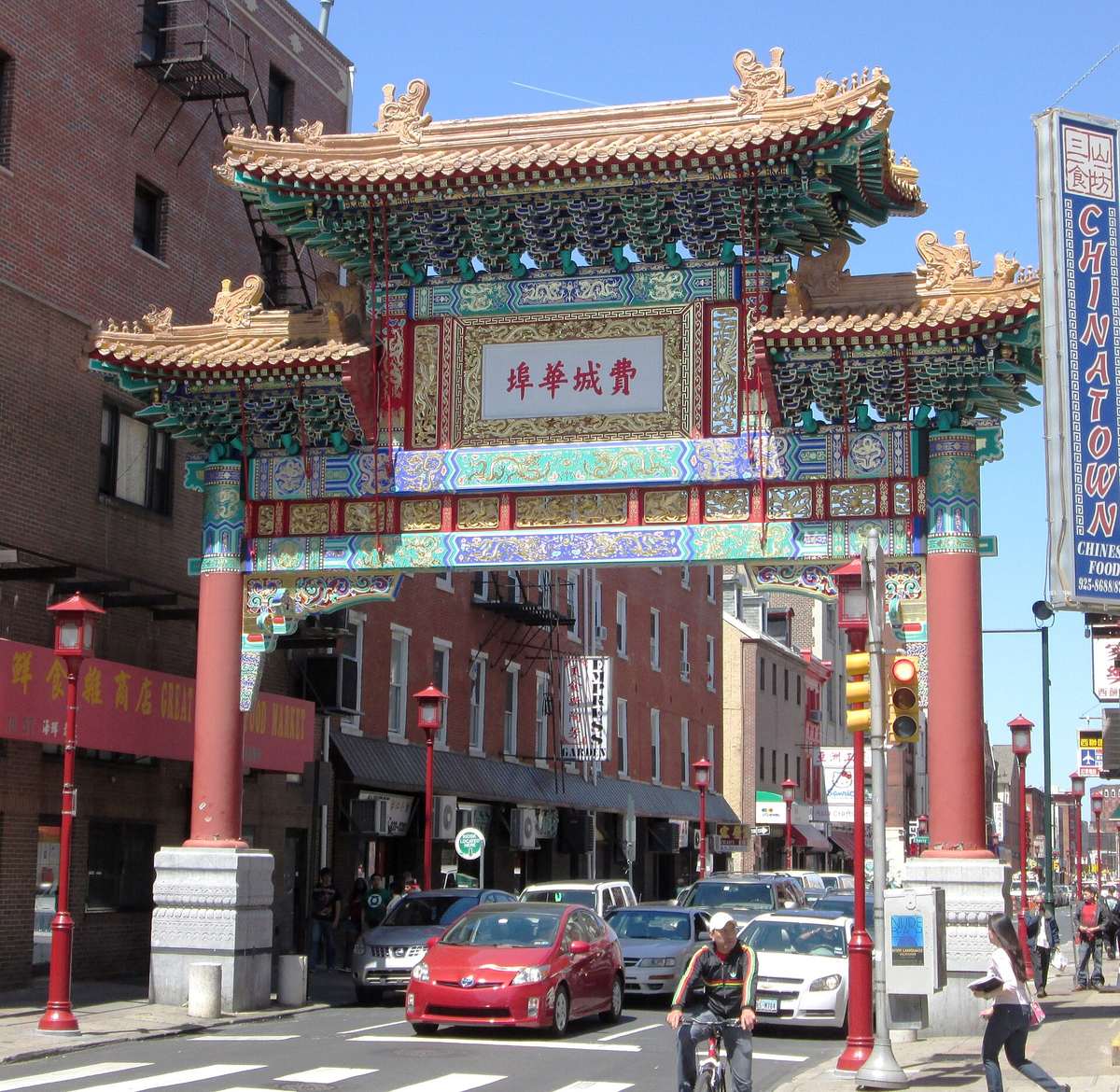
Chinatown in Philadelphia is a neighborhood in Center City, just north of Market Street. Visit Philly, the city's tourism organization, says it is centered on 10th and Arch streets, where the painted Friendship Gate stands. The neighborhood dates to 1871, and people come for Cantonese, Vietnamese, Korean and Japanese food, Lunar New Year celebrations and a walk under the gate. There is no ticket and no entry fee: these are city streets. Below: the neighborhood's history, what to see, how to get there on SEPTA and where to park. More of the city is on our Philadelphia city page.
History of Philadelphia's Chinatown
Chinese migrants began settling in Philadelphia in the 1870s. Historian Kathryn Wilson writes in the Encyclopedia of Greater Philadelphia that many were leaving the American West, where Chinese communities were being violently driven out. According to the Philadelphia Chinatown Development Corporation (PCDC), Chinatown began with Lee Fong's hand laundry at 913 Race Street in 1871. The first restaurant, Mei Hsiang Lou, opened at the same address in 1880. In 2010 the Pennsylvania Historical and Museum Commission dedicated a marker there.
The encyclopedia says the Chinese Exclusion Act of 1882 let only merchants bring their families, creating a "bachelor society" in which families were kept apart. In 1898 Rev. Lee Hong founded the First Chinese Baptist Church at 1006 Race Street. In October 1941 Holy Redeemer Chinese Catholic Church was dedicated at 10th and Vine streets, paid for entirely by donations. After World War II, looser immigration rules let men bring their wives from China, and Chinatown became a neighborhood of families.
Between 1940 and 1980 it grew north to Wood Street, south to Arch Street, and from 8th to 12th Street. The Hart-Celler Act of 1965 lifted the limits on Asian immigration; immigrants from Hong Kong arrived in the 1970s and Vietnamese refugees, many of them ethnically Chinese, in the 1980s.
The neighborhood has fought for its survival more than once. In 1966 the state unveiled plans for the Vine Street Expressway, which would have razed Holy Redeemer church and school. Residents met on March 27, 1966, and the committee they formed was incorporated as PCDC in 1969, with George Moy as its first president; the encyclopedia credits Cecilia Moy Yep alongside him. In July 1973 young people climbed a rubble pile at 10th and Winter streets in protest, and legal challenges held up the highway for more than a decade. The church still stands. Later the community opposed a federal detention center at 8th and Vine (in 1994 it went closer to the federal courthouse instead) and a baseball stadium at Vine Street announced in 2000, which was built in South Philadelphia.
Today Chinatown is a pan-Asian neighborhood. The encyclopedia says about 74 percent of its businesses are small or local, many restaurants are family-owned, and it remains a first stop for new immigrants. PCDC, active since 1966, works to keep Chinatown a residential and business community; its office is at 301-305 North 9th Street.
What to see in Chinatown
The Friendship Gate stands at 10th and Arch streets. Visit Philly describes it as about 40 feet tall, in traditional Qing Dynasty style, designed by Sabrina Soong. PCDC's timeline says the agreement with Tianjin, Philadelphia's sister city in China, was reached in November 1982, twelve Chinese artisans arrived in October 1983, and the gate was dedicated in January 1984. Its tiles came from Tianjin. It was restored in 2008.
10th Street Plaza is, in PCDC's words, Chinatown's first dedicated public space, with pergolas and two 8-foot granite foo dogs (guardian lions) shipped from China.
Murals. Arturo Ho painted "History of Chinatown" in 1995 for the neighborhood's 125th anniversary. Mural Arts Philadelphia says new construction hid the original on 10th Street and that Chenlin Cai recreated it at 217 North 9th Street; look for the large hands telling developers to stop. "The Past Supporting the Future" covers more than 100 feet of the west wall of the Crane Chinatown Community Center, which opened in 2019.
Holy Redeemer Church at 10th and Vine is the building the neighborhood saved from the expressway.
Food. Visit Philly lists Sang Kee Peking Duck House, Dim Sum Garden, Ocean City and Mayflower Bakery among many others, and names Reading Terminal Market and LOVE Park as nearby. Both are on our list of places to see in Philadelphia.
Festivals. PCDC lists yearly celebrations: Lunar New Year (January or February), the Dragon Boat Festival, the Mid-Autumn Festival and the YèShì Chinatown Night Market in October. PCDC posts the dates on its site.
How to get to Chinatown on SEPTA
Line and station names as listed by SEPTA:
| Mode | Line | Station |
|---|---|---|
| Subway | B3 (Broad-Ridge Spur) | Chinatown, 8th-Market |
| Subway | L1 (Market-Frankford) | 8th-Market, 13th St |
| Commuter rail | Regional Rail | Jefferson Station |
Visit Philly notes that Chinatown is an easy walk from Jefferson Station.
Hours, tickets and parking
| What | How it works |
|---|---|
| The neighborhood | Free, public streets |
| Friendship Gate, 10th Street Plaza, murals | Outdoors, no tickets |
| Restaurants and shops | Each sets its own hours; check its site |
| Discount parking | AutoPark at the Fashion District, 44 North 9th Street, with a voucher from a participating business |
Hours and prices checked on November 18, 2026 at chinatown-pcdc.org and visitphilly.com. PCDC keeps the parking terms and the list of businesses that hand out vouchers on its Chinatown Visitor Discount Parking Program page; terms can change, so check before you drive.
Tips before you go
Visit Philly warns that some shops take cash only, so bring some. If you drive, take a ticket at the AutoPark entry gate and ask a business on PCDC's list for a voucher; without one, regular rates apply. Visit Philly says Lunar New Year parades come through in winter. Start your walk at the gate on 10th and Arch.
Questions people ask
Where is the Friendship Gate in Philadelphia's Chinatown?
The Friendship Gate stands at 10th and Arch streets in Center City. It was dedicated in January 1984, built with artisans from Tianjin, Philadelphia's sister city in China, and is about 40 feet tall. It sits over a public street, so you can walk under it any time for free.
When did Philadelphia's Chinatown begin?
According to the Philadelphia Chinatown Development Corporation, Chinatown began with Lee Fong's hand laundry at 913 Race Street in 1871. The first Chinese restaurant opened at the same address in 1880, and the Pennsylvania Historical and Museum Commission placed a marker there in 2010.
Which SEPTA station is closest to Chinatown?
The B3 Broad-Ridge Spur has a station called Chinatown. The 8th-Market station serves both B3 and L1 trains, and 13th St is on the L1. Regional Rail trains stop at Jefferson Station, which Visit Philly describes as an easy walk from the neighborhood.
Where can I park in Chinatown?
The Philadelphia Chinatown Development Corporation runs a discount parking program at the AutoPark at the Fashion District garage, 44 North 9th Street. Take a ticket at the entry, ask a participating restaurant or shop for a voucher, and pay the discounted rate. The terms and the business list are on chinatown-pcdc.org.
Places on the map
Sources
- Welcome to Chinatown (Philadelphia Chinatown Development Corporation)
- History and timeline (Philadelphia Chinatown Development Corporation)
- About us (Philadelphia Chinatown Development Corporation)
- Chinatown Visitor Discount Parking Program (PCDC)
- Chinatown, Kathryn Wilson, Encyclopedia of Greater Philadelphia (Rutgers University-Camden)
- A Guide to Chinatown (Visit Philly)
- Chinatown Friendship Gate (Visit Philly)
- History of Chinatown mural (Mural Arts Philadelphia)
- B3 stops, including Chinatown and 8th-Market (SEPTA API)
- L1 stops, including 8th-Market and 13th St (SEPTA API)
- Jefferson Station departures (SEPTA API)