RussiansInUSA editorial team · Facts checked November 18, 2026 · Official site
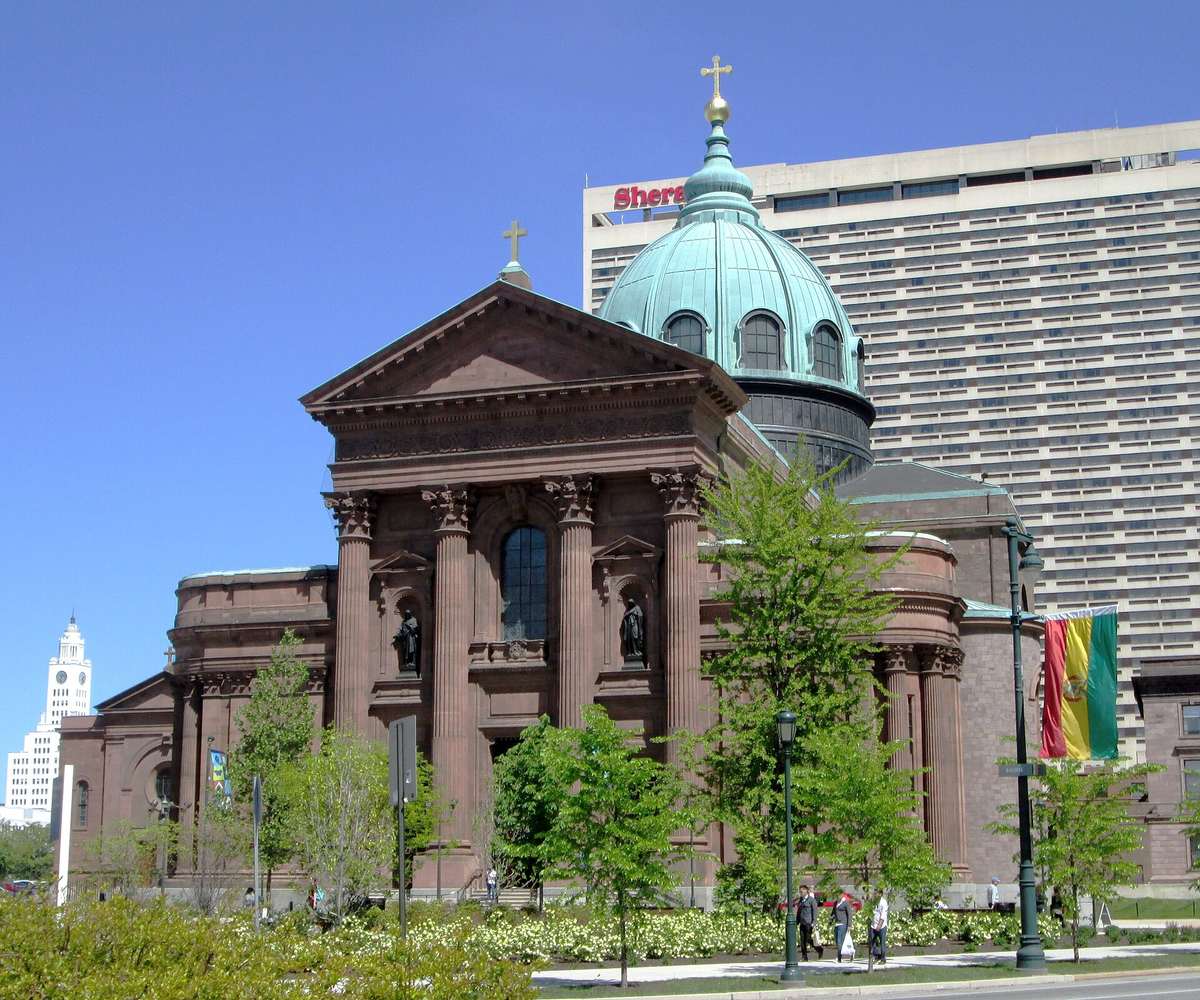
The Cathedral Basilica of Saints Peter and Paul in Philadelphia is the mother church of the Catholic Archdiocese of Philadelphia, at 18th Street and the Benjamin Franklin Parkway in Center City. It is open every day, its site lists no admission fee, and inside you can see a dome painted by Constantino Brumidi and the tomb of Saint Katharine Drexel, a Philadelphia-born saint.
History of the cathedral, from the 1844 riots to papal visits
Bishop Francis Kenrick began planning a great cathedral after the anti-Catholic riots of 1844 in Kensington. Two Vincentian priests, Fathers Mariano Maller and John Tornatore, drew the first sketches. The land was bought in 1845 for $37,200, and on June 29, 1846, Kenrick issued a pastoral letter asking for funds. His rule: no work without the money to pay for it.
The cornerstone was laid on September 6, 1846. Philadelphia-born architect Napoleon LeBrun designed the building and left in 1851 after a disagreement with the bishop. John Notman took over and left in 1857 over his fees. John Mahoney then managed the work until LeBrun came back around 1860. Bishop John Neumann kept construction going, and from 1857 Bishop James Wood was charged with finishing it.
The cross went up on the dome on September 14, 1859. Wood dedicated the finished cathedral on November 20, 1864, and Archbishop Patrick John Ryan consecrated it on June 29, 1890. Windows sit only at the clerestory level, which the cathedral says was most likely out of concern over potential anti-Catholic violence.
A complete renovation in 1914 under Archbishop Edmond Prendergast brought painted interior walls, a new white marble high altar and copper on the roof and dome. In 1956-1957, under John Cardinal O'Hara, a semicircular apse extended the sanctuary.
The cathedral was listed on the National Register of Historic Places in 1971. It hosted the 41st International Eucharistic Congress in August 1976, and on September 9, 1976, Pope Paul VI named it a minor basilica. Pope John Paul II visited on October 3, 1979, and Pope Francis celebrated Mass here in September 2015 during the World Meeting of Families. It is a working parish with Mass every day.
What to see inside
LeBrun modeled the cathedral on the Church of San Carlo al Corso in Rome. Bishop Kenrick did not care for Gothic, so the building is Neo-Classical, in Connecticut and New Jersey brownstone under a copper dome. It is about 300 feet long and 209 feet high to the top of its gold cross.
- The dome: Brumidi's fresco The Assumption of the Blessed Virgin (1862), 156 feet above the floor. Brumidi painted much of the interior.
- The nave: 236 feet long and 50 feet wide under an 80-foot vaulted ceiling, with walnut pews for more than 1,000 people.
- The baldachin: a canopy of antique Italian marble 38 feet high, topped by bronze panels, with a marble mosaic of the Holy Spirit as a dove on its underside.
- The apse: stained glass by Connick of Boston between six Verte Imperial marble columns.
- The Shrine of Saint Katharine Drexel. Born in Philadelphia on November 26, 1858, she founded the Sisters of the Blessed Sacrament on February 12, 1891, and served Black and Native American communities. She died on March 3, 1955, and was canonized on October 1, 2000. Her remains came to the cathedral on August 2, 2018, and her tomb was installed on November 18, 2018. You can pray there during cathedral hours.
- A reliquary of Saint Therese of Lisieux and her parents, Saints Louis and Zelie Martin.
The burial crypt beneath the main altar, where Philadelphia's first bishops Conwell and Egan and Cardinals Dennis Dougherty and Anthony Bevilacqua lie, is not open to the public.
How to get to the cathedral
The cathedral is at 18th Street and the Benjamin Franklin Parkway; the parish mailing address is 1723 Race Street, Philadelphia, PA 19103.
- SEPTA Metro B (formerly the Broad Street Line): Race-Vine station, then a few blocks west.
- SEPTA Metro L (formerly the Market-Frankford Line): 15th St/City Hall station, then walk north.
- T trolleys: the underground 19th St station on Market Street.
- Buses: route 2 (17th St & Race St), 32 (18th St & Vine St) and 33 (19th St & Cherry St).
- Regional Rail: Suburban Station is the closest rail station.
Parking: on Saturdays, Sundays and Holy Days, visitors may use the lot next to the cathedral, entered from 17th Street (222 North 17th Street). Other options are street parking, the Gateway Parking Garage at Spring and 16th Streets and the Sheraton garage between 16th and 17th Streets.
Wheelchair access is limited. Three entrances have ramps, but only the door off the main parking lot has an automatic push button.
Hours and admission
| Day | Cathedral hours |
|---|---|
| Monday-Friday | 7 am-5 pm |
| Saturday | 9 am-6:30 pm |
| Sunday | 8 am-7:30 pm |
| Federal holidays | only the Cathedral Chapel, for 9 am Mass |
| Mass | Time and place |
|---|---|
| Monday-Friday | 7:15 am and 12:05 pm, Cathedral Chapel |
| Saturday | 12:05 pm, Chapel; 5:15 pm Sunday anticipated Mass, Basilica |
| Sunday | 8, 9:30 and 11 am and 6:30 pm in the Basilica; 12:30 pm Spanish Mass in the Chapel |
Hours checked November 18, 2026 on cathedralphila.org.
The site lists no admission fee. The Drexel shrine page gives weekday hours of 7:30 am to 5 pm. The 11 am Sunday Mass is livestreamed. The Cathedral Shop is to the right of the main altar, with hours listed for Wednesday, Saturday and Sunday. Check the visitor information page before you go.
Tips before you visit
- Guided tours follow the 11 am Sunday Mass, meeting at the Side Altar of the Sacred Heart, right of the main sanctuary. They run on a very limited basis and not when other events are on. For a Sunday or private tour, email cathedral.ambassadors@gmail.com or call the parish office at 215-561-1313.
- For a self-guided visit, brochures sit by the Cathedral Shop entrance, and a printable PDF is on the site. A Cathedral Ambassador is in the Basilica most days to answer questions.
- Groups need no reservation, but the cathedral asks you to email your date and time; during other events you may not be able to walk around freely.
- Photography rules can change with services; be respectful of people praying and follow posted instructions.
The cathedral pairs well with other stops along the Parkway. See the Philadelphia places page for more sights and the Philadelphia city page for the full picture.
Questions people ask
Is the Cathedral Basilica in Philadelphia free to visit?
The cathedral's own site, cathedralphila.org, lists no admission fee. The Basilica is open Monday to Friday 7 am to 5 pm, Saturday 9 am to 6:30 pm and Sunday 8 am to 7:30 pm. On federal holidays only the Cathedral Chapel opens, for the 9 am Mass.
Where is Saint Katharine Drexel buried?
Saint Katharine Drexel's remains were moved to the Cathedral Basilica of Saints Peter and Paul in Philadelphia on August 2, 2018, and her tomb was installed there on November 18, 2018. Visitors can pray at the tomb during cathedral hours without an appointment; groups are asked to contact the shrine in advance.
Can you visit the crypt?
No. The burial crypt beneath the main altar of the Cathedral Basilica is not open to the public. It holds Philadelphia's first two bishops, Conwell and Egan, moved there in 1869, and Cardinals Dennis Dougherty and Anthony Bevilacqua.
Does the cathedral offer tours?
Guided tours are given after the 11 am Sunday Mass, meeting at the Side Altar of the Sacred Heart, but only on a very limited basis and not during other events. Arrange a Sunday or private tour by emailing cathedral.ambassadors@gmail.com or calling 215-561-1313. Brochures for a self-guided visit are by the Cathedral Shop.
Places on the map
Sources
- Cathedral Basilica of Saints Peter and Paul: home page, hours and Mass times
- About the Cathedral (history, art, dimensions)
- Visitor Information (tours, groups, parking, shop)
- Shrine of Saint Katharine Drexel
- Shrine of Saint Katharine Drexel: Our Inspiration
- Saint Katharine Drexel (biography)
- Shrine of Saint Katharine Drexel: FAQs
- SEPTA stops API: Metro B stations
- SEPTA stops API: Metro L stations
- SEPTA stops API: T trolley stations
- SEPTA Regional Rail arrivals: Suburban Station
- SEPTA stops API: bus route 2
- SEPTA stops API: bus route 32
- SEPTA stops API: bus route 33