RussiansInUSA editorial team · Facts checked November 18, 2026 · Official site
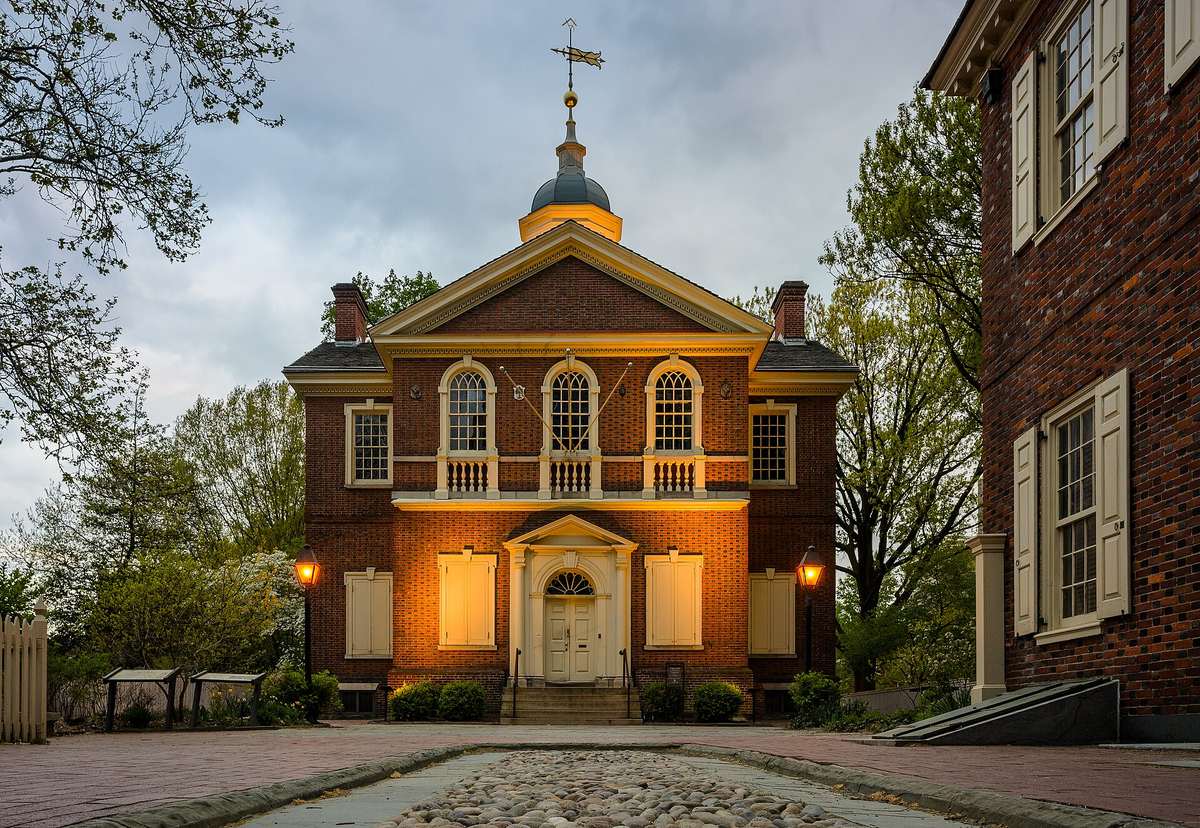
Carpenters' Hall in Philadelphia is a two-story brick building from the 1770s at 320 Chestnut Street in Old City, a few blocks from Independence Hall. A builders' guild, the Carpenters' Company, put it up, and the First Continental Congress met here in September 1774. Entry is free. Below: its history, what to see inside, how to get there on SEPTA and the opening hours. More places in the city are on the Philadelphia city page.
History of Carpenters' Hall
The Carpenters' Company of the City and County of Philadelphia was founded in 1724 and incorporated in 1790. The Company says it was patterned on the Worshipful Company of Carpenters of London. Despite the name, its members are not working carpenters but architects, building contractors and structural engineers; there are about 215 of them now, and more than 900 over three centuries.
The Company bought the lot on Chestnut Street on February 3, 1768, voted on New Year's Day 1770 to build, and started work on February 5, 1770. Robert Smith, a Scottish-trained architect and builder, led a 12-man construction committee and was charged with the design. The hall was meant to show off the members' skill and to earn rent. It has two stories on a plan 50 feet square with 10-foot cutouts at each corner, and its 13-inch brick outer walls carry most of the weight. The Company first met in the hall on January 21, 1771, while it was still being built.
Renting the space put the hall at the center of events. Benjamin Franklin's Library Company took the second floor in 1773 and stayed 17 years. From September 5 to October 26, 1774, the First Continental Congress met here, with delegates from 12 of the 13 colonies. Peyton Randolph of Virginia presided; Samuel and John Adams and John Dickinson were among the delegates. The Congress listed the colonies' grievances, sent a petition to King George III and formed the Continental Association, an agreement to stop importing British goods, which nearly all the delegates signed.
From June 18 to 25, 1776, the Pennsylvania Provincial Conference met in the hall: 103 elected delegates declared Pennsylvania an independent state and sent that document to the Second Continental Congress just before the Declaration of Independence was adopted. That is why the Company calls the hall the birthplace of Pennsylvania. Robert Smith fell ill after working on river fortifications at Billingsport, New Jersey, and died in February 1777.
Hospital, banks and the Franklin Institute
In 1776-1778 the hall served as an infirmary, first for American and then for British soldiers; the Company's timeline dates the British occupation from September 26, 1777 to June 18, 1778. After the war the rooms were let again: to the American Philosophical Society (from 1780), the Bank of North America (1791-1793), the Bank of the United States (1794-1797), the Philadelphia Customs House (1801-1817), the Second Bank of the United States (1816-1821) and the Franklin Institute (1824-1826). The timeline also records a robbery of the Bank of Pennsylvania, then a tenant, on September 2, 1798. The longest tenant was the C.J. Wolbert & Co. auction house, from 1828 to 1857.
In 1857 the Company repaired the building and opened it to the public. Its timeline gives April 15, 1970 as the date the hall was declared a National Historic Landmark. An inspection in the 1970s found dangerous stress cracks in the roof trusses, overloaded by bookcases added in the 1850s; in 1980 a steel framework went into the attic to carry the load to the four inside corners. Queen Elizabeth II visited on July 6, 1976.
What to see at Carpenters' Hall
Start outside. Approaching from Chestnut Street, New Hall, now a military museum, is on your right; the Company built it in 1790-1791 as more rental space. On Carpenters' Hall itself, look for the three flags by the upstairs window, the fire marks and the Flemish bond brickwork.
The front hall shows carpenters' tools and portraits and photographs of Company members. In the main room:
| What | Why look |
|---|---|
| Speaker's chair | Peyton Randolph's original chair from the First Continental Congress, plus a replica you may sit in |
| Windsor chairs | Chairs used by the delegates in 1774 |
| Gilded boards | Every member of the Company; the left column names the master builders of colonial Philadelphia |
| Washington portrait | Over the entrance, a copy of Gilbert Stuart's portrait by his daughter Jane Stuart |
| Banners | One carried in the parade for ratifying the Constitution, one in the parade for Washington's birth centennial |
| Model of the hall | Built over two years at the Hagley Museum to show 18th-century scaffolding, joinery and brickwork |
| Officers' room | Furniture from about 1890, still used for the Company's quarterly meetings, and a Minton tile floor |
The fan window on the south wall went in during the early 1790s, about 20 years after construction began. Nearby sights are on the places to see in Philadelphia page.
How to get to Carpenters' Hall
The address is 320 Chestnut Street, Philadelphia, PA 19106. The easiest way is SEPTA's L (formerly the Market-Frankford Line): the nearest stations are 2nd St and 5th St/Independence Hall. Schedules and station alerts are on the L1 page. The hall sits back from the street; you reach it from Chestnut Street past New Hall.
Hours and tickets
| Day | Hours | Entry |
|---|---|---|
| Tuesday to Sunday | 10 am to 4 pm | free |
| Monday | closed year-round | |
| Tuesday in January and February | closed | |
| Thanksgiving, Christmas, New Year's Eve, New Year's Day | closed |
Hours and prices checked November 18, 2026 on carpentershall.org.
No ticket is needed. Check the hours page before you go, especially in winter and around holidays. The hall sometimes closes for private events; the Company lists those days on its home page. Phone: 215-925-0167. The Company's site has a self-guided walking tour and a what you'll see page worth opening beforehand.
Questions people ask
Is Carpenters' Hall free to visit?
Yes. The Carpenters' Company says Carpenters' Hall at 320 Chestnut Street in Philadelphia is open free to the public from 10 am to 4 pm. There are no tickets to buy; you simply walk in during opening hours.
When is Carpenters' Hall closed?
Carpenters' Hall is closed on Mondays all year and also on Tuesdays in January and February. It is closed on Thanksgiving, Christmas, New Year's Eve and New Year's Day. On other days it opens from 10 am to 4 pm.
What happened at Carpenters' Hall in 1774?
The First Continental Congress met there from September 5 to October 26, 1774, with delegates from 12 of the 13 colonies and Peyton Randolph presiding. It sent a petition to King George III and agreed on a boycott of British goods, the Continental Association.
Why is Carpenters' Hall called the birthplace of Pennsylvania?
From June 18 to 25, 1776, the Pennsylvania Provincial Conference met in the hall. Its 103 delegates declared Pennsylvania an independent state and sent that document to the Second Continental Congress just before the Declaration of Independence was adopted.
Which subway station is closest to Carpenters' Hall?
The nearest stations on SEPTA's L (formerly the Market-Frankford Line) are 2nd St and 5th St/Independence Hall. Carpenters' Hall sits back from the street at 320 Chestnut Street in Old City; you reach it by the walkway from Chestnut Street past New Hall.
Places on the map
Sources
- Location, Hours, & Contact (Carpenters' Hall)
- Story of Carpenters' Hall (Carpenters' Company)
- Timeline (Carpenters' Company)
- Tenants of Carpenters' Hall (Carpenters' Company)
- Architectural History (Carpenters' Company)
- What You'll See (Carpenters' Hall)
- During Your Visit (Carpenters' Hall)
- FAQ (Carpenters' Hall)
- Delegates of the First Continental Congress (Carpenters' Company)
- About the Company (Carpenters' Company)
- L1 stops: 2nd St, 5th St/Independence Hall (SEPTA)
- L1 schedules (SEPTA)
- Carpenters' Hall (official site)
- The First Continental Congress (Carpenters' Company)
- SEPTA Metro: line names (SEPTA)