RussiansInUSA editorial team · Facts checked November 18, 2026
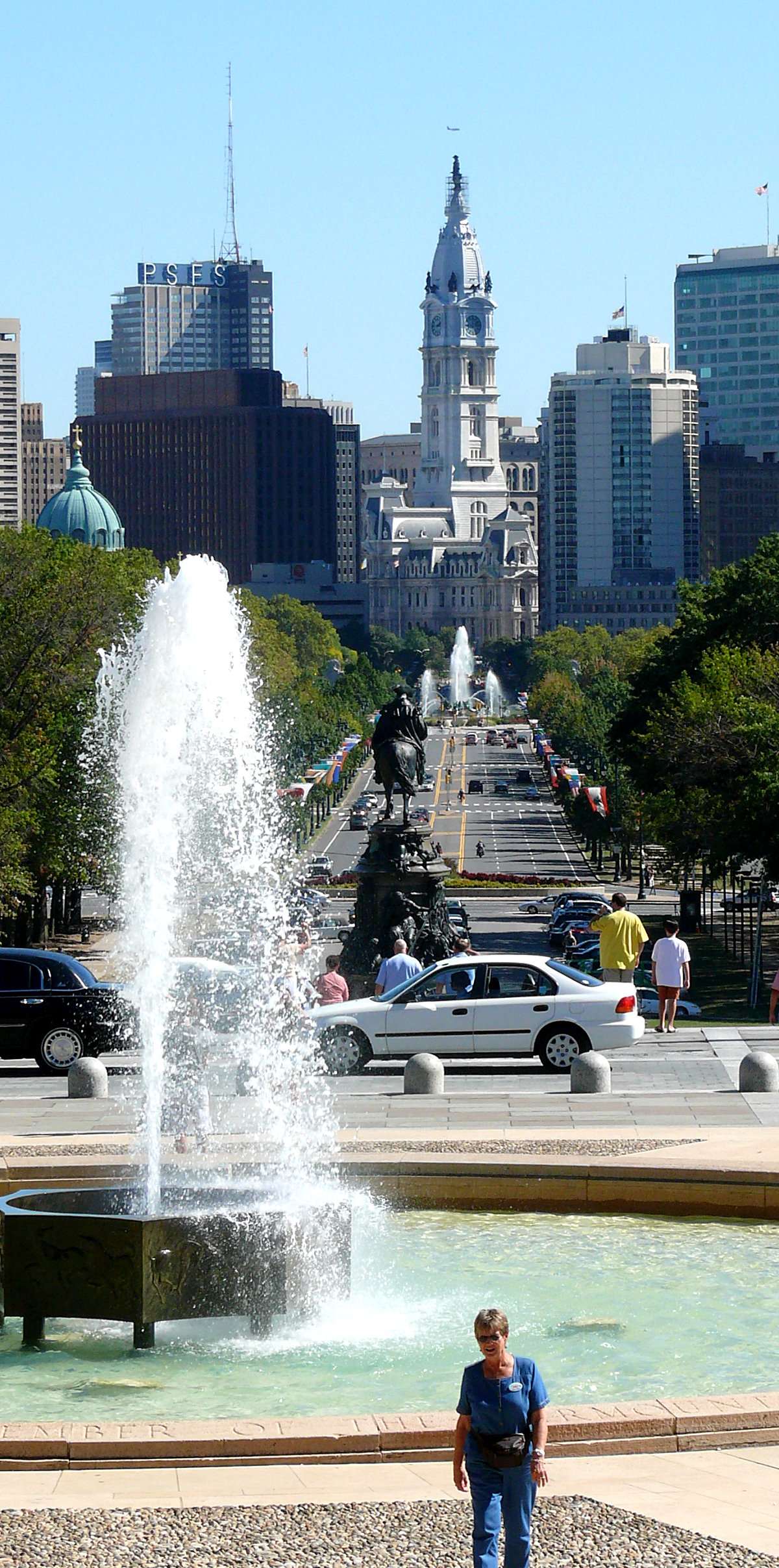
The Benjamin Franklin Parkway, usually just "the Parkway", is a tree-lined diagonal boulevard about a mile long in Center City Philadelphia. It runs northwest from City Hall to the Philadelphia Museum of Art and the edge of Fairmount Park, past museums, the central library, a cathedral, fountains, monuments and rows of flags from around the world. Walking it is free on any day. Below: its history, what to see, how to get there on SEPTA and the rules that apply. More of the city is on our Philadelphia page.
History of the Benjamin Franklin Parkway
According to the Encyclopedia of Greater Philadelphia (an essay by Temple University professor emeritus Lynn Miller), an anonymous pamphlet first proposed an avenue from the center to the park in 1871. City Councils passed an ordinance for the route on April 12, 1892, but the financial panic of 1893 delayed it. The Philadelphia Parkway Association formed in 1902. Demolition began on February 22, 1907. That year the Fairmount Park Art Association, now the Association for Public Art, commissioned a plan from architects Paul Cret, Clarence Zantzinger and partners, and Horace Trumbauer; the Association for Public Art says their plan was added to the City Plan in 1909. In 1915 Councils annexed the Parkway to Fairmount Park.
In 1917 the Fairmount Park Commission hired the French planner Jacques Gréber to revise the plan. Visit Philadelphia, the city's tourism agency, says the model was the Champs-Elysees in Paris. The Fairmount Parkway was declared open on October 25, 1918. The encyclopedia puts the cost at more than 1,300 properties demolished and $35 million.
Most of the buildings came in the 1920s and 1930s: the Free Library opened in 1927, the Art Museum officially in 1928, the Rodin Museum in 1929 and the Franklin Institute in 1934. The street was renamed the Benjamin Franklin Parkway in 1937. The Barnes Foundation opened its Parkway building in 2012.
What to see on the Parkway
The nonprofit TCLF (tclf.org), which documents designed parks and gardens, describes two parts. North of Logan Square the Parkway is wide, with two medians of red oaks and side drives lined with plane trees. From Logan Square to City Hall it is narrower, with a single row of trees on each side.
Logan Square and the Swann Fountain
Logan Square is one of William Penn's original five squares, Visit Philadelphia notes. At its center is the Swann Memorial Fountain by sculptor Alexander Stirling Calder with architect Wilson Eyre Jr., opened in July 1924. The Association for Public Art says its three bronze figures stand for the Delaware River, the Schuylkill River and Wissahickon Creek, and that it honors Dr. Wilson Cary Swann, founder of the Philadelphia Fountain Society. The pool is 124 feet across. The Cathedral Basilica of Saints Peter and Paul faces the square.
Museums and the library
Along the Parkway are the Free Library's Parkway Central Library, the Franklin Institute, the Barnes Foundation, the Rodin Museum with its free garden, and Calder Gardens, opened in 2025. At the far end, on the hill, is the Philadelphia Museum of Art, 2600 Benjamin Franklin Parkway.
The Washington Monument at Eakins Oval
In front of the Art Museum is Eakins Oval, with Berlin sculptor Rudolf Siemering's 44-foot Washington Monument. The Association for Public Art says it was unveiled on May 5, 1897, at the Green Street entrance to Fairmount Park, with President McKinley presiding, and moved here in 1928. Emmanuel Fremiet's Joan of Arc has stood nearby, at Kelly Drive and 25th Street, since 1948.
Flags and LOVE Park
Flags of many countries line the boulevard; the city says weather wears them out and it aims to replace them twice a year. At the City Hall end are John F. Kennedy Plaza, known to everyone as LOVE Park, and the small Sister Cities Park.
How to get to the Benjamin Franklin Parkway
- Subway. SEPTA's L and B lines stop at 15th St/City Hall. The Parkway starts a few blocks northwest of City Hall.
- Bus. SEPTA lists routes 32 and 38 at Ben Franklin Pkwy & 21st and 22nd St (38 also at 20th St); 7 and 48 at 21st St and 22nd St & Ben Franklin Pkwy; and 33 at 20th St & Ben Franklin Pkwy. Route 38 also reaches the Art Museum (stops on Art Museum Dr).
- Car. The Art Museum's garage is at 1 Anne d'Harnoncourt Drive.
Schedules and detours are on septa.org.
Hours and tickets
The Parkway is an open city street with lawns. There are no tickets; you pay only for the museums.
| What | Hours and prices |
|---|---|
| Parkway and lawns | free; city parks have a 10 p.m. curfew |
| Art Museum, Main Building | Mon, Thu, Sat, Sun 10am-5pm; Fri 10am-8:45pm; closed Tue and Wed |
| Art Museum garage | $9 an hour; Fridays 5-9 p.m. $10 total |
Hours and prices checked November 18, 2026, on phila.gov and philamuseum.org. The museum sometimes closes on a regular day, so check its Main Building page on philamuseum.org before you go.
Rules and tips
Since the Parkway is part of Fairmount Park, the Philadelphia Parks & Recreation rules apply on its lawns: dogs on a leash no longer than 6 feet, no alcohol except at permitted events, no bikes on the grass, and a permit for any gathering of 50 people or more.
The Parkway is the city's main stage. Visit Philadelphia lists the Welcome America Fourth of July celebration, the Philadelphia Marathon, the Thanksgiving Day Parade and the Puerto Rican Day Parade among its events, so expect crowds on those days. A good walk starts at City Hall, passes Logan Square and ends at the Art Museum, where bus 38 runs back toward Center City. More sights are on what to see in Philadelphia.
Questions people ask
Is it free to visit the Benjamin Franklin Parkway?
Yes. The Benjamin Franklin Parkway in Philadelphia is an open city street with lawns that are part of Fairmount Park, and there are no tickets. You pay only for the museums along it, such as the Philadelphia Museum of Art; the Rodin Museum garden is free year-round.
Who designed the Parkway?
Architects Paul Cret, Clarence Zantzinger and partners, and Horace Trumbauer drew the first full plan, commissioned in 1907 by the Fairmount Park Art Association. In 1917 the Fairmount Park Commission hired the French planner Jacques Gréber to revise it, and his plan shaped the boulevard declared open on October 25, 1918.
When was it named for Benjamin Franklin?
In 1937. Before that it was the Fairmount Parkway, declared open on October 25, 1918. Most of the museums and the Free Library along it were built in the 1920s and 1930s, with the Barnes Foundation arriving in 2012.
What is the closest subway station to the Parkway?
SEPTA's 15th St/City Hall station on the L and B lines, near City Hall where the Parkway begins. For the middle of the Parkway and the Art Museum a bus is easier: routes 32 and 38 stop on Ben Franklin Pkwy at 21st and 22nd Streets (38 also at 20th), and route 38 continues to Art Museum Dr.
Places on the map
Sources
- Benjamin Franklin Parkway, Lynn Miller (Encyclopedia of Greater Philadelphia, Rutgers-Camden)
- The Benjamin Franklin Parkway: Philadelphia's French connection (Association for Public Art)
- Benjamin Franklin Parkway (TCLF)
- Swann Memorial Fountain, Alexander Stirling Calder (Association for Public Art)
- Washington Monument, Rudolf Siemering (Association for Public Art)
- Benjamin Franklin Parkway (Visit Philadelphia)
- City to replace all existing flags on the Benjamin Franklin Parkway (City of Philadelphia)
- Rules and regulations (Philadelphia Parks & Recreation)
- Main Building: hours, address, parking (Philadelphia Museum of Art)
- SEPTA stops, route 38 (also checked 7, 32, 33, 48)
- SEPTA stops, Metro line L (also checked B1)
- Joan of Arc, Emmanuel Fremiet (Association for Public Art)