RussiansInUSA editorial team · Facts checked November 11, 2026 · Official site
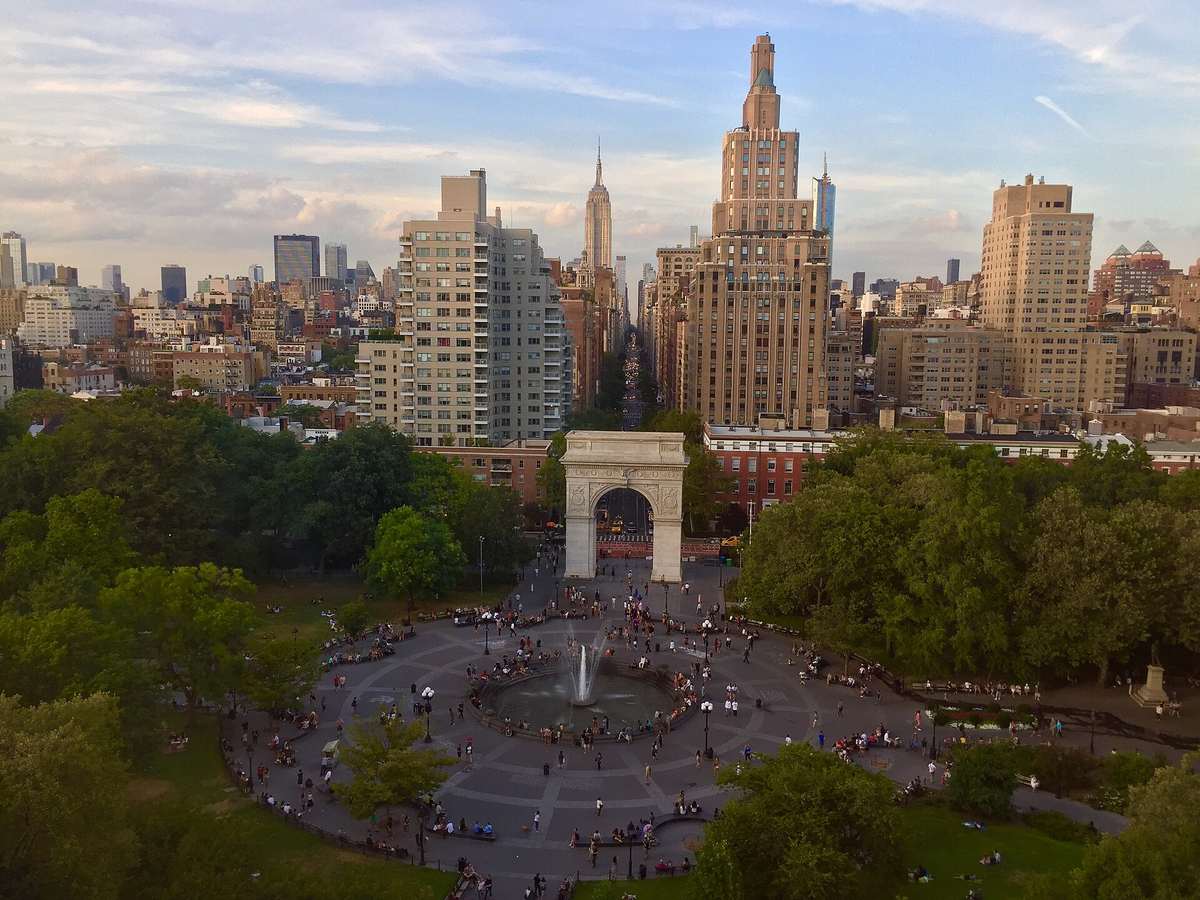
Washington Square Park is a city park in Greenwich Village, Lower Manhattan, New York, where Fifth Avenue ends. NYC Parks gives its edges as Fifth Avenue, Waverly Place, West 4th Street and MacDougal Street, and its size as 9.75 acres. Entry is free and there are no tickets. People come for the marble Washington Square Arch, the fountain, the chess tables and the street performers, and for a history that runs from marsh to cemetery to parade ground to the place where neighbors stopped a highway.
Washington Square Park history
The NYC Parks signs in the park start with a marsh fed by Minetta Creek, a water source for the Lenape village of Sapokanikan. In the 1640s Willem Kieft, director of New Amsterdam, began freeing people enslaved by the Dutch West India Company, and the area became known as the Land of the Blacks. Anthony Portuguese received a land grant here in 1645, followed by Manuel Trumpeter. After the English took the colony in 1664 they withdrew the Black population's rights, and by 1716 all their property had passed to white landowners.
In 1797, during a yellow fever epidemic, the city's Common Council bought land here for a potter's field, a burial ground for the poor. NYC Parks estimates about 20,000 burials; they stopped in 1825. In 1826 the site was graded into a military parade ground, and in 1827 the city expanded it and declared it should "forever thereafter" remain a public square. Greek Revival mansions went up on the north side. The Landmarks Preservation Commission's 1969 Greenwich Village Historic District report says the Washington Square North block east of Fifth Avenue was developed in 1833 under the trustees of Sailors' Snug Harbor, who leased out the land. Henry James visited his grandmother at No. 18 Washington Square North and used the house as the setting of his novel Washington Square.
In 1838 NYU professor Samuel F.B. Morse gave the first public demonstration of the telegraph here. M.A. Kellogg and Ignatz Pilat redesigned the park in 1871, and in 1878 it was formally named for George Washington. For the centennial of Washington's inauguration in 1889, a temporary wood and plaster arch went up north of the park. It was so popular that a citizens committee raised money for a permanent one, dedicated on May 4, 1895.
In the 20th century the park became a stage for marches and music. Labor unions marched here after the Triangle Shirtwaist Factory fire in 1911; later came the Beats and the folk singers. In the early 1950s the city proposed a four-lane roadway through the middle of the park. In February 1952 Shirley Hayes, a Greenwich Village mother of four sons, learned of the plan and began the fight against it, joined by neighbors whom NYC Parks says included Jane Jacobs. On November 1, 1958 a trial period began that closed the park to all vehicles except buses; months later buses were barred too, and in August 1959 the Board of Estimate closed it to vehicles for good.
Starting in 2003 the arch was restored and the park redesigned: the fountain was raised and moved east to line up with the arch and Fifth Avenue, and a new Park House with restrooms was built. The Washington Square Park Conservancy says the $30 million city renovation was completed in 2014. Local leaders founded the Conservancy in 2012, and in 2025 it was approved for a license agreement with NYC Parks as the park's official nonprofit partner.
The arch, the fountain and what to see
Washington Square Arch. Stanford White designed it after Roman triumphal arches, mostly in Tuckahoe marble. It stands 73 feet 6 inches high with a 30-foot span. Philip Martiny made the eagles on the keystones and Frederick MacMonnies the spandrel figures. On the north face stand two statues of Washington: the eastern one by Hermon Atkins MacNeil (1916), Washington as Commander-in-Chief with Fame and Valor, and the western one by Alexander Stirling Calder (1918), Washington as President with Wisdom and Justice. The Piccirilli Brothers did the carving. Traffic ran through and around the arch for more than 65 years, pollution ate at the marble, and a 1966 cleaning damaged the statues. The arch was rededicated in 2004 after a city restoration.
The fountain. NYC Parks calls the fountain the arch's elder by 43 years, and its monument record lists a dedication date of January 31, 1852, noting this may not be the original date. The record gives the basin as 50 feet across. The NYC Parks history sign tells a separate story: the 1871 redesign added a carriage drive that required the fountain to be moved, and a couple of years later it was replaced with today's fountain, which originally stood at Fifth Avenue and East 59th Street. Around 1970 the fountain was lowered and set in a two-tier plaza that became an informal stage.
Monuments. Giovanni Turini's statue of Giuseppe Garibaldi (1888); the sculptor had served as a volunteer in Garibaldi's Fourth Regiment. John Quincy Adams Ward's bust of engineer Alexander Lyman Holley (1890). A World War I memorial flagpole. The headstone of James Jackson, an Irish immigrant who died of yellow fever in 1799, found during 2009 archaeological work and shown, the Conservancy says, in the Park House window.
Hangman's Elm. Lore says the English elm in the northwest corner was a hanging tree. NYC Parks calls that a legend: the only documented hanging in the potter's field was Rose Butler's in 1818, and it took place at the gallows.
Chess and play. Chess and game tables sit at the south and northwest entrances, and the mounded area to the southwest is a long-loved play space.
How to get to Washington Square Park
The closest subway station is W 4 St-Wash Sq, served in the daytime by the A, C, E and B, D, F, M trains. MTA data lists it as accessible to wheelchair users. To the east, on Broadway, is 8 St-NYU (R and W); to the west is Christopher St-Stonewall (1). MTA data lists neither as accessible. The dataset gives daytime routes, so check your train before a late-night trip.
Hours and tickets
| What | How it works |
|---|---|
| Entry | Free, no tickets |
| Hours | NYC Parks rules open parks from 6:00 a.m. to 1:00 a.m. unless other hours are posted at the park |
| Restrooms | In the Park House, open daily from 8:00 a.m.; NYC Parks sets closing time by season, from 4:00 p.m. in winter to as late as 10:00 p.m. in summer |
| Dog run | Fenced dog run on the south side of the park, behind the building |
| Audio tour | Free, in the Bloomberg Connects app |
Hours and prices checked November 11, 2026 on nycgovparks.org and washingtonsqpark.org.
Rules and tips
- The Conservancy notes that NYC Parks rules ban smoking, drinking alcohol, skateboarding, bathing in the fountain, and amplified sound without an NYPD permit.
- Outside the dog run, dogs must be on a leash no longer than six feet. Dogs are not allowed in playgrounds or fountains.
- Selling art or performing for donations falls under NYC Parks' Expressive Matter Rules.
- Free programs (talks, tours, kids' activities, cleanups and performances) are listed on the Washington Square Park Conservancy calendar.
Before you go, load the free Conservancy audio tour in the Bloomberg Connects app. More sights are on the New York places page, and the whole city is covered in our New York City guide.
Questions people ask
Is Washington Square Park free to visit?
Yes. Washington Square Park in Greenwich Village is a free city park with no tickets. Under general NYC Parks rules, parks are open from 6:00 a.m. to 1:00 a.m. unless the park posts other hours. The Conservancy's audio tour in the Bloomberg Connects app is free as well.
Who designed the Washington Square Arch?
Architect Stanford White designed the marble Washington Square Arch. Its foundations were laid in 1890 and it was dedicated on May 4, 1895, honoring the centennial of George Washington's inauguration. The two statues of Washington on the north face came later, by Hermon Atkins MacNeil in 1916 and Alexander Stirling Calder in 1918.
Which subway station is closest to Washington Square Park?
The closest is W 4 St-Wash Sq, served in the daytime by the A, C, E, B, D, F and M trains, and MTA data lists it as wheelchair accessible. The 8 St-NYU station (R and W) and Christopher St-Stonewall (1) are also nearby, but MTA data does not list them as accessible.
Why are there no cars in Washington Square Park?
In the early 1950s the city planned a four-lane roadway through the park. Greenwich Village residents led by Shirley Hayes fought it for seven years. A trial closure to all vehicles except buses began on November 1, 1958, buses were barred months later, and in August 1959 the Board of Estimate closed it to vehicles for good.
Places on the map
Sources
- Washington Square Park Conservancy: official site
- Washington Square Park Conservancy: History
- Washington Square Park Conservancy: Map and park rules
- Washington Square Park Conservancy: Audio tour
- NYC Parks: Washington Square Park
- NYC Parks: Washington Square Park history
- NYC Parks: Washington Square Arch
- NYC Parks: Washington Square Fountain
- NYC Parks: Shirley Hayes and the Preservation of Washington Square Park
- NYC Parks: Giuseppe Garibaldi Monument
- NYC Parks: Washington Square Park dog-friendly areas
- NYC Parks: Washington Square Park public restroom
- NYC Parks: Rules and regulations (section 1-03, hours)
- Landmarks Preservation Commission: Greenwich Village Historic District Designation Report (LP-0489), 1969
- MTA Subway Stations (data.ny.gov open data)
- Washington Square Park Conservancy: FAQs (restroom hours, Expressive Matter Vending)
- Washington Square Park Conservancy: Calendar