RussiansInUSA editorial team · Facts checked November 11, 2026
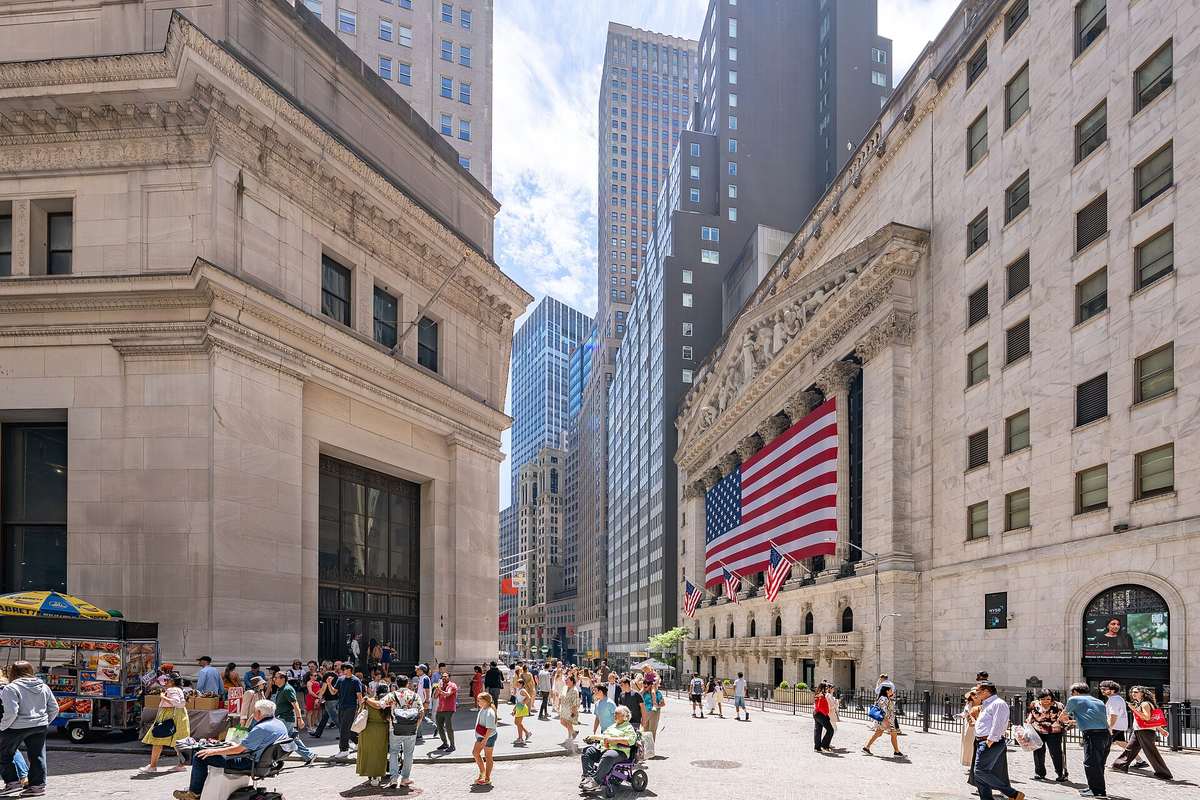
Wall Street is a short street in Lower Manhattan that runs east from Broadway toward the East River. Its name stands for the whole American financial system, but for a visitor it is a walk through the place where both New York and the United States government began. Within a few blocks you find Federal Hall, where George Washington took the oath as the first president, the New York Stock Exchange building and Trinity Church, where Alexander Hamilton is buried. The street itself is open at all hours and free. For the city as a whole, see our New York city guide.
Wall Street history: from a wall to the exchange
The name is literal. The National Park Service (NPS) says that in 1653, on Governor Peter Stuyvesant's orders, the colony's enslaved workers helped build New Amsterdam's best-known fortification, "The Wall," which spanned Manhattan from the East River to the Hudson. The street grew up along it. NPS also records a darker chapter: in 1711 a market for the sale of enslaved people opened on a pier at Wall Street and the East River, and it operated until 1762.
Between 1699 and 1703 a City Hall was built on the site of today's 26 Wall Street. John Peter Zenger was jailed, tried and acquitted of libel there for exposing government corruption in his newspaper, which NPS calls an early victory for freedom of the press. In October 1765 the Stamp Act Congress met in the building to protest "taxation without representation."
After the Constitution was ratified in 1788, New York stayed the national capital. Pierre L'Enfant remodeled City Hall for the new federal government, and it became Federal Hall. The First Congress met there and wrote the Bill of Rights, and on April 30, 1789, George Washington was inaugurated there as the first president. The capital moved to Philadelphia in 1790, and the old Federal Hall was demolished in 1812.
The exchange story starts in the same century. According to the New York Stock Exchange (NYSE), 24 stockbrokers signed the Buttonwood Agreement on May 17, 1792. On March 8, 1817, they adopted a constitution creating the New York Stock & Exchange Board, the forerunner of today's NYSE, and rented a room at 40 Wall Street. In 1865 the exchange moved into its first permanent home on part of its present Broad Street site, and in 1903 into a new building with a much larger trading floor.
What to see on Wall Street
Federal Hall
The building on the old City Hall site opened in 1842 as a Customs House. In 1862 Customs moved to 55 Wall Street and the building became the US Sub-Treasury; NPS says millions of dollars in gold and silver sat in its basement vaults until the Federal Reserve Bank replaced the Sub-Treasury system in 1920. Today it is Federal Hall National Memorial, run by NPS.
The bronze statue of Washington on the front steps is by sculptor John Quincy Adams Ward. Inside, a first-floor gallery sometimes shows the Bible Washington used for his oath. St. John's Lodge No. 1, a Masonic lodge, owns it, and NPS notes that it often travels to other venues, so it is not always there.
New York Stock Exchange
Architect George B. Post designed the 1903 building. Its pediment sculpture, "Integrity Protecting the Works of Man," is by the same John Quincy Adams Ward. A 1922 addition at 11 Wall Street expanded the space. The NYSE describes a trading floor with marble walls and a gilded ceiling, and a brass bell that has signaled the opening and closing of trading since 1903; a Chinese gong came first. The exchange's history page says nothing about visits for tourists and calls the building an exclusive event space, so plan to see the facade from the street.
Trinity Church
The church stands on Broadway at the head of Wall Street. The parish was chartered in 1697 and the first church went up in 1698. It burned in the Great Fire of 1776; the second church, from 1790, lost its roof under heavy snow in 1839. Richard Upjohn's Neo-Gothic church was consecrated in 1846, and the church says its 281-foot steeple made it the tallest building in the United States for 23 years. Alexander and Eliza Hamilton are buried in the churchyard, which also has a Soldiers' Monument to Revolutionary War soldiers.
How to get to Wall Street
Several subway stations serve the street, according to MTA data:
| Station | Lines | Best for |
|---|---|---|
| Wall St | 2, 3 | the middle of the street |
| Wall St | 4, 5 | Broadway end and Trinity Church |
| Broad St | J, Z | the Stock Exchange |
| Rector St | 1, and R, W (two separate stations) | south of Trinity Church |
MTA data lists none of these stations as accessible, so wheelchair users should plan the route ahead. NPS says the visitor entrance to Federal Hall is around the corner at 15 Pine Street.
Hours and tickets
Wall Street is a city street, free to walk at any hour. Only the buildings keep hours.
| Place | Hours | Admission |
|---|---|---|
| Federal Hall | Wednesday to Sunday, 10 AM to 4 PM; closed Monday and Tuesday | free |
| Federal Hall holidays | closed Nov 26, 2026 (Thanksgiving), Dec 25, 2026 and Jan 1, 2027 | - |
| Trinity Church | daily, 8:30 AM to 4 PM | security check at entry |
| Trinity churchyard | daily, 8:30 AM to 6 PM | - |
| New York Stock Exchange | no visitor information on its site | - |
Hours and prices checked November 11, 2026 on nps.gov and trinitychurchnyc.org. Before you go, check the NPS hours page for holiday closures or call 212-825-6990. Trinity Church also closes for a few hours at a time for services and events and posts those closures on its site.
Tips before you go
- Inside Federal Hall eating, drinking, gum chewing and smoking are not allowed, and phone use is restricted. NPS says the building is fully wheelchair accessible, with an elevator between levels.
- Ranger programs are listed on the Federal Hall calendar on nps.gov.
- At Trinity Church expect a security check, and entry may be limited in bad weather or during construction. The church offers augmented reality (AR) tours of its art and architecture.
- A simple route: start at Trinity Church on Broadway, walk east on Wall Street past the exchange to Federal Hall at number 26, and continue toward the East River.
More sights nearby are on our things to see in New York page.
Questions people ask
Can you go inside the New York Stock Exchange?
The New York Stock Exchange history page says nothing about tourist visits and describes its 1903 building as an exclusive event space. Visitors usually see George B. Post's facade and John Quincy Adams Ward's pediment from the street. Federal Hall at 26 Wall Street, a free National Park Service site, is a few steps away.
How much does Federal Hall cost?
Admission to Federal Hall National Memorial is free, according to the National Park Service. NPS lists it as open Wednesday to Sunday, 10 AM to 4 PM, closed Monday and Tuesday. The building is at 26 Wall Street, and the visitor entrance is at 15 Pine Street.
Why is it called Wall Street?
The street follows the line of a wall built in New Amsterdam in 1653 on Governor Peter Stuyvesant's orders. According to the National Park Service, the wall spanned Manhattan from the East River to the Hudson, and the colony's enslaved workers helped build it.
Where is Alexander Hamilton buried?
Alexander Hamilton is buried in the Trinity Church churchyard at 89 Broadway, at the head of Wall Street. His wife Eliza and Angelica Schuyler Church are also buried there. The churchyard is open daily from 8:30 AM to 6 PM and the church from 8:30 AM to 4 PM.
Places on the map
Sources
- History & Culture, Federal Hall National Memorial (NPS)
- Operating Hours & Seasons, Federal Hall National Memorial (NPS)
- Fees and Passes, Federal Hall National Memorial (NPS)
- Basic Information, Federal Hall National Memorial (NPS)
- Federal Hall National Memorial (NPS)
- The George Washington Inaugural Bible (NPS)
- African Burial Ground in History (NPS)
- History of the NYSE (New York Stock Exchange)
- Trinity Church: A Historic House of Worship (Trinity Church)
- MTA subway stations data (lines, accessibility)