RussiansInUSA editorial team · Facts checked November 11, 2026
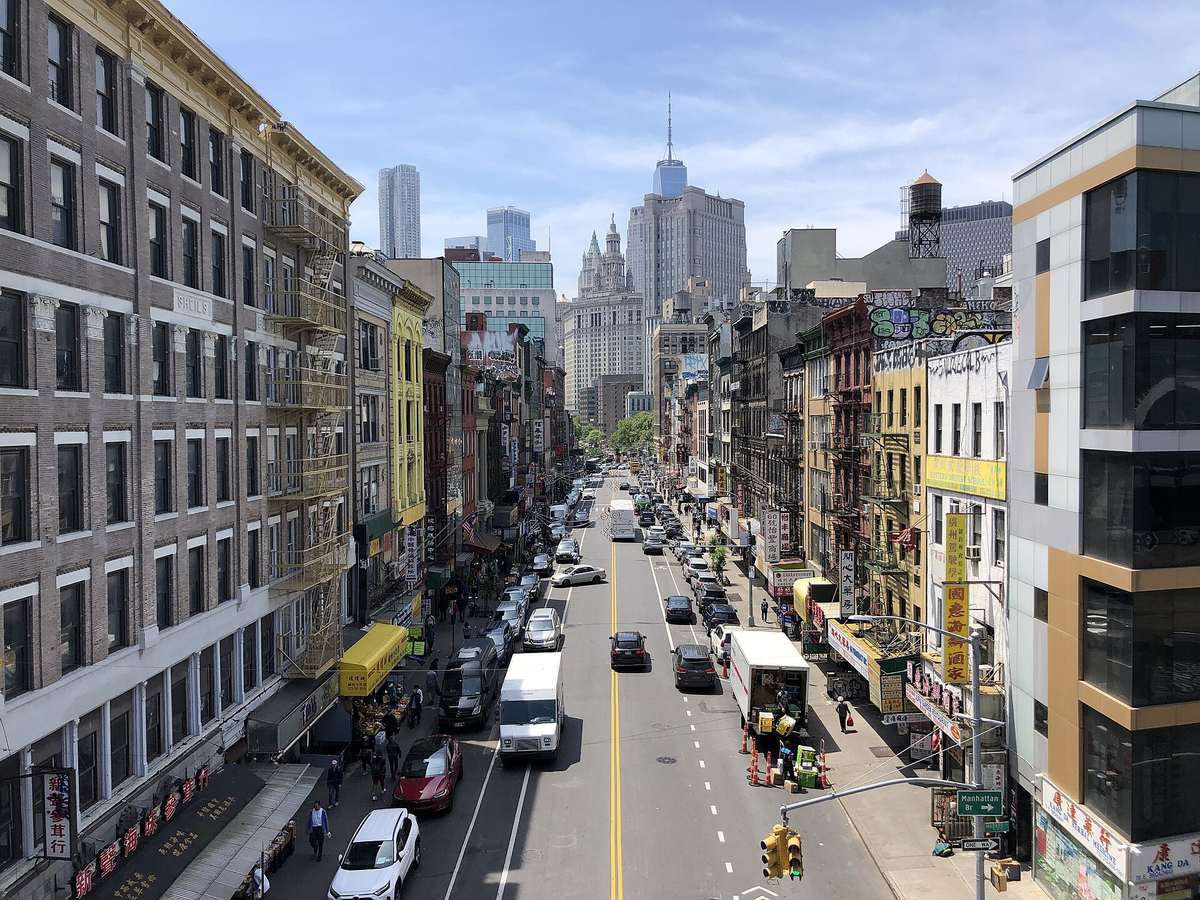
Chinatown in New York is the Chinese neighborhood of Lower Manhattan, around Canal Street, close to the Manhattan Bridge. People come to walk Mott, Pell and Doyers, the streets where it began, sit in Columbus Park, step into a Buddhist temple and visit the Museum of Chinese in America. The neighborhood itself is open at all hours and free: only the museum has tickets and set hours. For the city as a whole, see our New York city guide, and for more sights, our list of places to see in New York.
Chinatown history: from Five Points to today
The neighborhood grew over one of old New York's most notorious districts. NYC Parks says that until 1808 the area was swampy ground near the Collect Pond, with tanneries. The pond was filled, the fill began to sink, and the area became the Five Points slum, nicknamed "murderer's alley" and "den of thieves." Charles Dickens visited in 1842 and wrote about it harshly in American Notes.
Five Points was an immigrant district. According to NYC Parks, German Jews and the city's first garment district were on Baxter Street in the 1840s, the area then became the largest Irish community outside Dublin, and Italians arrived in the 1880s. Chinese immigrants, says the city's official tourism site, NYC Tourism + Conventions, settled in the 19th century in a cluster around Pell, Doyers and Mott Streets, and the neighborhood has spread out since. In the 20th century, NYC Parks writes, a sprawling Chinatown took in the whole area around Five Points.
Federal law shaped the community for decades. The National Archives says the Chinese Exclusion Act, approved on May 6, 1882, placed an absolute 10-year ban on Chinese laborers immigrating to the United States. Congress repealed all the exclusion acts in 1943, when China was an Allied nation in World War II.
Today Manhattan's Chinatown is one of several in the city, alongside Flushing in Queens and Sunset Park in Brooklyn, but NYC Tourism + Conventions calls it the one most enticing to visitors.
What to see in Chinatown
Columbus Park
The park is bounded by Baxter, Worth, Bayard and Mulberry Streets. NYC Parks says Calvert Vaux, co-designer of Central Park, planned it in the 1880s, and it opened in summer 1897 as Mulberry Bend Park, replacing slum housing. Jacob Riis, who described the slum in How the Other Half Lives, called the change "little less than a revolution." It was named for Columbus in 1911. A 1934 limestone recreation building now holds public restrooms, and basketball courts were added in the 1980s. In 2019 the north plaza was renamed for Dr. Sun Yat-sen, first Provisional President of the Republic of China, with a statue by Lu Chun-Hsiung. The pedestal carries the motto "All Under Heaven Are Equal" in his own calligraphy.
Kimlau Square and the memorial arch
Kimlau Square is the small island at the center of Chatham Square, where Oliver Street, East Broadway, the Bowery and Park Row meet. NYC Parks says it was named in 1961 for Second Lieutenant Benjamin Ralph Kimlau, a Chinese-American bomber pilot killed near New Guinea in 1944. The memorial, designed by architect Poy G. Lee and given by Chinese-American veterans in 1961, resembles a triumphal arch and stands 18 feet 9 inches tall. Its English and Chinese inscription honors Americans of Chinese ancestry who died defending freedom and democracy.
Mahayana Buddhist Temple
The temple is at 133 Canal Street, at the foot of the Manhattan Bridge. NYC Tourism + Conventions calls it the city's largest Buddhist temple, home to New York's largest Buddha, a 16-foot gold statue seated on a lotus. The same community's original temple is at 64 Mott Street. The temple's site says its temples are open every day from 8:30 a.m. to 5:30 p.m. It lists no admission fee and says it is supported by donations.
Mott, Pell and Doyers Streets
These are the streets where, according to NYC Tourism + Conventions, the neighborhood began. The same site describes produce stands, herbalists and roast-meat sellers along them during business hours, with Chinese-language signs on facades and awnings. From here Columbus Park and the Museum of Chinese in America are within walking distance.
Museum of Chinese in America: hours and tickets
The Museum of Chinese in America (MOCA) is at 215 Centre Street. It describes itself as dedicated to preserving and celebrating the history and contributions of Chinese in America. The museum's own history says it moved in 1984 into four second-floor rooms at 70 Mulberry Street, announced a campaign in 2006 for a larger space on Centre Street and opened there three years later. On January 23, 2020, a fire hit 70 Mulberry Street, which held more than 85,000 artifacts; the museum says much of the collection was salvageable.
| What | Now |
|---|---|
| Wednesday to Saturday | 11 a.m. to 6 p.m. |
| Sunday | 11 a.m. to 4 p.m. |
| Monday and Tuesday | guided group tours only |
| Closed | Thanksgiving, Christmas Eve, Christmas Day, New Year's Day |
| Adults | $15 |
| Seniors over 55, students with ID, visitors with disabilities | $10 |
| Children under 12, members, caregivers of visitors with disabilities | free |
| Flex ticket (any open day, no reservation) | $20 |
| NYC residents | pay what you wish, in person only, with proof of residency |
Hours and prices checked November 11, 2026 on mocanyc.org.
General admission can be reserved on the museum's website. Flash photography, phone calls, food and drinks are not allowed in the galleries; photos without flash and strollers are fine.
How to get to Chinatown by subway
The closest station is Canal St. MTA station data lists the 6, J, Z, N, Q, R and W there, and marks the 6 platform as accessible. MOCA says the walk from Canal Street on the N, Q, R, W, J, Z or 6 is 2 minutes, from Grand Street (B, D) about 7 minutes, and from Canal Street on the A, C, E about 9 minutes.
For the east side of the neighborhood, along East Broadway, the closer station is East Broadway on the F. The J and Z also stop at Chambers St, south of the neighborhood.
| Station | Lines |
|---|---|
| Canal St | 6, J, Z, N, Q, R, W |
| Grand St | B, D |
| East Broadway | F |
| Chambers St | J, Z |
Lines and stations checked November 11, 2026 against MTA data.
Questions people ask
Do you have to pay to visit Chinatown?
No. Manhattan's Chinatown is a city neighborhood of public streets and parks, such as Columbus Park and Kimlau Square, so walking around it costs nothing at any hour. The paid stop is the Museum of Chinese in America at 215 Centre Street, where an adult ticket is $15 and children under 12 get in free.
When is the Museum of Chinese in America open?
The Museum of Chinese in America at 215 Centre Street is open Wednesday to Saturday from 11 a.m. to 6 p.m. and Sunday from 11 a.m. to 4 p.m. On Monday and Tuesday it takes guided group tours only. It closes on Thanksgiving, Christmas Eve, Christmas Day and New Year's Day.
Can visitors go inside the Mahayana Buddhist Temple?
Yes. The temple's own site says its buildings at 133 Canal Street and 64 Mott Street are open every day from 8:30 a.m. to 5:30 p.m. It lists no admission fee and says it runs on donations. The Canal Street temple holds New York's largest Buddha, a 16-foot gold statue.
Who designed Columbus Park in Chinatown?
Calvert Vaux, co-designer of Central Park, planned it in the 1880s on the site of the Mulberry Bend slum in Five Points. According to NYC Parks, it opened in summer 1897 and was named for Christopher Columbus in 1911. Its north plaza was renamed for Dr. Sun Yat-sen in 2019.
Places on the map
Sources
- Columbus Park History (NYC Parks)
- Columbus Park: Dr. Sun Yat-sen Monument and Plaza (NYC Parks)
- Kimlau Square History (NYC Parks)
- Chinese Exclusion Act (1882) (National Archives)
- A Walk Down Chinatown's Streets (NYC Tourism + Conventions)
- Mahayana Buddhist Temple (NYC Tourism + Conventions)
- Mahayana Temple Buddhist Association
- Plan Your Visit (Museum of Chinese in America)
- History (Museum of Chinese in America)
- MTA Subway Stations dataset (data.ny.gov)