RussiansInUSA editorial team · Facts checked November 11, 2026 · Official site
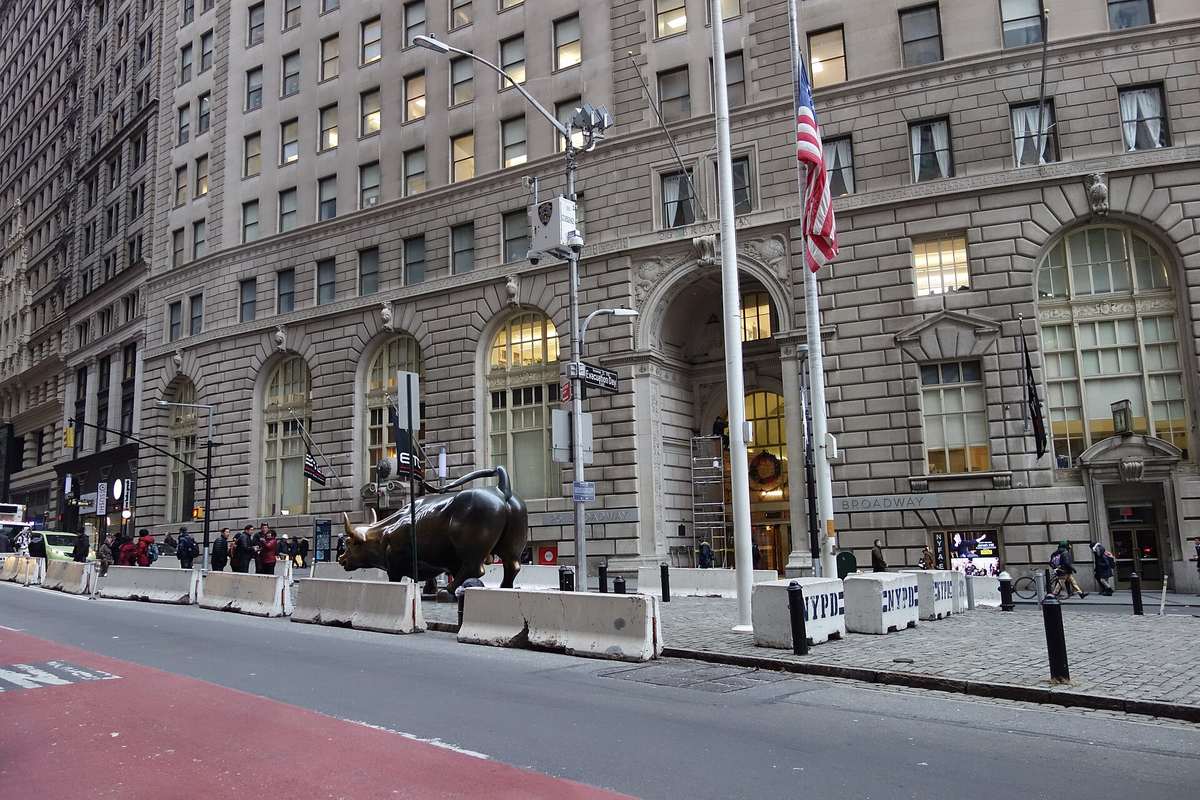
Charging Bull in New York is a bronze sculpture by Arturo Di Modica that stands in Bowling Green, the small park at Broadway and Whitehall Street at the bottom of Manhattan, in the Financial District. NYC Parks says it was installed in front of the New York Stock Exchange on December 14, 1989; according to the artist's estate, he delivered it himself, at night and without permission. Because of where it stands, NYC Parks says, it has come to symbolize a rising, "bull" market.
People come for the story of an immigrant artist who paid for a gift to the city out of his own pocket, and for the park around it, which NYC Parks calls perhaps the city's first park. For the rest of the city, see our New York city guide.
Charging Bull history: a gift after the 1987 crash
Arturo Di Modica (1941-2021) was born in Vittoria, Sicily. According to NYC Parks, he studied sculpture at the Accademia di Belle Arti in Florence, worked at the famous marble quarry at Pietrasanta in the late 1960s and emigrated to New York in 1970. He lived and worked at his studio in SoHo.
As the sculptor's estate tells it, the trigger was Black Monday, the stock market crash of October 1987. By then Di Modica owned a five-floor building on Crosby Street in SoHo and had collectors around the world. America had been good to him, the country was in shock, and he decided to repay it with an artwork for the city. He worked on the bull for two years and had spent $350,000 by the time it was cast in bronze. According to NYC Parks, it was cast at Bedi-Makky, a fine arts foundry in Greenpoint, Brooklyn.
According to the estate, the installation was unauthorized: Di Modica had timed the security rounds at the exchange and found a window of four and a half minutes. At around 1:30 a.m. on December 14, 1989, he left the bull under a Christmas tree in front of the New York Stock Exchange. NYC Parks gives the same date.
The estate says the exchange pressed the city to remove it. The bull was hauled away and ended up at a police storage facility in Queens, where Di Modica paid the fine and the cost of the truck to get it back. Arthur Piccolo suggested Bowling Green, and the Parks Commissioner and Mayor Ed Koch approved the move. The bull arrived in Bowling Green on the morning of December 20 with a ceremony, and the crowds started that same day.
NYC Parks says Di Modica described the bull as embodying the "strength and determination" of the American people. Hence its second meaning: a "bull market" of rising stocks. The estate points out that the bull and the bear have stood for market gains and losses since the early 18th century.
What to see in Bowling Green
The bull does not take up much room, so walk the park around it too. According to NYC Parks, Bowling Green was perhaps the city's first official park. Under the Dutch it was a market place and parade ground. On March 12, 1733, the Common Council leased it for one peppercorn a year to John Chambers, Peter Bayard and Peter Jay, who had to add grass, trees and a wooden fence.
In 1770 a gilded lead statue of King George III went up in the center of the park, the first statue in a city park, NYC Parks says. In 1771 a wrought iron fence was put up around the oval to protect the park and its monument. That fence survives and is a designated New York City Landmark.
On July 9, 1776, after the Declaration of Independence was read in City Hall Park, a crowd marched down Broadway to Bowling Green, toppled the statue of George III and hacked it to pieces to be recast as musket balls. Broadway itself starts here: the park sits at the beginning of the old Dutch road, Heere Staat.
On site, look for:
- The bull itself, which NYC Parks lists among the park's highlights.
- The 1771 fence around the park, a city landmark.
- The oval Bowling Green Fountain and memorial plaques, all in NYC Parks' list of the park's monuments.
- The start of Broadway, which runs north from here through all of Manhattan.
NYC Parks lists the park at 1.02 acres.
How to get to Charging Bull
The NYC Parks address is Bowling Green, Broadway and Whitehall St, Manhattan, NY 10004.
The closest subway stop is Bowling Green on the 4 and 5 lines. According to the MTA, its entrances are in Bowling Green Park at Whitehall St, at Battery Place and State St, and at Battery Place and Broadway. The station is ADA accessible. The 5 stops here at all times except late nights. Weekend and late-night service can differ, so check the MTA line map before you go.
The previous stop on the same lines is Wall St, with its entrance at Rector St and Broadway. Other lower Manhattan sights are in our list of New York places.
Hours and tickets
Charging Bull is a sculpture in a city park, not a museum. We checked the park's page on the NYC Parks site and the sculptor's estate site: neither lists hours, tickets or an admission fee.
| Item | What the official pages say |
|---|---|
| Location | Bowling Green, Broadway and Whitehall St, Manhattan, NY 10004 |
| Managed by | NYC Parks, park ID M007 |
| Hours | Not listed |
| Tickets and admission fee | Not listed |
| Nearest subway | Bowling Green, 4 and 5 lines |
Hours and prices checked November 11, 2026 on nycgovparks.org and arturodimodica.com.
Any closures or work in the park will show up on the Bowling Green page on nycgovparks.org. The estate tells the bull's story at length on Arturo Di Modica's official site.
Questions people ask
Who made the Wall Street bull?
Charging Bull is by Arturo Di Modica (1941-2021), a sculptor from Vittoria, Sicily. He studied in Florence, worked at the Pietrasanta marble quarry and emigrated to New York in 1970, where he kept a studio in SoHo. The bull was cast in bronze at the Bedi-Makky foundry in Greenpoint, Brooklyn.
Why is the bull in Bowling Green and not at the stock exchange?
NYC Parks says the bull was installed in front of the New York Stock Exchange on December 14, 1989. According to the artist's estate, Di Modica did it without permission, the exchange pressed for its removal and the bull ended up in police storage in Queens. The Parks Commissioner and Mayor Ed Koch approved a spot in Bowling Green, and the bull moved there on the morning of December 20, 1989.
How much did Charging Bull cost to make?
According to the sculptor's estate, Arturo Di Modica had spent $350,000 of his own money on the bull by the time it was cast in bronze. He worked on it for two years after the 1987 crash and meant it as a Christmas gift to the city.
Which subway stop is closest to Charging Bull?
The closest stop is Bowling Green on the 4 and 5 lines. According to the MTA, its entrances are in Bowling Green Park at Whitehall St and at Battery Place, both at State St and at Broadway. The station is ADA accessible, and the 5 does not stop there late at night.