RussiansInUSA editorial team · Facts checked November 4, 2026 · Official site
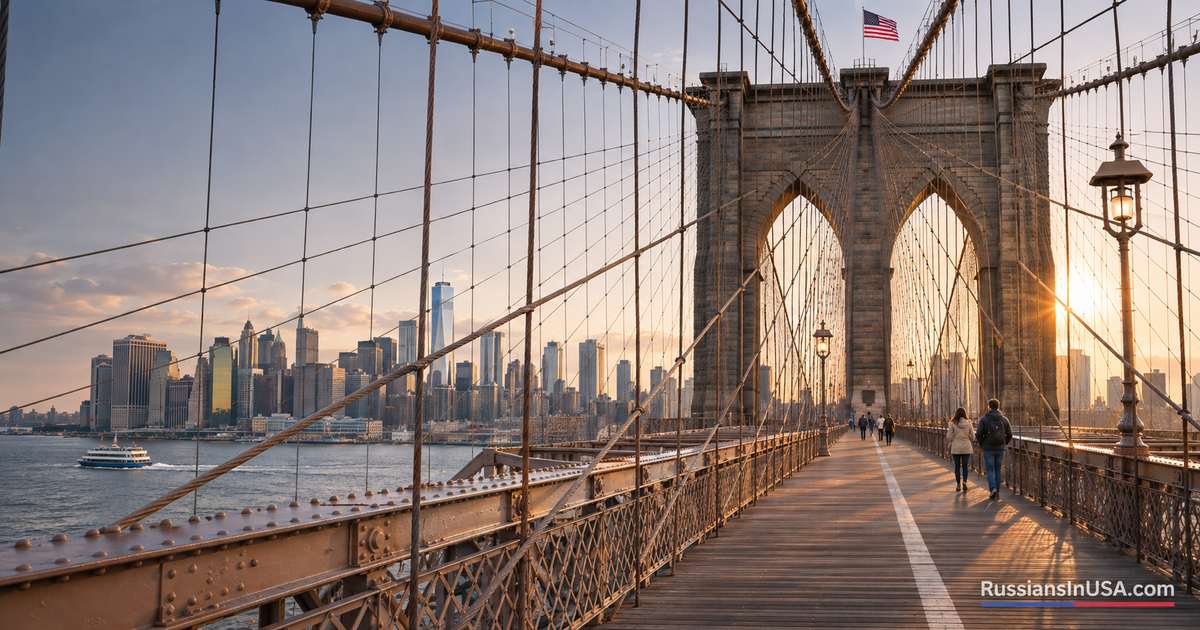
The Brooklyn Bridge links Lower Manhattan and Brooklyn Heights across the East River. It is a suspension bridge that opened on May 24, 1883, with a wooden walkway raised above the traffic lanes. Walking across is free, and the city's Department of Transportation (NYC DOT) says the promenade is open at all times. Below: the bridge's history, what to look at on the way, which subway stations to use and the rules on the walkway today. More places in the city are on our New York city page.
Brooklyn Bridge history, 1869 to today
The bridge was designed by engineer John A. Roebling, and NYC DOT dates construction from 1869 to 1883. Roebling never saw it built. The Museum of the City of New York (MCNY) blog says a boat crushed his toes on June 28, 1869, and he died of tetanus within a month. His son Washington Roebling, then 32, became chief engineer, and the museum gives January 2, 1870, as the start of work.
The tower foundations were dug from caissons, huge boxes in which men worked on the riverbed under compressed air. The American Society of Civil Engineers (ASCE) mentions a fire in the Brooklyn caisson. Caisson disease, now called the bends, did more harm: MCNY says it killed or badly disabled over a hundred men. Washington Roebling came up too fast in early 1872 and was ill for most of the project.
His wife Emily Roebling stepped in. According to MCNY, she taught herself the math and engineering, carried his notes to the engineers from their Brooklyn home and oversaw much of the work. ASCE writes that the bridge might not have been finished without her careful inspection and management. On opening day she was the first to cross by carriage.
The city closed schools and businesses for the opening, ASCE says, and MCNY puts the first-day crowd at over 50,000 people on foot. The project cost 15 million dollars and 27 lives. At the time it was the longest suspension bridge in the world.
At first the bridge carried horse-drawn traffic and trains, with the raised walkway for pedestrians and cyclists. Trolleys came in 1898. The overhead trains and the terminals at both ends were removed in 1944, and in 1950 the trolley tracks came out and traffic was limited to passenger cars. DOT lists a full reconstruction from 1944 to 1954. The bridge became a National Historic Landmark in 1964, a New York City landmark in 1967 and a National Historic Civil Engineering Landmark in 1972.
Today it carries five car lanes (no trucks), the promenade and a separate bike path. DOT's 2024 counts give an average day as 103,051 vehicles, 28,845 pedestrians and 5,504 cyclists.
What to see on the Brooklyn Bridge
The towers. The two stone towers stand 276.5 feet tall and took three years to build, ASCE says; when finished they were taller than any office building in New York. The walkway passes through their arches.
The cables. Four main cables, each almost 16 inches thick, hold more than 5,000 wires apiece. This was the first use of galvanized steel wire in cable construction. The design started in iron and switched to steel to cut the weight.
The size. The bridge with its approaches runs 6,016 feet, the main span between the towers is 1,595.5 feet, and the clearance at the center is 135 feet. From up there you see Lower Manhattan, the East River and the Manhattan Bridge next door.
The walkway itself. Cars run underneath you. In 2017 DOT called the promenade the top tourist attraction in Brooklyn and one of the top five in the city.
How to get to the Brooklyn Bridge
You can walk the bridge in either direction.
- Manhattan. Brooklyn Bridge-City Hall station (4, 5, 6 trains), in the same complex as Chambers St (J, Z). MTA lists Brooklyn Bridge-City Hall as accessible. Most walkers come from Centre Street; DOT also points people to the stairs down to Park Row at Frankfort Street as an exit, to ease crowding.
- Brooklyn. The walkway starts at Tillary Street and Adams Street, on the Adams Street median. DOT rebuilt the Brooklyn walking and biking entrance in 2017.
Cyclists use the bike path. In Manhattan its entrance is in the middle of the street at Centre Street and Chambers Street, an intersection DOT redesigned for it.
Hours, entry and rules on the bridge
There are no tickets. It is a city bridge, maintained by NYC DOT.
| Item | Current rule |
|---|---|
| Pedestrian promenade | open at all times |
| Cost | free |
| Bikes | separate two-way protected bike path, opened September 14, 2021 |
| Promenade | pedestrians only since 2021 |
| Street vending | banned on the walkway and bike path since January 3, 2024 |
| Trucks | not allowed on the bridge |
| Repairs | parts of the walkway are narrowed at times |
Hours and prices checked on November 4, 2026, on nyc.gov (NYC DOT). Repair work on the bridge comes and goes, and DOT warns that parts of the walkway may be narrowed, so look at the DOT bridge page before you go.
The 8-foot bike path was made from the innermost Manhattan-bound car lane; before it, walkers and cyclists shared the promenade for decades. In October 2021 DOT counted an average of 4,206 cyclists a day, up 88% on a year earlier.
The vending ban is a DOT rule: vendors may not set up on walkways or bike lanes on city bridges and their approaches, with carts, tables, tents, coolers or generators. The city said police enforcement follows outreach to vendors.
Tips for walking the bridge
- Weekends are the busiest. In January 2024 DOT said an average fall weekend day brings about 34,000 pedestrians, against 17,000 in 2021. From 2008 to 2015 weekend pedestrian volumes rose 275%.
- The walkway is narrow. It averages 16 feet across but is under 5 feet in several places, so step aside before you stop for photos.
- Stay off the bike path. Since 2021 walkers and cyclists have their own spaces.
- Vendors on the walkway are breaking DOT's 2024 rule.
To keep going on the Brooklyn side, see our Brooklyn page, and for more sights see places to visit in New York.
Questions people ask
Does it cost anything to walk across the Brooklyn Bridge?
No. Walking the Brooklyn Bridge promenade is free and there are no tickets. It is a city bridge maintained by the Department of Transportation (NYC DOT), which says the walkway is open at all times, though repair work sometimes narrows parts of it.
Can you ride a bike over the Brooklyn Bridge?
Yes, but only in the separate two-way protected bike path. It opened on September 14, 2021, in what used to be the innermost Manhattan-bound car lane, and since then the raised wooden promenade above the traffic has been for pedestrians only.
Which subway stop is closest to the Brooklyn Bridge?
On the Manhattan side, use Brooklyn Bridge-City Hall station on the 4, 5 and 6 trains, which shares a complex with Chambers St on the J and Z. On the Brooklyn side, the walkway starts at Tillary Street and Adams Street. You can start from either end.
Who built the Brooklyn Bridge and when did it open?
John A. Roebling designed it but died in 1869 before work began. His son Washington Roebling ran construction, and after he fell ill Emily Roebling oversaw much of the work. The bridge opened on May 24, 1883, as the longest suspension bridge in the world at the time.
Places on the map
Sources
- Brooklyn Bridge (NYC DOT)
- Brooklyn Bridge Promenade Recommendation Report, December 2017 (NYC DOT)
- NYC DOT announces new public safety measures on the Brooklyn Bridge, January 2024
- Notice of public hearing, vending on bridges, DOT Traffic Rules 4-12(g) (The City Record)
- Brooklyn Bridge bike lane ridership skyrockets (NYC DOT, 2021)
- NYC DOT 2021 projects: Brooklyn Bridge protected bike lane
- Brooklyn Bridge Protected Bike Lane and Access, Manhattan CB1, April 2021 (NYC DOT)
- MTA subway stations data (lines, accessibility)
- Brooklyn Bridge, historic civil engineering landmark (ASCE)
- The Curse of the Roeblings? The Construction of the Brooklyn Bridge (Museum of the City of New York)
- Brooklyn Bridge Promenade Gateway Sign, CB2, January 2021 (NYC DOT)
- Tillary Street and Adams Street Gateway to Brooklyn (NYC DOT)