RussiansInUSA editorial team · Facts checked November 4, 2026 · Official site
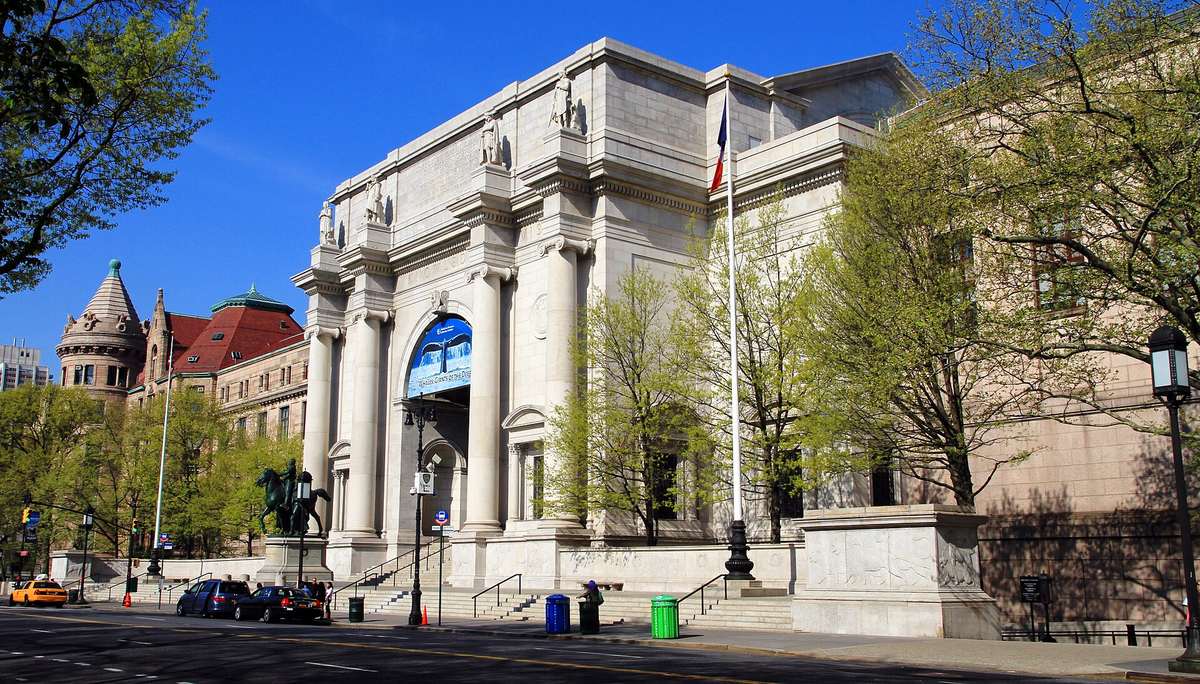
The American Museum of Natural History (AMNH) in New York stands on Manhattan's Upper West Side at 200 Central Park West, facing Central Park between 77th and 81st Streets. It is open daily from 10 am to 5:30 pm. Inside are more than 40 permanent halls: dinosaurs, a blue whale hanging from the ceiling, the Hayden Planetarium and the new Gilder Center with its butterflies and insects. Below: its history, what to see, how to get there, hours and tickets.
American Museum of Natural History: a short history
The museum was the idea of naturalist Albert Smith Bickmore, a former student of Harvard zoologist Louis Agassiz. William E. Dodge Jr., Theodore Roosevelt Sr., Joseph Choate and J. Pierpont Morgan backed him. On April 6, 1869, New York Governor John Thompson Hoffman signed the act of the State Legislature that created the museum.
The first exhibits went on view in 1871 in the Arsenal on the east side of Central Park. The collection soon outgrew it, and the museum secured Manhattan Square across the park. President Ulysses S. Grant laid the cornerstone of a five-story red brick-and-stone building on 77th Street in 1874, and President Rutherford B. Hayes opened it in 1877.
The museum calls 1880 to 1930 its golden age of exploration: expeditions to the North Pole, unmapped parts of Siberia, Outer Mongolia and the Gobi, and the Congo. Franz Boas ran the Jesup North Pacific Expedition in 1897-1902, and from 1922 Roy Chapman Andrews found some of the world's richest dinosaur fossil sites in the Gobi.
The museum is open about its darker pages too. It hosted the Second International Eugenics Congress in 1921, and in 2021 it apologized for its role in advancing that pseudo-science.
The Central Park West entrance and rotunda were built in 1929-1935 as New York State's memorial to Theodore Roosevelt and opened in 1936. The Hayden Planetarium opened in 1935, the Rose Center for Earth and Space in 2000, and the Richard Gilder Center in 2023. Today the collections hold more than 30 million specimens and objects, and in 2006 it became the first American museum authorized to award its own Ph.D.
What to see at the museum
You will not see everything in one day. Pick three or four halls and download the map or the free Explorer app from the museum's site.
- Milstein Family Hall of Ocean Life, first floor. The 94-foot, 21,000-pound blue whale model has hung here since 1969 and was resculpted in 2003. More than 750 marine organisms fill 14 dioramas and eight ocean ecosystem displays.
- Fossil halls, fourth floor. Tyrannosaurus rex and Apatosaurus in the Hall of Saurischian Dinosaurs, Triceratops and Stegosaurus in the Hall of Ornithischian Dinosaurs, a mammoth among the advanced mammals. The 122-foot Titanosaur cast has been in the Wallach Orientation Center since 2016.
- Theodore Roosevelt Rotunda. A five-story-high Barosaurus cast, installed in 1991 as the world's highest freestanding dinosaur display.
- Akeley Hall of African Mammals. Opened in 1942. Artists and scientists led by Carl Akeley went to Africa to sketch, photograph and mold leaves and bark so the dioramas would be accurate.
- Rose Center for Earth and Space. The Hayden Sphere, the 360-foot Cosmic Pathway through 13 billion years of the universe, and the 400-foot Scales of the Universe walkway. The museum's meteorite hall has more than 130 meteorites plus Moon and Mars rocks.
- Gilder Center. An insectarium, floor-to-ceiling collection displays and a live butterfly vivarium, linked to the rest of the museum on four floors.
The Space Show, the butterfly vivarium and other ticketed exhibitions cost extra and need a timed entry. The list changes, so check the ticket page.
How to get to the museum
- Subway: B (weekdays only) or C to 81st Street. The 1 train stops two blocks west at Broadway and West 79th Street. The 81st Street station is not wheelchair accessible; the nearest accessible station is 72nd Street (1, 2, 3), then the northbound M7 bus on Amsterdam Avenue.
- Bus: the M79 crosses Central Park on 79th Street and stops by the museum on West 81st Street. The M7, M10, M11, M86 and M104 also stop at or near it.
- Car: the garage on 81st Street between Central Park West and Columbus Avenue (GPS: 56 West 81st Street) is open 6 am to 11 pm weekdays and 8 am to 11 pm weekends. Rates are on the museum's site.
Enter at Central Park West and 79th Street (up the steps), or through the accessible entrances at 81st Street/Rose Center and Columbus Avenue at 79th Street/Gilder Center (415 Columbus Avenue). The museum recommends the last two for strollers.
AMNH hours and tickets
Open daily 10 am to 5:30 pm, closed Thanksgiving Day and Christmas Day. Some halls close temporarily; the hours page lists closures and is updated weekly.
| Ticket | Adult | Senior (60+) / Student | Child (3-12) |
|---|---|---|---|
| General Admission, NY State residents (suggested, pay what you wish) | $25 | $20 | $14 |
| + one ticketed exhibition, residents | $30 | $24 | $17 |
| + all ticketed exhibitions, residents | $35 | $28 | $20 |
| General Admission, visitors from outside NY State | $37 | $30 | $22 |
| + one ticketed exhibition, visitors | $43 | $35 | $26 |
| + all ticketed exhibitions, visitors | $48 | $39 | $30 |
Hours and prices checked November 4, 2026 on amnh.org.
Pay What You Wish is for New York State residents only and covers General Admission only; ticketed exhibitions cannot be added. Accepted ID: driver's license, state ID, IDNYC, student ID, a utility bill with your address or a voter registration card. Everyone else pays the full fee.
Free: children under 3, Museum Members, IDNYC Members, caregivers of visitors with disabilities and anyone entering in the last hour of the day. Military families get in free under Blue Star from Armed Forces Day to Labor Day; the rest of the year a service member and one guest get free General Admission. Free entry still needs a ticket. Book on the museum's visit page.
Tips before you go
- Buy tickets online in advance for faster entry.
- Lockers cost $7 (small) or $12 (large) a day and are available until 5 pm.
- Personal photography is fine, flash included. No selfie sticks, tripods or lights, and no photos or filming in the theaters, including the Hayden Planetarium Space Theater and the LeFrak Theater.
- Bike racks are in the Rose Center driveway on 81st Street.
Central Park is across the street. For more sights see places to visit in New York and our New York city guide.
Questions people ask
Can you visit the Natural History Museum in New York for free?
New York State residents with ID pay what they wish for General Admission; the suggested adult price is $25. Children under 3, Museum Members, IDNYC Members and visitors entering in the last hour, after 4:30 pm, get in free. Everyone still needs a ticket, and ticketed exhibitions such as the Hayden Planetarium Space Show cost extra.
Which subway stop is closest to the museum?
The 81st Street station on the C train, and the B on weekdays, is right at the museum. The 1 train stops two blocks west at Broadway and 79th Street. The 81st Street station is not wheelchair accessible; the accessible option is 72nd Street on the 1, 2 and 3, then the northbound M7 bus.
How much time do you need at the American Museum of Natural History?
The museum's hours, 10 am to 5:30 pm, are not enough to see all 40-plus permanent halls. Most visitors do better choosing a few: the blue whale in the Hall of Ocean Life, the fourth-floor dinosaur halls, the Rose Center and the Gilder Center. The museum's map and free Explorer app help plan a route.
Is the planetarium show included in a regular ticket?
No. The Hayden Planetarium Space Show, the butterfly vivarium and other ticketed exhibitions need a General Admission plus exhibition ticket and a timed entry. An adult New York State resident pays $30 for admission with one exhibition; a visitor from another state pays $43. A Pay What You Wish ticket cannot include an exhibition.
Places on the map
Sources
- American Museum of Natural History
- AMNH: Plan Your Visit (hours, tickets, directions, parking, lockers, photography)
- AMNH: Hours and Temporary Hall Closures
- AMNH: Mission Statement and History
- AMNH: Historical Timeline
- AMNH: Permanent Exhibitions
- AMNH: Milstein Family Hall of Ocean Life
- AMNH: Gilder Center for Science, Education, and Innovation
- AMNH: Rose Center for Earth and Space