RussiansInUSA editorial team · Facts checked November 11, 2026
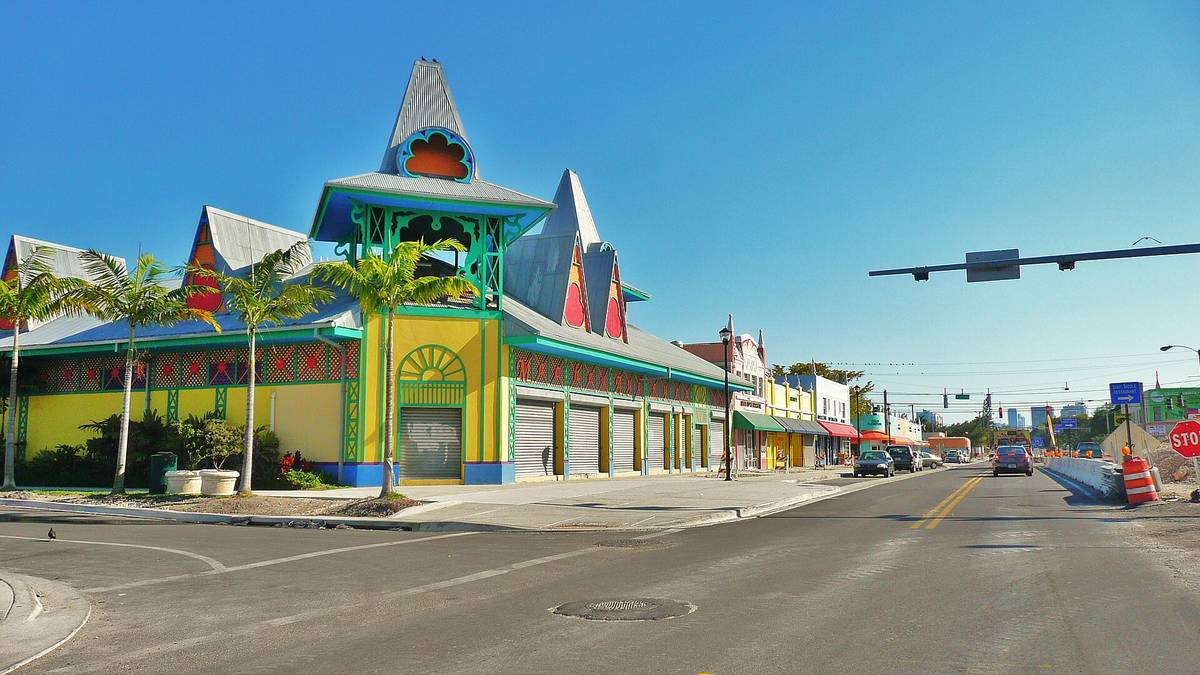
Little Haiti is Miami's Haitian neighborhood, on the north side of the city. The GMCVB describes it as bounded by I-95 and the Florida East Coast Railway, from 54th to 87th Street. NE 2nd Avenue runs through it. Here you find the Little Haiti Cultural Complex, the Caribbean Marketplace built on the model of the Iron Market in Port-au-Prince, and the Haitian Catholic parish of Notre Dame d'Haiti. People come for Haitian music, art and Creole food, and the free City of Miami Trolley runs a Little Haiti route.
Little Haiti history: from Lemon City to a Haitian neighborhood
Long before Haitians arrived, this was Lemon City. According to the Greater Miami Convention & Visitors Bureau (GMCVB), it was founded in 1869, 27 years before the City of Miami was incorporated, and named for the wild sweet lemon trees that grew in the area. Its early residents were white and Black pioneers, most of them African American and Bahamian. Lemon City had a post office, a library, a hotel, churches, a school for Black children and a cemetery. By 1900 the Black community had three neighborhoods of its own: Nazarene, Knightsville and Boles Town.
In the 1920s Miami pushed its borders north, new businesses came and the population changed. In the 1930s many families moved to Allapattah and Liberty City.
In the 1970s, the GMCVB writes, a large number of Haitians moved in and revitalized the area. The Haitian businessman and community leader Viter Juste coined the name Little Haiti, because the neighborhood reminded him of Port-au-Prince. Miami-Dade County's own history page adds that in the 1990s Haitians fled their homeland to come here seeking a better life.
The parish history of Notre Dame d'Haiti traces the same years. In 1980 Archbishop Edward A. McCarthy founded the Pierre Toussaint Haitian Catholic Center. In August 1981 the mission moved into the former cafeteria of the Notre Dame Academy for Girls. On October 26 of that year, 33 Haitians drowned off the Florida coast. In 1988 the Archdiocese of Miami ordained its first Haitian priest.
The community shows in the street names too. NE 2nd Avenue was renamed Avenue Felix Morisseau-Leroy, after the Haitian American poet and activist, and Toussaint L'Ouverture Elementary School sits just off it.
What to see in Little Haiti
Little Haiti Cultural Complex
The center at 212-260 NE 59th Terrace belongs to the City of Miami and is part of City of Miami Parks. The center says it broke ground in 2006, from a vision of the late City Commissioner Arthur E. Teele, Jr., and that its mission is to present and preserve Afro-Caribbean cultures. More than 100,000 people a year visit or take part in its programs, according to the city. It has an art gallery for local artists, dance studios and a Proscenium Theatre with two balconies and a 1,370 square foot stage; the GMCVB describes it as a 300-seat theater. Exhibitions and classes change, so check the center's miami.gov page or its Instagram, @lhccmiami.
Caribbean Marketplace
The market at 5925 NE 2nd Avenue is also called Mache Ayisyen. The GMCVB says the 9,000 square foot building was designed by architect Charles Pawley as a modern replica of Port-au-Prince's Iron Market. It is the largest venue in the cultural complex. You can browse Haitian art and crafts, eat lunch at the open seating, and pick up information at an official GMCVB visitor center inside.
Notre Dame d'Haiti
The Haitian Catholic parish church stands at 130 NE 62nd Street. Its patroness is Our Lady of Perpetual Help, and ground was broken for a shrine in her honor in 2008. There is Mass every day; times are in the table below.
Libreri Mapou
The GMCVB says this bookstore was founded in 1990 by Jan Mapou, a Haitian playwright and activist, and that it carries rare books in French, Creole and English, plus international newspapers. The GMCVB gives no address or hours, so confirm them before you go.
Little Haiti Soccer Park
A city park at 6301 NE 2nd Avenue with a soccer field and stadium, a playground, outdoor gym equipment, picnic tables, BBQ grills, bathrooms and parking, according to the city.
How to get to Little Haiti
The easiest way is the free Miami Trolley. Its Little Haiti route stops include:
| Stop | What is near |
|---|---|
| Lemon City Liberty | historic Lemon City |
| Edison Junior High School | the school |
| Little Haiti Soccer Park, Eaton Park, Buena Vista Park | neighborhood parks |
| Design District | the Miami Design District |
The city says trolleys arrive roughly every 15 to 45 minutes across the system, not per route. Maps and live vehicle locations are on the Miami Trolley page, and the help line is 305-416-1132. The City of Miami trolley does not go to Miami Beach.
Miami-Dade Metrobus also serves the area. The fare is $2.25, or $1.10 discounted. A bus-to-bus transfer within 3 hours is free, though it cannot be used for a round trip, and bus-to-Metrorail transfers are free. You can pay with an EASY Card, EASY Ticket, the GO Miami-Dade Transit app, a contactless card or cash. Plan a route on the Metrobus page.
Little Haiti hours and tickets
Little Haiti is a city neighborhood with no gate or ticket. Individual places keep their own hours:
| Place | Hours | Admission |
|---|---|---|
| Little Haiti Cultural Complex | Mon-Fri 9 am-9 pm, Sat 9 am-5 pm, Sun closed | no fee listed on the center's page |
| Caribbean Marketplace | Mon-Sat 9 am-5 pm, Sun closed | no fee listed |
| Notre Dame d'Haiti, Mass | Mon-Sat 8 am; Sat 7 pm; Sun 7 am, 9:30 am, 12 pm and 5:30 pm | parish church |
| Little Haiti Soccer Park | Mon-Fri 7 am-10 pm, Sat-Sun 8 am-6 pm | no fee listed |
| Miami Trolley, Little Haiti route | Mon-Sat 6:30 am-8 pm, Sun 8 am-8 pm | free |
Hours and prices checked November 11, 2026 on miami.gov, miamidade.gov and notredamedhaiti.org.
The city notes that the cultural center's hours are subject to change and that it closes on federal holidays. Sources disagree on the marketplace: the city lists Monday to Saturday, while the GMCVB says Friday through Sunday. Call the center at 305-960-2969 or email LHCC@miamigov.com before you go.
Tips before you go
- Sounds of Little Haiti. The GMCVB describes it as an Afro-Caribbean party with live music at the cultural center on the third Friday of each month. The center's miami.gov page does not list it, so confirm the date and time with the center.
- Go on a weekday or Saturday for the cultural center. It is closed on Sunday, and the park keeps shorter weekend hours. Sources disagree on the marketplace's days, see above.
- Mass at Notre Dame d'Haiti. There are four Masses on Sunday. The parish office is open Monday to Friday, 9 am to 5 pm, and Sunday, 9 am to 1 pm.
For the rest of the city, start with our Miami page and the things to see in Miami. You can catch the Little Haiti trolley at its Design District stop.
Questions people ask
How do I get to Little Haiti in Miami for free?
Take the free City of Miami Trolley on its Little Haiti route. It stops in the Design District, at Little Haiti Soccer Park and at Lemon City Liberty. According to the City of Miami, the route runs Monday to Saturday from 6:30 am to 8 pm and on Sunday from 8 am to 8 pm, and it does not go to Miami Beach.
When is the Little Haiti Cultural Complex open?
The center at 212-260 NE 59th Terrace is open Monday to Friday from 9 am to 9 pm and Saturday from 9 am to 5 pm, according to the City of Miami. It is closed on Sunday and on federal holidays. The city says hours can change; call 305-960-2969 to check.
What was Little Haiti called before?
Lemon City. The Greater Miami Convention & Visitors Bureau says it was founded in 1869 and named for wild sweet lemon trees, and that most early residents were African American and Bahamian. Haitians arrived in large numbers in the 1970s, and businessman Viter Juste coined the name Little Haiti.
What is the Caribbean Marketplace in Little Haiti?
It is Mache Ayisyen, at 5925 NE 2nd Avenue, part of the Little Haiti Cultural Complex. The GMCVB says architect Charles Pawley designed it as a modern replica of the Iron Market in Port-au-Prince. It sells Haitian art and crafts and houses an official visitor center.
Places on the map
Sources
- City of Miami: Little Haiti Cultural Center (addresses, hours, venues)
- City of Miami: Little Haiti Cultural Center, About (history, mission)
- City of Miami: Little Haiti Soccer Park
- City of Miami: Trolley information, schedules and maps
- City of Miami: Trolley maps and routes (Little Haiti route)
- Miami-Dade County: Metrobus fares and payment
- Miami-Dade County: About Miami-Dade County (history)
- Notre Dame d'Haiti Catholic Church: address, Mass times, office hours
- Notre Dame d'Haiti Catholic Church: parish history
- GMCVB: The Legacy of Lemon City and the Magic of Little Haiti (2024)
- GMCVB: Little Haiti insider guide (Libreri Mapou, Sounds of Little Haiti)
- GMCVB: Little Haiti's Caribbean Marketplace