RussiansInUSA editorial team · Facts checked November 11, 2026 · Official site
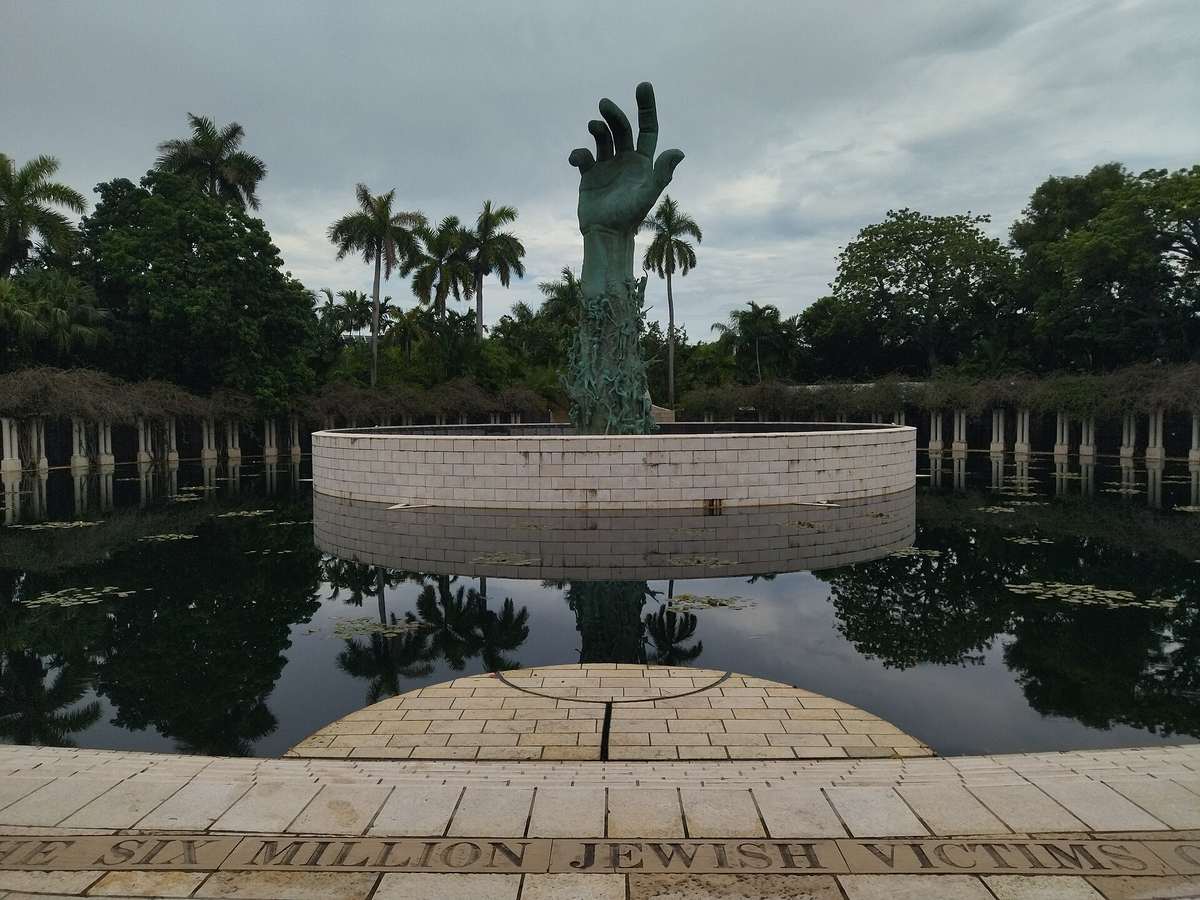
The Holocaust Memorial Miami Beach stands at 1933-1945 Meridian Avenue in Miami Beach. It honors the six million Jews who perished in the Holocaust: an outdoor sequence of bronze sculptures, a wall of names and photographs etched in black granite. Admission is free and it is open every day. Miami Beach is its own city next to Miami; our Miami city guide covers the wider area.
History: from survivors' idea to the 1990 dedication
According to the memorial, a small group of Holocaust survivors came together in 1984 to create a permanent memorial in Miami. South Florida had one of the largest survivor populations in the United States, an estimated 20,000 to 25,000 people, many living in Miami Beach itself. The Holocaust Memorial Committee was formally set up as a private non-profit in 1985.
The site covers several city blocks, and its street numbers, 1933-1945, match the years of the Nazi regime. The memorial says many took this as fate, and it helped persuade some city legislators.
There was opposition. Some argued a resort city should stay about sun and fun; others said a memorial on city land breached the separation of church and state. The memorial says it is also a historical monument, and all religious symbols were removed from the plans. On November 27, 1984, about 500 people, dozens of them survivors, packed a Miami Beach Planning Board meeting. The board approved the memorial unanimously, and the City Commission followed eight days later.
Architect and sculptor Kenneth Treister was commissioned in 1985. His focal point is an outstretched arm more than four stories high, tattooed with an Auschwitz number. Critics called it grotesque; survivors and committee members answered that this was exactly the point. The bronze was cast at a foundry in Mexico City between 1987 and 1989, the arm in five interlocking pieces that were trucked to Miami Beach. The foundation is pink-hued Jerusalem stone brought from Israel.
Construction took more than four years. The memorial was dedicated on Sunday, February 4, 1990, with Nobel laureate Elie Wiesel as guest speaker. Today it is part of the Greater Miami Jewish Federation, which says more than 100,000 people visit each year and that survivors serve as docents.
What to see
The memorial is laid out as a procession of outdoor spaces, described on its own gallery page:
- Garden of Meditation: a Jerusalem stone plaza, a 200-foot-diameter water lily pond, a semicircular colonnade and a palm forest. Treister said the white lilies recall the souls lost in the Holocaust.
- The first sculpture: a mother and two children as the first signs of the Holocaust appear, framed by words of Anne Frank.
- Arbor of History: a Jerusalem stone colonnade under a wooden arbor with white bougainvillea, followed by black granite slabs etched with photographs of Holocaust history, with captions by the memorial's historian, Professor Helen Fagin.
- Dome of Contemplation: an eternal flame, a line from the 23rd Psalm and a shaft of yellow light from a Star of David bearing the word Jude, like the patches Jews were forced to wear.
- The Lonely Path: a dark stone tunnel lit by thin slats of sunlight, where Israeli children's voices sing songs from the Holocaust. Plaques naming the death camps were moved from the ground to the walls after visitors felt they were walking on graves.
- Sculpture of Love and Anguish: the arm carries more than 100 intertwined figures and is encircled by other freestanding victims; nearby vignettes show families comforting each other.
- Memorial Wall: many thousands of names carved in black granite, with more added at families' request. The site has a directory to locate a name.
- The final sculpture: the same mother and two children, now dead, again framed by Anne Frank's words.
Education Center and tours
The memorial's Education Center is on the same grounds. Its centerpiece, Dimensions in Testimony, was developed with the USC Shoah Foundation and lets visitors hold simulated conversations with Holocaust survivors, including those no longer living. It keeps shorter hours than the memorial (see the table).
For self-guided visits there is an iPhone app and audio tour with recollections of Miami survivors and a "Sculptor's Tour" led by Kenneth Treister. It is available in eight languages, Russian among them. Groups of 10 or more must reserve at least two weeks ahead.
How to get there and parking
From the north: I-95 south to I-195 East (Julia Tuttle Causeway), exit right onto Alton Road, left on Dade Boulevard, left on Meridian Avenue; the memorial is on the left. From the south: I-95 north to I-395 East (MacArthur Causeway), exit left onto Alton Road, right on 17th Street, left on Meridian Avenue; it is on the right.
Limited metered parking is on Elie Wiesel Way (19th Street). The Miami Beach 17th Street Garage is at 640 17th St. Public transit runs seven days a week; the memorial does not name routes and suggests checking Google Maps or similar. According to the city, the free Miami Beach Trolley Middle Beach Loop stops at Meridian Avenue and 19 Street (stop 201, northbound), running daily from 8 a.m. to 11 p.m. about every 20 minutes; see the city's route page. More sights nearby are on our Miami places page.
Hours and admission
| What | When | Price |
|---|---|---|
| Memorial (outdoors) | Daily, 365 days a year, 10 a.m. to sunset | Free, no tickets |
| Education Center | Mon-Wed 1-4 p.m., Thu 1-7 p.m., Fri 1-4 p.m., Sat-Sun 10 a.m.-3 p.m. | Price not listed on the center's page |
| Dimensions in Testimony sessions | Mon-Wed 1 and 3 p.m., Thu 1, 3 and 6 p.m., Fri 1 and 3 p.m. |
Hours and prices checked November 11, 2026 on holocaustmemorialmiamibeach.org.
The Greater Miami Jewish Federation page gives an earlier opening time (9 a.m. to sundown), so rely on the memorial's own FAQ or call 305-538-1663.
Tips for your visit
- Allow one to one and a half hours; the memorial says about 90 minutes.
- Recommended for visitors age 10 and older.
- No bicycles and no pets; for a service dog, email info@holocaustmemorialmiamibeach.org.
- The memorial asks that you not bring food.
- It is almost entirely outdoors: hats, sunglasses, sunscreen and water help.
Questions people ask
Do you need tickets for the Holocaust Memorial Miami Beach?
No. The memorial's official site says tickets are not required and admission is free. It is entirely outdoors at 1933-1945 Meridian Avenue in Miami Beach. Donations can be made online or at the information center on site. Groups of 10 or more need to reserve at least two weeks ahead.
What time does the memorial open, and is it open on holidays?
The memorial is open every day, 365 days a year, from 10 a.m. until sunset. The Education Center keeps its own shorter schedule, usually from 1 p.m. on weekdays and 10 a.m. to 3 p.m. on weekends. Other websites list different opening times, so check the memorial's own site before you go.
Is there an audio tour in Russian?
Yes. The memorial's iPhone app and audio tour is available in eight languages, including Russian. It automatically plays video and audio as you walk, featuring Miami Holocaust survivors, and includes a Sculptor's Tour narrated by the memorial's designer, Kenneth Treister. Docent-led visits are offered to groups that book in advance.
Where do you park at the Holocaust Memorial Miami Beach?
Limited metered city parking is on Elie Wiesel Way, also called 19th Street, beside the memorial. More spaces are at the Miami Beach 17th Street Garage, 640 17th St. Bicycles and pets are not allowed on the memorial grounds.
Places on the map
Sources
- Holocaust Memorial Miami Beach, official site
- Our History, Holocaust Memorial Miami Beach
- The Holocaust Memorial Gallery
- The Holocaust Memorial Wall
- Sculpture of Love & Anguish (documentary)
- FAQs, Holocaust Memorial Miami Beach
- Directions & Transportation
- Self-Guided & Virtual Tours
- Field Trips & Group Tours
- The Education Center at the Holocaust Memorial Miami Beach
- Greater Miami Jewish Federation: Holocaust Memorial Miami Beach
- Middle Beach Loop, City of Miami Beach
- Citywide Free Trolley, City of Miami Beach