RussiansInUSA editorial team · Facts checked November 11, 2026 · Official site
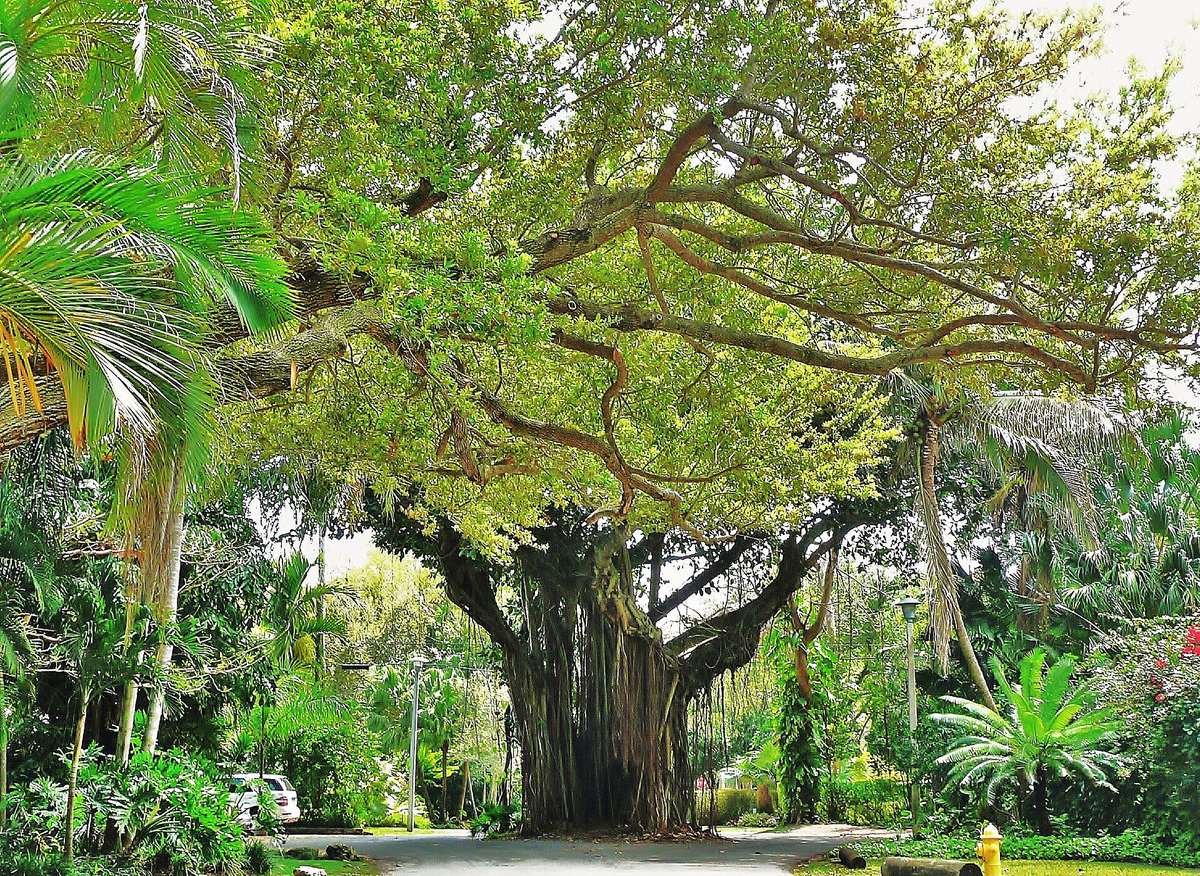
Coconut Grove in Miami is the city's oldest neighborhood, on Biscayne Bay south of downtown and Brickell. Its business improvement district (the Coconut Grove BID) calls it Miami's oldest neighborhood. People come for The Barnacle, an 1891 pioneer house, the homes of early Bahamian settlers on Charles Avenue, bayfront Peacock Park, the Dinner Key marina and The Kampong garden. Metrorail and the free Miami Trolley both reach it.
Coconut Grove history: a bay settlement older than Miami
The Grove is older than the city around it. Miami-Dade County says the City of Miami was incorporated in 1896, while the Museum of Miami ran walking tours in January 2023 to mark Coconut Grove's 150th anniversary. The museum credits Dr. Horace Porter, who opened a post office, with giving the place its name.
The museum lists the Beasley, Frow and Pent families, E. W. F. Stirrup and Mariah Brown among the early residents, and says Bahamian settlers shaped the Grove with their knowledge of tropical plants and local building materials.
The City of Miami's historic preservation office adds detail. Mariah Brown came to Florida from the Bahamas in 1880, worked at the Peacock Inn, and around 1890 built a house on Charles Avenue within walking distance of the hotel; the city calls it one of the first houses thought to have a Black owner. Ebenezer Stirrup, also an African-Bahamian immigrant, built his two-story house on the same street in 1897. According to the city, he became one of the largest landowners in the Grove and built more than 100 houses so that newly arrived Bahamians could buy a first home.
In 1887 residents formed the Biscayne Bay Yacht Club and elected Ralph Middleton Munroe commodore, a title he held for 22 years. In 1891 Munroe moved into his bungalow on the ridge above the bay, later called The Barnacle.
Plymouth Congregational Church was built of local limestone in 1917. A movie house called The Grove opened on Main Highway in 1926; the city says it closed in 1954 and reopened in 1956 as a live theater, the Coconut Grove Playhouse. Pan American Airways later based its Clipper flying boats at Dinner Key, and the old Pan Am terminal is now Miami City Hall. The BID adds that Alexander Graham Bell, Tennessee Williams, David Crosby, Jimmy Buffett and Madonna all lived in the Grove.
What to see in Coconut Grove
The Barnacle
Munroe's house at 3485 Main Highway is now The Barnacle Historic State Park. The Barnacle Society, the nonprofit that supports the park, says that in 1908 the whole house was lifted and a new first floor built beneath it. The 1887 boathouse was the first building on the land; it was rebuilt after the 1926 hurricane and became the yacht club's first clubhouse. Munroe paid $400 for the land plus his sailboat Kingfish, valued at another $400. In 1973 the Florida Park Service bought the last five acres of his original 40 from his descendants.
Charles Avenue and the Bahamian houses
The Mariah Brown House is at 3298 Charles Avenue and the Stirrup House at 3242 Charles Avenue. Both are city-designated historic sites. The city compares the Brown house to the wooden homes of Key West and the Bahamas in the late 1800s.
Plymouth Church and other landmarks
Plymouth Congregational Church (3429 Devon Road), with its twin bell towers, was built of oolitic limestone by one stonemason, Spanish-born Felix Rebom; the congregation dates from 1897. El Jardin (3747 Main Highway, 1917) is, per the city, the earliest known full Mediterranean Revival building in Miami and now houses a private school. The Woman's Club of Coconut Grove meets in its 1921 building at 2985 S Bayshore Drive. Marjory Stoneman Douglas wrote "The Everglades: River of Grass" (1947) in her house at 3744-3754 Stewart Avenue.
Peacock Park and Dinner Key
City-run Peacock Park, 2820 McFarlane Road, sits on the water with a playground, basketball court, picnic tables and restrooms; leashed dogs are allowed. Dinner Key Marina, 3400 Pan American Drive, has 587 slips and sits beside historic City Hall.
The Kampong
A National Tropical Botanical Garden site at 4013 South Douglas Road. Plant explorer David Fairchild lived here and named it after villages he had seen in Malaysia.
How to get to Coconut Grove
Take Metrorail to Coconut Grove or Douglas Road station. Trains run 5 am to midnight daily, a ride costs $2.25, and rail-to-bus transfers are free. Fare gates take no cash: use a contactless card, an EASY Card or the GO Miami-Dade Transit app.
The free Miami Trolley Coconut Grove route stops at both stations, at Bayside, Armbrister and Douglas parks and at Grove Central. The BID says it runs along Grand Avenue and South Bayshore Drive past Peacock and Kennedy parks. Citywide, trolleys come every 15 to 45 minutes.
Driving: the BID's parking page lists 13 lots, among them the public MPA Playhouse Lot (3500 Main Highway, 235 spaces, 12 EV chargers), the Commodore Lot (3121 Commodore Plaza, 220 spaces) and two CocoWalk garages (3059 Grand Avenue and 3351 Virginia Street). The public King's Lot (3431 Main Highway, 189 spaces) is close to The Barnacle.
Hours and tickets
| Place | Hours | Price |
|---|---|---|
| The Barnacle grounds | Thu-Mon 9 am-5 pm; closed Tuesday, Wednesday, Christmas Day and New Year's Day | $2 per walker or cyclist, 5 and under free |
| The Barnacle house | guided tours only: 10 am, 11:30 am, 1 pm, 2:30 pm | 13 and up $3, ages 6-12 $1, 5 and under free |
| The Kampong | Tue-Sat 9 am-4:30 pm, last entry 3 pm; closed Sun and Mon | not listed on the site |
| Peacock Park | daily 7 am-10 pm | no fee listed on the city page |
| Miami Trolley, Coconut Grove route | Mon-Sat 6:30 am-11 pm, no Sunday service | free |
Hours and prices checked November 11, 2026 on thebarnacle.org, ntbg.org and miami.gov.
Tips before you go
The Barnacle has no parking of its own; the society points to metered spaces nearby and warns that Google Maps shows the wrong address, so search for 3485 Main Highway. House tour tickets are sold at the Carriage House Ranger Office, and prices may change during special events.
The Kampong encourages booking ahead to secure parking. On Sundays the Coconut Grove trolley does not run and The Kampong is closed, so Thursday, Friday or Saturday is the day when The Barnacle, The Kampong and the trolley all work.
For more of the city, see our Miami guide and the list of Miami sights.
Questions people ask
How much does it cost to visit The Barnacle in Coconut Grove?
Entry to The Barnacle Historic State Park grounds is $2 per walker or cyclist, and children 5 and under get in free. The house itself is shown only on guided tours at 10 am, 11:30 am, 1 pm and 2:30 pm, costing $3 for ages 13 and up and $1 for ages 6 to 12.
When is The Barnacle closed?
The Barnacle is open Thursday through Monday, 9 am to 5 pm. It is closed on Tuesdays and Wednesdays, on Christmas Day and on New Year's Day. The park is at 3485 Main Highway in Coconut Grove and has no parking of its own; the public King's Lot is at 3431 Main Highway.
Which Metrorail station is closest to Coconut Grove?
Two Metrorail stations serve the area, Coconut Grove and Douglas Road. The free Miami Trolley Coconut Grove route links both to the neighborhood Monday through Saturday, 6:30 am to 11 pm. A Metrorail ride costs $2.25, paid with a contactless card, an EASY Card or the GO Miami-Dade Transit app.
Where did the first Bahamian settlers of Coconut Grove live?
Bahamian settlers built along Charles Avenue. The Mariah Brown House at 3298 Charles Avenue dates from about 1890 and the E. W. F. Stirrup House at 3242 Charles Avenue from 1897. Both are City of Miami historic sites.
Places on the map
Sources
- Coconut Grove BID: official neighborhood site
- Coconut Grove BID: Coconut Grove history
- Coconut Grove BID: directions and parking
- The Barnacle Society: visit (hours, fees, tours, parking)
- The Barnacle Society: history
- The Barnacle Society: maritime history
- City of Miami Historic Preservation: Mariah Brown House
- City of Miami Historic Preservation: E.W.F. Stirrup House
- City of Miami Historic Preservation: Plymouth Congregational Church
- City of Miami Historic Preservation: Coconut Grove Playhouse
- City of Miami Historic Preservation: El Jardin
- City of Miami Historic Preservation: Housekeepers Club of Coconut Grove
- City of Miami Historic Preservation: Marjory Stoneman Douglas House
- City of Miami: Peacock Park
- City of Miami: Dinner Key Marina (Pan Am terminal, City Hall)
- City of Miami: trolley maps and routes (Coconut Grove route)
- City of Miami: trolley information (free fare, frequency)
- Miami-Dade County: Metrorail hours and fares
- Miami-Dade County: About Miami-Dade County (1896 incorporation)
- National Tropical Botanical Garden: The Kampong
- Museum of Miami (HistoryMiami): Coconut Grove 150th anniversary tour
- Museum of Miami: History in the Grove, Charles Avenue walking tour
- CBS News Miami: the Mariah Brown House