RussiansInUSA editorial team · Facts checked November 11, 2026
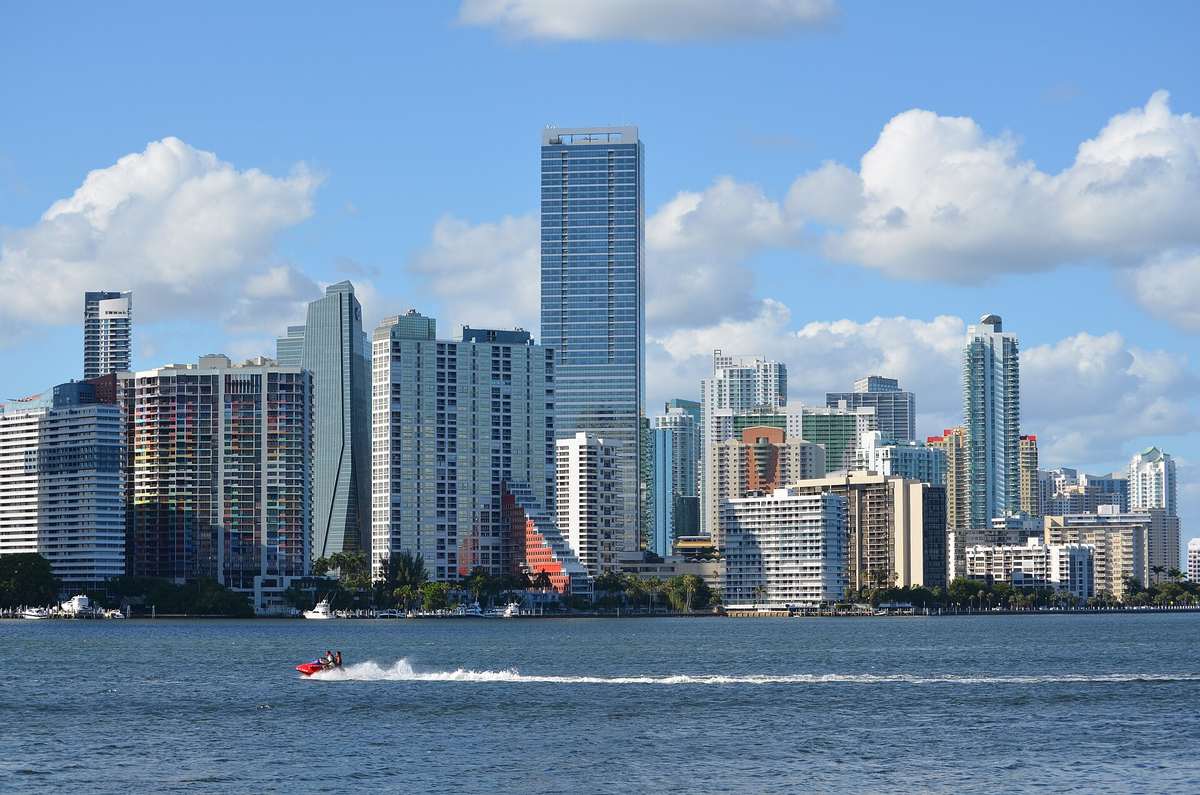
Brickell is the Miami neighborhood on the south bank of the Miami River, stretched along Brickell Avenue and Biscayne Bay. Today it is a district of high-rises, yet between the towers you can still find the oldest layers of the city's story: a pre-Columbian circle cut into the rock, the tomb of a pioneer family and fragments of tropical forest. Come for the waterfront, that history and the free transit that links Brickell with downtown and Little Havana.
Brickell history: from trading post to avenue
The neighborhood carries the Brickell family name. According to its National Register of Historic Places nomination, William Brickell was born in Steubenville, Ohio, in 1825 and moved to Miami in 1871. He paid $3,000 for a large parcel running from the south shore of the Miami River to Coconut Grove. There he built his home and trading post of local rock, traded profitably with the Seminole Indians, and his land became the center of local activity.
The same document credits William Brickell, together with Julia Tuttle, with luring railroad entrepreneur Henry M. Flagler to Miami, which gave the city its rail link with northern Florida and the rest of the Eastern Seaboard. His wife, Mary Brickell, handled the family's real estate, and their daughter Alice served as postmistress.
The Brickell home was demolished long ago. The only surviving structure tied to the family is the 1924 mausoleum in Brickell Park. Their daughter Maude E. Brickell had it built, and in 1924 she deeded the five acres around it to the City of Miami for a park. In 1948, the nomination says, Maude complained that the nights were too noisy there and moved the family's remains to Woodlawn Cemetery. The mausoleum was listed in the National Register on January 4, 1989.
What to see in Brickell
Miami Circle
An archaeological site at Brickell Point on the Miami River, at 401 Brickell Avenue. The Florida Department of State says it was discovered during archaeological salvage excavations in 1998 and is made of holes and basins carved into the shallow limestone. The City of Miami calls it the only complete cut-in-rock prehistoric structural footprint discovered in eastern North America and believes it was the southern part of a pre-Columbian village. The State bought the property in 1999, per the City. The National Park Service designated it a National Historic Landmark on January 16, 2009.
Florida's Division of Historical Resources says you reach it by the driveway in front of the Icon Brickell high-rise, or through Brickell Park and along the baywalk. A large Tequesta village from the time of European contact, the same source says, was found across the river, near the Hyatt Regency and the convention center.
Brickell Mausoleum in Brickell Park
A small granite tomb, about 11 by 15 feet, in a Neo-Classical style: four Ionic columns, a shallow pediment and the name "Brickell" across the entablature. The Thurmond Monument Company built it, and it faces east to Biscayne Bay. The park address is 501 Brickell Avenue. The tomb has been empty for decades.
"Tequesta Family" on the bridge
The bronze "Tequesta Family" stands on top of the Brickell Avenue Bridge over the Miami River. The state credits it to Cuban-born sculptor Manuel Carbonell.
Simpson Park
A city park at 55 SW 17 Road. The City of Miami describes it as a remnant of the Brickell Hammock, a tropical hardwood forest, and one of the first conservation efforts in Miami: more than eight acres, over 162 plant species, at least 96 of them native. Free nature walks run on Saturdays and Sundays at 10:30 am and 1:30 pm, up to 20 people, first come, first served.
Alice C. Wainwright Park
A waterfront park at 2651 Brickell Avenue. The City describes its natural forest as a tropical hardwood hammock; it also has a playground, basketball courts and BBQ grills. Leashed dogs are welcome.
How to get to Brickell
- Metrorail. Brickell station. The fare is $2.25, or $1.10 discounted. Pay with a contactless card, EASY Card, EASY Ticket or the GO Miami-Dade Transit app; fare gates do not take cash. The Orange Line goes to the airport (MIA station); check the Metrorail page for weekend service.
- Metromover. A free people mover running above the streets from Financial District Station in Brickell to School Board Station in the Omni area, with its own Brickell Loop.
- Miami Trolley. Free. The Brickell route stops at Brickell Key, Brickell City Centre, Brickell Park and Kennedy Park, Brickell Metrorail Station, Mercy Hospital and City Hall. The Little Havana route connects Brickell with Little Havana and stops at Brickell Metrorail/Metromover Station, and the Coral Way route reaches Vizcaya Metrorail Station. The City of Miami trolley does not go to Miami Beach.
Routes and the live map are on the Miami Trolley page; fares are on the Metrorail page.
Brickell hours and tickets
Brickell is an ordinary city neighborhood with no admission. Parks and transit keep hours:
| Place | Hours | Price |
|---|---|---|
| Simpson Park | daily 8 am - 3 pm | no fee listed on the City page |
| Alice C. Wainwright Park | sunrise to sunset | no fee listed on the City page |
| Metrorail | daily 5 am - midnight | $2.25, discounted $1.10 |
| Metromover | daily 5:30 am - 10 pm | free |
| Miami Trolley, Brickell route | Mon-Sat 6:30 am - 11 pm, Sun 8 am - 8 pm | free |
Hours and prices checked on November 11, 2026 at miami.gov and miamidade.gov. The official pages we opened list no hours for the Miami Circle or Brickell Park.
Tips before you go
- Simpson Park's trail may close ahead of weather alerts; call 305-533-3577 to check. Dogs are not allowed in Simpson Park.
- The City says trolleys arrive roughly every 15 to 45 minutes. Trolley help line: 305-416-1132.
- Alice C. Wainwright Park is unstaffed; questions go to Parks Administration at 305-416-1300.
For the rest of the city, see our Miami page and what to see in Miami. The free Little Havana trolley stops at Brickell station.
Questions people ask
Can I get to Brickell from downtown Miami for free?
Yes. Metromover, Miami-Dade County's people mover, is free and runs daily from 5:30 am to 10 pm, including the Brickell Loop. The City of Miami Trolley is free too: its Brickell, Biscayne and Coral Way routes all stop at Brickell Metrorail Station.
What is the Miami Circle?
It is an archaeological site at 401 Brickell Avenue: holes and basins carved into limestone, found during salvage excavations in 1998. The City of Miami believes it was the southern part of a pre-Columbian village. The State of Florida bought the property in 1999, and it became a National Historic Landmark in 2009.
Who is Brickell named after?
The neighborhood carries the Brickell family name. William Brickell came to Miami in 1871, paid $3,000 for land from the Miami River to Coconut Grove and built a home and trading post. With Julia Tuttle, he persuaded Henry Flagler to bring his railroad to Miami. The family's 1924 mausoleum in Brickell Park is its only surviving structure.
When is Simpson Park open?
Simpson Park, at 55 SW 17 Road, is open every day from 8 am to 3 pm. Free guided nature walks run on weekends at 10:30 am and 1:30 pm, for up to 20 people. Dogs are not allowed, and the trail may close ahead of weather alerts; call 305-533-3577 for updates.
Places on the map
Sources
- National Park Service: National Register nomination, Brickell Mausoleum (listed Jan. 4, 1989)
- National Park Service: National Historic Landmarks by state (Miami Circle at Brickell Point, 01/16/09)
- City of Miami: Historic Preservation (Brickell Park and Mausoleum, Miami Circle archeological zones)
- Florida Department of State, Division of Historical Resources: Miami Circle
- Florida Division of Historical Resources: Miami Circle (access, Brickell Park, Tequesta Family statue)
- City of Miami: Simpson Park
- City of Miami: Alice C. Wainwright Park
- City of Miami: Trolley information, schedules and maps
- City of Miami: Trolley maps and routes
- Miami-Dade County: Metrorail
- Miami-Dade County: Metromover