RussiansInUSA editorial team · Facts checked November 12, 2026 · Official site
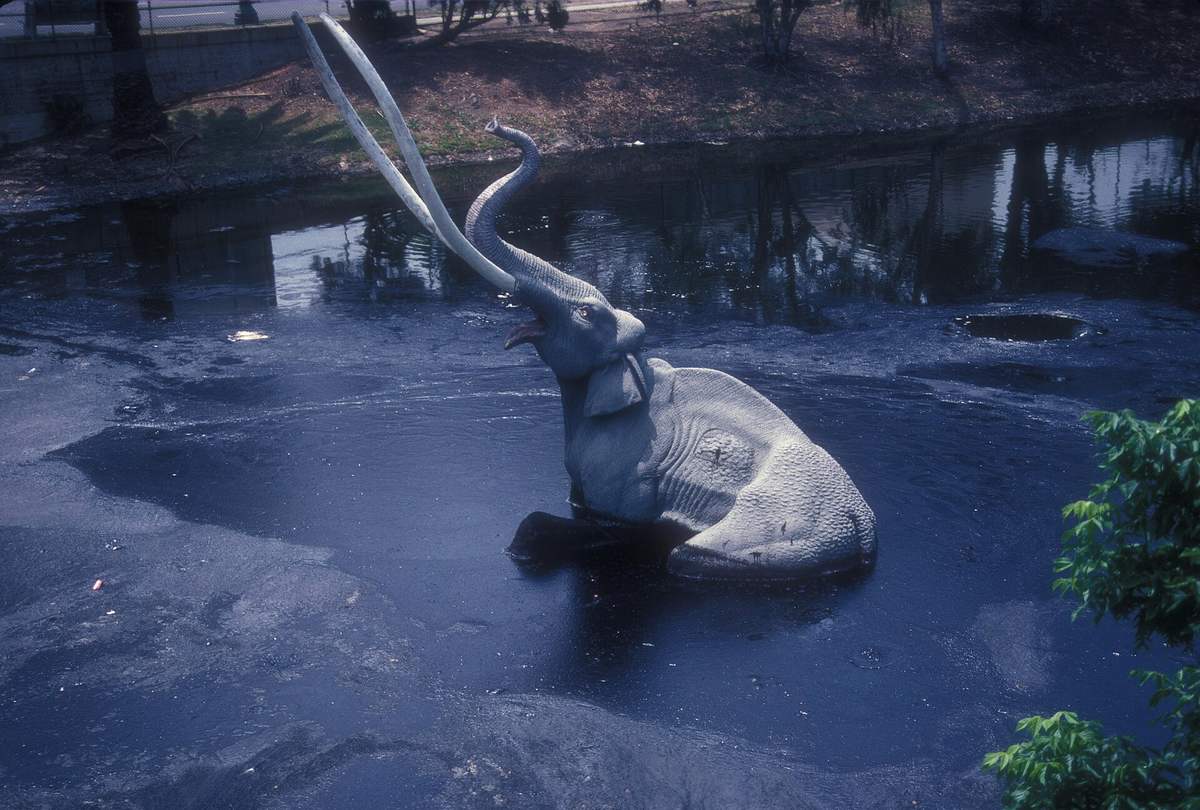
The La Brea Tar Pits in Los Angeles are a place where natural asphalt still seeps out of the ground and paleontologists dig up Ice Age bones in the middle of a city park. The pits sit in Hancock Park at 5801 Wilshire Boulevard, next door to LACMA. People come for the mammoth figures at the lake, the bubbling asphalt and excavations that happen in plain view.
La Brea Tar Pits history: from "springs of pitch" to a museum
The first written mention comes from Juan Crespi, who traveled with the 1769 expedition of Gaspar de Portola and recorded "springs of pitch" in his diary. In 1828 Antonio Jose Rocha received Rancho La Brea, a Mexican land grant of more than 4,400 acres, on the condition that residents could take asphalt for their own use.
Science came later. W. Denton first described fossils from the rancho in 1875. In 1901 Los Angeles geologist W. W. Orcutt recognized the bones as extinct animals and excavated with F. Anderson. J. C. Merriam of UC Berkeley dug here in 1905, and in 1907 teacher J. Z. Gilbert brought Los Angeles High School students.
In 1913 ranch owner George Allan Hancock gave Los Angeles County exclusive rights to dig for two years. The museum calls the 1913 to 1915 collections the largest and best documented of their time: 96 sites and well over 750,000 plant and animal specimens. In 1924 Hancock donated 23 acres to the county on the condition that the park be preserved and the fossils properly exhibited. That land became Hancock Park.
In the 1960s Rancho La Brea became one of the first National Natural Landmarks; the museum's history page gives both 1963 and 1964. Pit 91, left at 10 feet in 1915, reopened in 1969 and was sampled until 2007. Philanthropist George C. Page funded an on-site museum, and the George C. Page Museum opened in 1977. It was renamed La Brea Tar Pits & Museum in 2015.
In 2006, construction of LACMA's underground garage exposed 16 new fossil deposits. They were moved out whole in 23 large wooden boxes, which gave Project 23 its name. One find is a mammoth nicknamed Zed, a Columbian mammoth about 80 percent complete. In 2022 the International Union of Geological Sciences named La Brea one of its first 100 Geological Heritage Sites. The site belongs to the Natural History Museums of Los Angeles County.
What to see at the La Brea Tar Pits
The fossils span roughly the last 50,000 years. Oil formed underground and tectonic activity pushed it to the surface as asphalt, where animals became stuck, and the museum calls La Brea a famous carnivore trap. Whole skeletons are rare; bones from different animals are usually jumbled together. The museum's closure page says more than 3.5 million fossils have been excavated so far, while its history page counts more than 2 million specimens in the collection.
The museum says dire wolves are the most common large mammals, followed by saber-toothed cats and coyotes. Its scientists also study ancient bison and Western horses, and finds include giant short-faced bears, ground sloths and mammoths. The museum describes its fossil bird collection as one of the largest in the world.
In the park:
- Lake Pit. Left over from asphalt mining in the late 1800s, with mammoth and mastodon models showing a mammoth trapped in the "tar." The best known view in the park.
- Pit 91. First excavated in 1915. A viewing station looks deep into the pit, and in summer you can watch paleontologists at work.
- Project 23. The salvage dig of the LACMA garage boxes, which the museum says could double its collections.
- Observation Pit. Opened in 1952 over Pit 101 as the first museum in Hancock Park, with real fossils and casts laid out the way excavators find them. Check its page to see whether it is open.
The museum building is being rebuilt to a design by Weiss/Manfredi, with a new Wilshire entrance, labs and collections visitors can see into, classrooms and the Samuel Oschin Global Center for Ice Age Research. While the work goes on, check tarpits.org for which buildings and outdoor areas are open.
How to get to the La Brea Tar Pits
Take the Metro D Line to Wilshire/Fairfax station, as the museum's site recommends. LA Metro says Wilshire/Fairfax opened with Wilshire/La Brea and Wilshire/La Cienega as Section 1 of the D Line Extension, and all three stations are fully ADA accessible.
The museum lot is on South Curson Avenue (Insider Tours meet at 725 South Curson Avenue). Check tarpits.org for whether it is open to the general public. On the check date it was reserved for Insider Tour ticket holders, who get a free space and show their confirmation email at the booth.
For more on the city, see our Los Angeles guide.
Hours and tickets
| Item | What the official site says |
|---|---|
| Museum building | Closed for renovation and regular admission paused on the check date; check tarpits.org for which buildings are open |
| Hancock Park and outdoor digs | Many outdoor areas open on the check date, hours not listed |
| Insider Tour days | Saturday 11 am, Sunday 11 am and 2:30 pm, may vary |
| Insider Tour, adult | $125, $100 for members |
| Insider Tour, child | $105, $80 for members |
Hours and prices checked November 12, 2026 on tarpits.org.
The Insider Tour runs entirely outdoors. It brings you close to the Lake Pit mammoths and to the bubbling tar behind the fences, and you sort microfossils with scientists. It is open to ages 7 and up; anyone 17 and under needs a parent or guardian, at most three children per adult, a parent signs a waiver for the minors and each adult signs their own. Meet at the lot at 725 South Curson Avenue. Tickets are not refunded, and guests more than 10 minutes late may miss parts of the tour.
The site offers $2 off for showing a TAP card at check-in. It does not list opening hours right now, so check tarpits.org or call 213-763-3466 before you go.
Tips before you go
- Wear closed-toed, sturdy walking shoes for the Insider Tour; the museum requires them.
- The Insider Tour takes you behind the fences to the bubbling asphalt.
- Summer is when the museum says you can watch the Pit 91 dig.
- LACMA is right next door on Wilshire. More sights are on our Los Angeles places page.
Questions people ask
Can you visit the La Brea park for free?
On the check date the La Brea Tar Pits site said many outdoor areas of Hancock Park and select excavation sites remain open while the museum building is closed for renovation; check tarpits.org for what is open now. The Insider Tour costs $125 for adults and $105 for children, or $100 and $80 for museum members.
How old are the La Brea fossils?
According to La Brea Tar Pits, the fossils span roughly the last 50,000 years up to the present. They include saber-toothed cats, dire wolves, ancient bison, Western horses, ground sloths and mammoths. The museum says more than 3.5 million fossils have been excavated, and digging continues today.
Where do you park for La Brea Tar Pits?
The museum lot is on South Curson Avenue. On the check date it was open only to Insider Tour ticket holders, who get a reserved free space; check tarpits.org for whether it is open to everyone. The museum points visitors to the Metro D Line and Wilshire/Fairfax station.
How old do kids need to be for the Insider Tour?
The La Brea Tar Pits Insider Tour is open to visitors aged 7 and older. Children 17 and under must come with a parent or guardian, with no more than three children per adult. A parent signs a waiver for the children, closed-toed shoes are required and tickets are not refundable.
Places on the map
Sources
- La Brea Tar Pits
- La Brea Tar Pits History
- Museum closure, La Brea Tar Pits
- La Brea Tar Pits and Hancock Park
- Our Excavations, La Brea Tar Pits
- Pit 91, La Brea Tar Pits
- Project 23, La Brea Tar Pits
- Observation Pit, La Brea Tar Pits
- Our Research, La Brea Tar Pits
- Reimagine La Brea Tar Pits
- Parking and Directions, La Brea Tar Pits
- La Brea Tar Pits Insider Tour
- Metro D Line Subway Extension, LA Metro