RussiansInUSA editorial team · Facts checked November 18, 2026
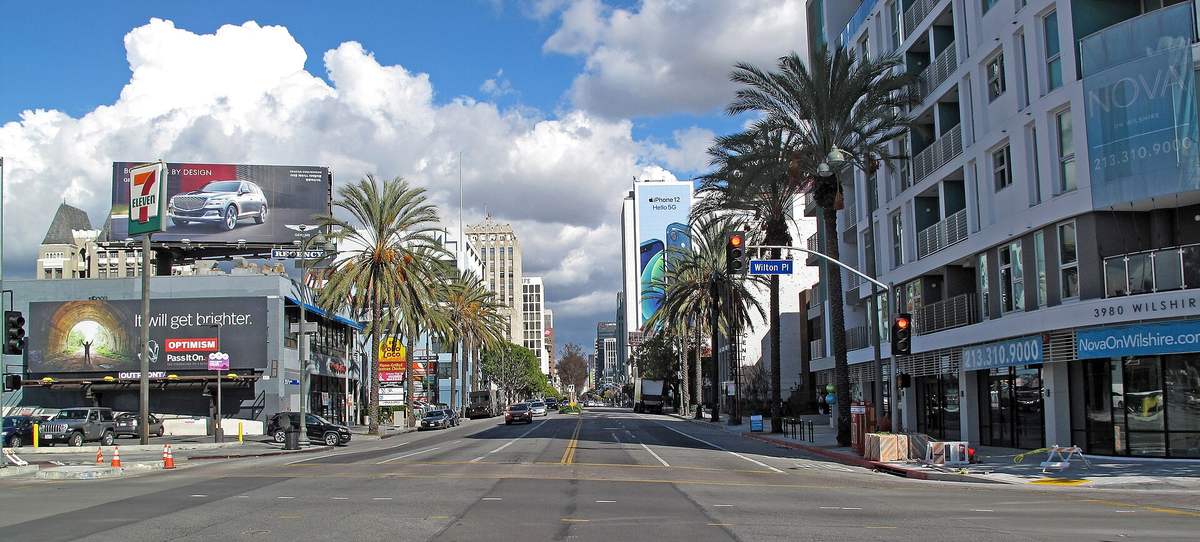
Koreatown (K-Town) in Los Angeles lies west of downtown and south of Hollywood, along Wilshire Boulevard. Discover Los Angeles, the city's tourism bureau, puts it at roughly 3 square miles. People come for Korean food, nightlife and the Art Deco buildings of the 1920s and 1930s: the Wiltern, the former Bullocks Wilshire department store, old temples and hotels. The Los Angeles city page covers the city as a whole.
History of Koreatown
In the early twentieth century most of Los Angeles' Korean residents lived on Bunker Hill downtown, one of the few places then open to non-white residents, the Los Angeles Conservancy writes. A Los Angeles Public Library blog post traces the community to independence activist Dosan Chang Ho Ahn, who arrived in the US in 1902 and later moved his family to Los Angeles, to Bunker Hill. The Korean Presbyterian Church and the Korean National Association on Jefferson Boulevard became the center of what is now called Old Koreatown.
Wilshire was a different place then. In the 1920s it filled with grand hotels, apartment buildings and department stores. Myron Hunt designed the Ambassador Hotel at 3400 Wilshire Blvd in 1921. The Conservancy says its Cocoanut Grove nightclub was the premier celebrity spot for decades, the hotel hosted six Academy Awards ceremonies, and Robert F. Kennedy was assassinated in the hotel in 1968. Discover Los Angeles calls the area the epicenter of Golden Age Hollywood.
A second wave of Korean immigrants came in the 1950s after the Korean War, and many more after federal immigration rules were relaxed in 1965. In 1957 the city lifted its height limit and office towers rose along Wilshire, while the original residents moved west and to the suburbs. Low rents and empty commercial space drew Korean businesses. The library blog says businessman Hi Duk Lee, who arrived in 1968, opened the Olympic Market and built the VIP Plaza near Normandie Avenue and Olympic Boulevard, and that Koreatown was recognized as an official neighborhood of Los Angeles County in 1980.
In 1992 the Los Angeles riots spread to Koreatown. The Conservancy notes that Radio Korea, founded in 1989, dropped its regular programs and opened its phone lines so people could call for help and share news. The Ambassador closed in 1989 and was demolished starting in 2005; the Robert F. Kennedy Community Schools now stand on the site.
Koreatown has never been only Korean. The Conservancy said in 2017 that about 53% of its residents identify as Latinx. The El Salvador Corridor, formally designated in 2012, runs south on Vermont Avenue, and Little Bangladesh borders it to the north.
What to see in Koreatown
The Wiltern and Pellissier Building
The blue-green terra cotta complex at 3790 Wilshire Blvd, on the corner of Western Avenue, opened in 1931 as Warner Bros.' Western Theatre. Stiles O. Clements of Morgan, Walls & Clements designed it, and G. Albert Lansburgh the theater interior. In 1979 the owner sought to demolish it, and the Conservancy counts its rescue as its first major advocacy win. Developer Wayne Ratkovich bought it in 1981, architect Brenda Levin led a four-year rehabilitation, and it reopened in 1985. Today it is a concert venue.
Bullocks Wilshire
This Art Deco store at 3050 Wilshire Blvd was built in 1929 by John and Donald Parkinson. The Conservancy calls it one of the first department stores built for shoppers arriving by car, with its own parking and porte cochere. It closed in 1993, and Southwestern Law School bought it in 1994. Its 241-foot tower is easy to spot from the boulevard.
Temples on Wilshire
The Conservancy counts more than a hundred religious institutions in Koreatown. Wilshire Boulevard Temple at 3663 Wilshire Blvd is home to the city's oldest Jewish congregation (founded in 1862), and its temple under a vast Byzantine-style dome was dedicated in 1929. Immanuel Presbyterian Church at 3300 Wilshire Blvd (1928) is modeled on French Gothic cathedrals. St. Basil Catholic Church at 3611 Wilshire Blvd (1969) is Brutalist concrete with a 160-foot spire.
Olympic Boulevard and Da Wool Jung
At 1000 S Normandie Ave, at Olympic Boulevard, stands Da Wool Jung ("harmonious gathering place"), a traditional Korean pavilion built in 2006 by craftspeople from Korea without nails or screws. Four Koreatown gateways went up along Olympic Boulevard in 2011, each topped by the Bong Hwang, a mythical bird of happiness and prosperity, with panels at the base telling the neighborhood's history.
Chapman Plaza and the Brown Derby
Chapman Plaza at 3451 W 6th St (1929) was one of the first drive-in markets on the West Coast, and the Conservancy says it is now filled mostly with Korean businesses. The hat-shaped dome of the famous Brown Derby restaurant was saved during demolition and built into the second floor of the shopping center at 3377 Wilshire Blvd.
Food and nightlife
Discover Los Angeles says Koreatown has one of the largest concentrations of nightclubs and 24-hour businesses in the country, and more large malls than any area of its size in the US. Korean barbecue leads, followed by dessert cafes serving patbingsoo (shaved ice), karaoke and skin care shops.
How to get to Koreatown
Metro is the easiest way. Metro's timetable shows the D Line running from Union Station through downtown with three stops in Koreatown: Wilshire/Vermont, Wilshire/Normandie and Wilshire/Western. The B Line also stops at Wilshire/Vermont before turning north toward Hollywood.
| Station | Lines | Nearby |
|---|---|---|
| Wilshire/Vermont | B, D | east end of the neighborhood, Bullocks Wilshire a few blocks east |
| Wilshire/Normandie | D | Wilshire Boulevard Temple, St. Basil, Chapman Plaza |
| Wilshire/Western | D | The Wiltern |
A ride on Metro rail or bus costs $1.75. Transfers within two hours are free when you tap to ride, but round trips do not count. Fares are capped at $5 a day and $18 for seven days; the caps do not apply to cash on buses. See metro.net for fares and schedules.
Hours and tickets
The neighborhood is open around the clock and needs no ticket. Individual stops keep their own hours:
| Place | Hours | Price |
|---|---|---|
| Streets, Da Wool Jung, Olympic Boulevard gateways | 24 hours | free |
| The Wiltern (3790 Wilshire Blvd) | show days | tickets on wiltern.com, phone 213-388-1400 |
| Wilshire Boulevard Temple (3663 Wilshire Blvd) | active synagogue | visits via wbtla.org, phone 213-388-2401 |
| Metro | per line schedule | $1.75, capped at $5 a day |
Hours and prices checked November 18, 2026 on metro.net, wiltern.com and wbtla.org.
Tips
Bullocks Wilshire is now a law school building, and the Conservancy says nothing about public access, so view it from the street. The temples are active congregations; call before going inside. The gateways and Da Wool Jung are on Olympic Boulevard, a few blocks south of Wilshire, so see them together. More sights are on our list of places to visit in Los Angeles.
Questions people ask
How do I get to Koreatown by Metro?
The Los Angeles Metro D Line runs from Union Station through downtown and stops in Koreatown at Wilshire/Vermont, Wilshire/Normandie and Wilshire/Western stations. The B Line also stops at Wilshire/Vermont. A ride costs $1.75, and fares are capped at $5 a day when you tap a TAP card.
Where was the Ambassador Hotel in Koreatown?
The Ambassador Hotel stood at 3400 Wilshire Blvd. Myron Hunt designed it in 1921, it hosted six Academy Awards ceremonies, and Robert F. Kennedy was assassinated there in 1968. It closed in 1989, demolition began in 2005, and the Robert F. Kennedy Community Schools now occupy the site.
What is the Wiltern?
The Wiltern is a concert venue in a 1931 Art Deco building at 3790 Wilshire Blvd, on the corner of Wilshire and Western. It opened as a Warner Bros. movie theater. When its owner sought to demolish it in 1979, the Los Angeles Conservancy fought to save it, and it reopened in 1985 after restoration. The nearest Metro station is Wilshire/Western.
When did Koreatown become an official neighborhood?
According to a Los Angeles Public Library blog post, Koreatown was recognized as an official neighborhood of Los Angeles County in 1980. Businessman Hi Duk Lee pushed for it after arriving in 1968, opening the Olympic Market and building the VIP Plaza near Normandie Avenue and Olympic Boulevard.
Places on the map
Sources
- LA Metro: Fares
- LA Metro: B and D Lines timetable
- Los Angeles Public Library: The History of Koreatown, a Heartbeat of Los Angeles
- Los Angeles Conservancy: L.A.'s K-Town, Culture and Community (tour map)
- Los Angeles Conservancy: The Wiltern and Pellissier Building
- Los Angeles Conservancy: Bullocks Wilshire
- Los Angeles Conservancy: Ambassador Hotel
- Discover Los Angeles: The Guide to Koreatown
- The Wiltern
- Wilshire Boulevard Temple
- Academy Museum: Ambassador Hotel