RussiansInUSA editorial team · Facts checked November 18, 2026 · Official site
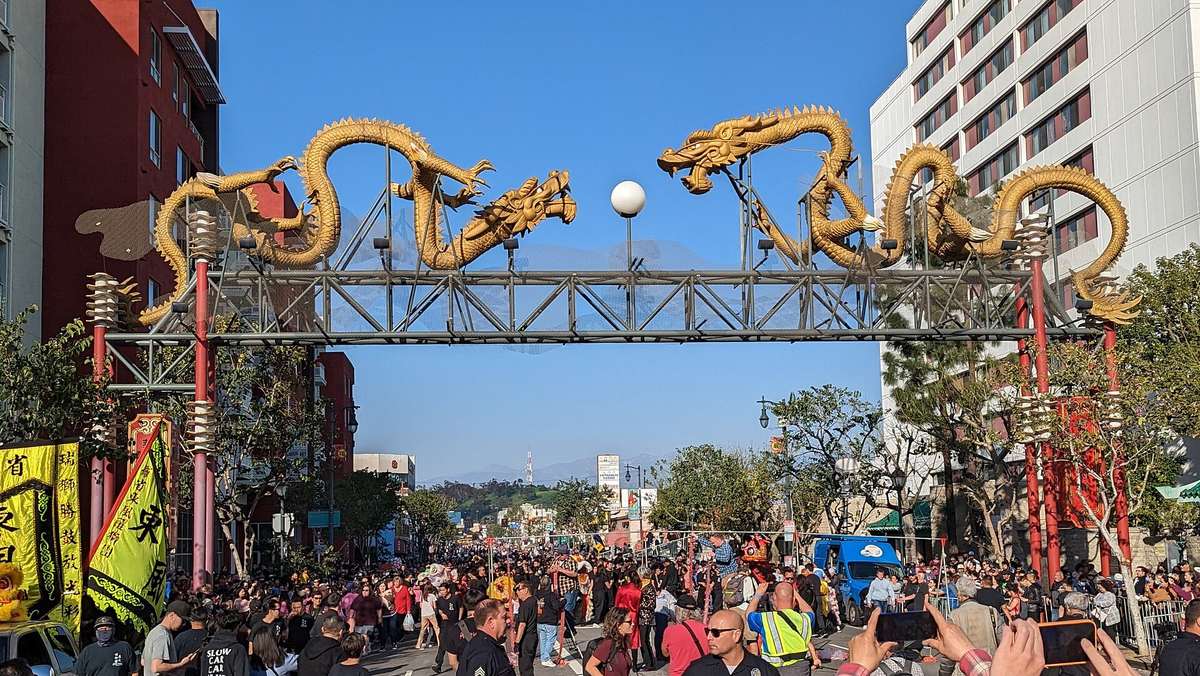
Chinatown in Los Angeles is the Chinese district just north of the old El Pueblo plaza, on North Broadway and Hill Street, with its business district office at 727 N. Broadway. People come for the 1938 gates, Central Plaza, old bakeries and shops, and for its story: in 1938 historian William Hoy called it the only Chinese community in America planned beforehand. The Los Angeles city page covers it briefly; this page goes further into how the district moved, what to see and how to get there.
History of LA Chinatown: from Old Chinatown to New
The district's official site, chinatownla.com, publishes its history as a reprint from the 1988 guidebook for New Chinatown's 50th year. By that account, the first Chinese resident of Los Angeles was recorded in 1852, and continuous Chinese settlement began in 1857. By 1870 a Chinatown of about 200 people stood on Calle de Los Negros near the El Pueblo plaza.
Old Chinatown peaked from 1890 to 1910, with a Chinese opera theater, three temples and, for a time, a newspaper. The Exclusion Acts then cut off new arrivals, and a new produce center at City Market drew residents away.
The land was wanted for a railroad. On November 7, 1914, San Francisco capitalist L.F. Hanchett bought the Chinatown property east of Alameda Street for more than $2 million, but the courts stopped his plan for a terminal there. On May 19, 1931, a California Supreme Court decision cleared the way for Union Station on the Old Chinatown site.
A 1933 relocation plan was dropped as too costly, and the Chinese School was torn down that December. In the late 1930s Christine Sterling, who had created Olvera Street, opened China City with stalls for displaced merchants; after fires it was gone by the early 1950s.
The lasting answer came from Peter SooHoo, a Chinese American engineer and community leader, who worked with railroad officials to secure a site on North Broadway. He called Santa Fe land agent Herbert Lapham the "godfather" of Chinatown. On April 22, 1937, the founders met at the Tuey Far Low restaurant and formed the Los Angeles Chinatown Project Association. They raised the money by selling 546.5 shares at $100 each, with no bank loans; about $100,000 had gone in by opening day.
Architects Erle Webster and Adrian Wilson mixed Chinese motifs with modern buildings. The first 18 units went up along Gin Ling Way, and stores opened in February 1938. The grand opening was June 25, 1938: Governor Frank Merriam dedicated a plaque to Chinese pioneers, with Mayor Frank Shaw and actress Anna May Wong among the guests. Historian William Hoy wrote that this was the only Chinese community in America planned beforehand.
The Chinese Historical Society of Southern California (CHSSC), founded in 1975, runs tours of the district and supports commemorations, among them one for the Chinese Massacre of 1871. Today the district's business group describes it as a busy center of commerce, tourism, culture and community, a stone's throw from the city's civic and cultural center.
What to see in Chinatown
Central Plaza and the gates
Central Plaza is the pedestrian heart of New Chinatown, entered through the East Gate. Y.C. Hong built the East Gate, also called the Broadway Gate, in 1938; it was refurbished in 1985. The West Gate on Hill Street (once Castelar Street) is the oldest pailou, or ceremonial gate, in Chinatown. It contains camphor wood about 150 years old when the gate was built, and its poem was written by Consul T.K. Chang.
The pagoda and the Seven Star Caverns
The five-tier Hop Louie pagoda, also called the Golden Pagoda, went up in early 1941. The Seven Star Sacred Caverns with their wishing pool were made by Prof. Liu Hong Kay. Artist Tyrus Wong later painted murals in New Chinatown.
Bakeries and shops
The official site points to a few long-running businesses. Queen's Bakery (809 N. Broadway) has made sachima, a fried-dough sweet bound with syrup, since 1961 and ships it nationwide. The site also features the Hop Li restaurant (526 Alpine St.). The Dining and Shopping sections of chinatownla.com list the rest.
The Metro station's art
According to Metro Art, the artwork at Chinatown Station, "The Wheels of Change" by Chusien Chang, is based on the ancient Chinese I Ching, the Book of Changes.
Chinese American Museum
The Chinese American Museum is not in Chinatown itself but at El Pueblo, in the historic Garnier Building at 425 N. Los Angeles St., near where Old Chinatown stood. It makes a good second stop: from the new district to the place it left.
How to get to Chinatown
By Metro: Metro says to take the A Line to Chinatown Station. The same Metro page notes that the station is a 1.2-mile uphill walk from Dodger Stadium, so the district pairs well with a game. The A, B and D Lines all stop at Union Station, next to El Pueblo. Timetables are on Metro's schedules page.
By car: the district's official site gives no parking advice. If you start at the Chinese American Museum, the museum points to El Pueblo's paid public lots; the nearest is Lot 2 at 615 N. Main St., at Main Street and Cesar Chavez Avenue. The museum warns that street parking nearby is limited.
Hours, prices and tours
The district is a public neighborhood, free to walk at any time. Each shop and restaurant keeps its own hours.
| What | Hours | Price |
|---|---|---|
| Streets and Central Plaza | open | free |
| Shops and restaurants | generally daily, 10am-6pm | |
| CHSSC guided tour | by appointment, 1-4 hours | requested donation $20 per adult, $10 per child |
| Chinese American Museum | Tuesday-Sunday, 10am-3pm | suggested $3, seniors 60+ and students $2 |
Hours and prices checked November 18, 2026 on chinatownla.com, chssc.org and camla.org.
The district's site asks visitors to check holiday hours with each business. The Chinese American Museum is closed Mondays, Thanksgiving Day, Christmas Day and New Year's Day.
CHSSC tours are led by trained volunteer docents, a program running since 1981. Groups need at least 10 people; book by calling (323) 352-8824 or emailing info@chssc.org, and timing depends on docent availability. For a walk on your own, CHSSC hands out a trail brochure at its office, 411 Bernard St., between Hill Street and Broadway. The district's site also links to a self-guided walk from Angels Walk LA.
When to go
The busiest days are the festivals. The official site names Chinese New Year, Chinatown Summer Nights, the Moon Festival and CicLAvia. Dates change every year and are posted under Events on chinatownla.com. For a quiet browse of the shops, pick an ordinary day between 10am and 6pm, Tuesday to Sunday if you want the museum too. More sights nearby are on the Los Angeles places page.
Questions people ask
Does it cost anything to visit Chinatown in Los Angeles?
No. Chinatown is a public neighborhood of streets and the Central Plaza, open to walk without a ticket. You pay only for food, shopping, parking and tours. The Chinese Historical Society of Southern California requests a $20 donation per adult and $10 per child for a guided tour, and the Chinese American Museum at El Pueblo suggests $3.
How do you get to LA Chinatown by Metro?
LA Metro says to take the A Line to Chinatown Station. The A, B and D Lines also stop at Union Station, beside El Pueblo, where Old Chinatown once stood and the Chinese American Museum is today. Metro notes that Chinatown Station is a 1.2-mile uphill walk from Dodger Stadium.
When was New Chinatown in Los Angeles built?
New Chinatown's stores on North Broadway opened in February 1938, and the grand opening was June 25, 1938. It replaced Old Chinatown, which was cleared for Union Station after a 1931 California Supreme Court decision. The founders raised the money by selling $100 shares, with no bank loans.
Can you book a guided tour of Chinatown?
Yes. The Chinese Historical Society of Southern California (CHSSC) runs tours by appointment for groups of 10 or more, lasting one to four hours depending on docent availability. Book by calling (323) 352-8824 or emailing info@chssc.org. A self-guided trail brochure is available at the society's office at 411 Bernard St.
Places on the map
Sources
- Los Angeles Chinatown (Chinatown Business Improvement District)
- History, Los Angeles Chinatown (reprint from the 1988 Los Angeles Chinatown 50th Year Guidebook)
- Contact, Los Angeles Chinatown
- Chinese Historical Society of Southern California
- Walking Tours of L.A. Chinatown, CHSSC
- Visit, Chinese American Museum
- Dodger Stadium Express and Metro Guide, LA Metro
- Chinatown Station, Metro Art
- Line schedules and maps, LA Metro
- The Wheels of Change, Metro Art