RussiansInUSA editorial team · Facts checked November 11, 2026 · Official site
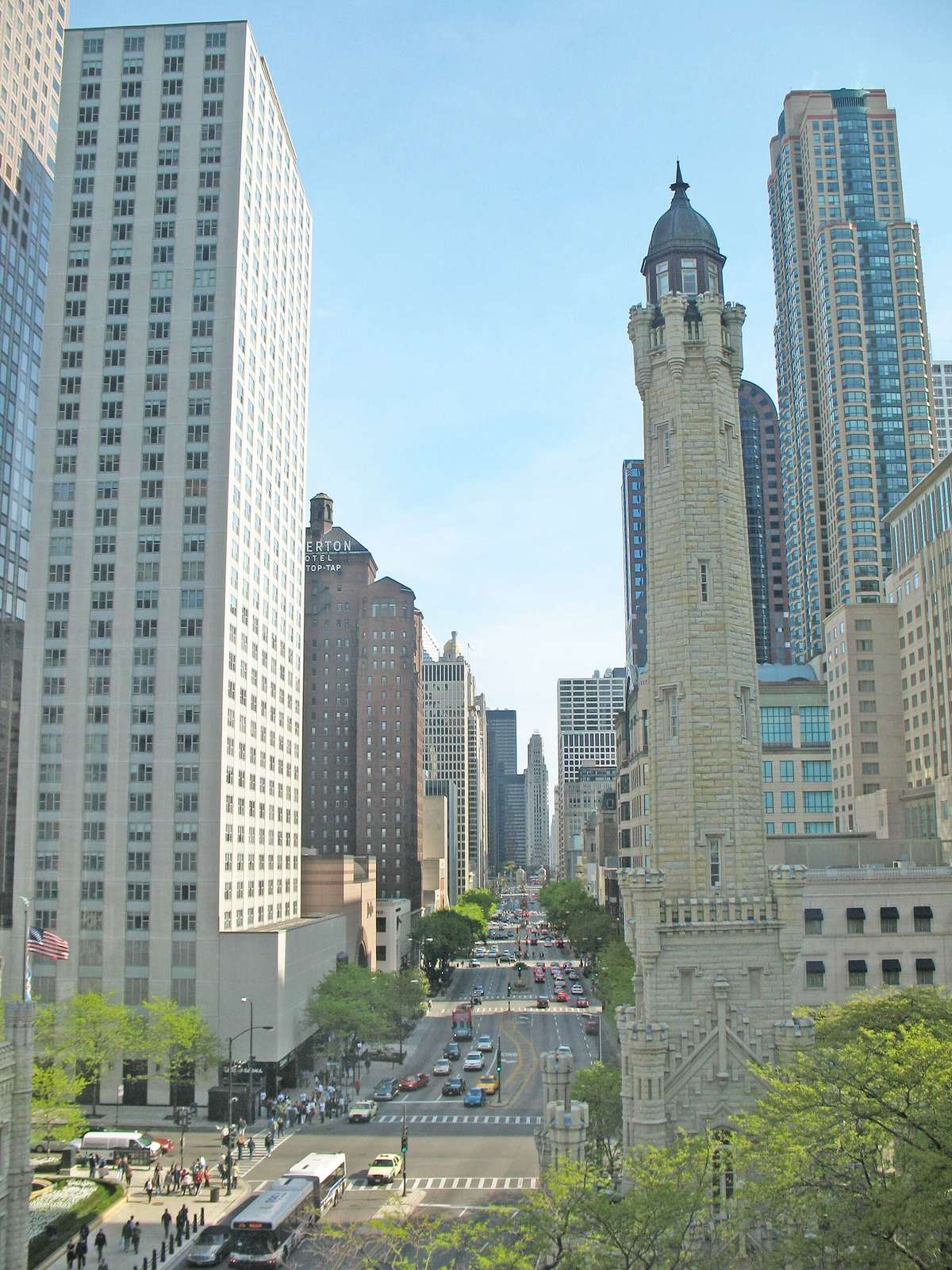
The Magnificent Mile (Mag Mile) in Chicago is the north end of Michigan Avenue, the city's main shopping street, running from the Chicago River up to Oak Street near Lake Michigan. It holds flagship stores, hotels, 1920s towers and the old Water Tower that survived the Great Chicago Fire of 1871. It is a public street, so there is no ticket and no entry fee. People come for the shops, the architecture and, in November, the Lights Festival. The Chicago city page covers the rest of the city.
The edges depend on who you ask. The Commission on Chicago Landmarks describes a one-mile stretch between Tribune Tower and the Drake Hotel. The Magnificent Mile Association draws its district wider, from Oak Street on the north to Randolph Street and Millennium Park on the south.
Magnificent Mile history, from Pine Street to the 1920 bridge
According to the Commission on Chicago Landmarks, the avenue north of the river grew up very differently from the Loop side. It was Pine Street, a narrow, mostly residential street cut off from downtown. Around the Water Tower grew Towertown, a bohemian pocket of artists' studios and nightclubs.
The Water Tower hid a 138-foot standpipe, removed in 1911 when it became obsolete. The commission says it and the pumping station across the avenue are the only public buildings that survived in the area burned in 1871. The Old Chicago Water Tower District became a Chicago Landmark on October 6, 1971.
Daniel Burnham's 1909 Plan of Chicago changed the street. It proposed a grand bridge linking South Michigan Boulevard to a widened, renamed North Michigan Avenue. Later plans called for a "carriage street" of shops with height limits, a uniform balcony line and matching storefronts.
The bridge opened on May 14, 1920. The Chicago History Museum writes that Mayor William Hale Thompson cut the ribbon on the upper level at 4:00 pm while the lower level was still being built. The commission credits the design to architect Edward H. Bennett. The Wacker Drive esplanade followed in 1926 and the sculptures on the bridge towers in 1928. The bridge joined the National Register of Historic Places in 1978 as part of the Michigan-Wacker Historic District, became a Chicago Landmark in 1991, and was renamed the DuSable Bridge in 2010, after Jean Baptiste Point du Sable, Chicago's first permanent resident.
Dozens of buildings went up in the decade after the bridge opened, and several still stand. The Magnificent Mile Association dates its own work to 1913, when it was the North Central Business District Association.
What to see on the Magnificent Mile
Walk from south to north, river to Oak Street. Along the way, according to the landmarks commission and the association:
- DuSable Bridge, a double-deck bascule bridge with bas-reliefs of early Chicago. A plaque on it marks the 1673 expedition of Louis Jolliet and Father Jacques Marquette.
- Wrigley Building (410 N. Michigan Ave.), white terra cotta, lit up at night. The association says its design drew on a cathedral in Seville.
- Tribune Tower (435 N. Michigan Ave.), built 1922 to 1925 by Howells & Hood. It won the Chicago Tribune's 1922 contest for "the most beautiful office building in the world", and its buttressed crown follows Rouen Cathedral. More than 120 stones from famous sites in all 50 states and dozens of countries are set into its base.
- Pioneer Court (401 N. Michigan Ave.), which the association calls Chicago's largest public square. A marker there notes the site believed to be du Sable's home and trading post.
- Allerton Hotel (701 N. Michigan Ave.), 25 stories, 1922 to 1924, a rare Chicago example of North Italian Renaissance style and, per the commission, the city's first highrise with pronounced setbacks and towers.
- The Water Tower (806 N. Michigan Ave.) and the pumping station across Michigan, at Chicago Avenue.
- 875 North Michigan Avenue, the former John Hancock Center. The association says it was the world's second tallest building when it was finished in 1969. The 360 Chicago observation deck is at the top.
- Jane Byrne Park (180 E. Pearson St.), named after Chicago's first woman mayor and open 24 hours a day.
- Palmolive Building (919 N. Michigan Ave.), 1927 to 1929, by Holabird & Root: one of the country's leading Art Deco setback towers and the first commercial skyscraper built far from the Loop. Its rooftop navigation light ran from 1930 to 1981 and was restored in 2007.
The association lists shops, restaurants and an event calendar on its own site. For other sights, see what to see in Chicago.
How to get to the Magnificent Mile
The closest stops are two CTA Red Line subway stations, both marked accessible:
| Station | Address | Bus connections |
|---|---|---|
| Grand | 521 N. State St. | 29, 36, 65 |
| Chicago | 800 N. State St. | 36, 66; two blocks east on Michigan: 143, 146, 147, 148, 151 |
Michigan Avenue is two blocks east of either station. The association suggests:
- From O'Hare: Blue Line to Lake, transfer to the Red Line toward Howard, get off at Grand or Chicago.
- From Midway: Orange Line to Roosevelt, transfer to the Red Line toward Howard.
- From Union Station: bus 151 northbound or 157 eastbound at Adams and Canal. From Ogilvie: bus 157.
- From Millennium Station: walk four blocks north, or take bus 3, 26, 143, 147, 151 or 157 on Michigan at Randolph.
- By car: from the north, Lake Shore Drive to the Michigan Avenue exit; from the south, exit at Illinois Street or Grand Avenue.
Hours, tickets and the 2026 Lights Festival
The street is always open and free. Each store, restaurant and museum keeps its own hours, so check the place itself. The paid stops nearby, such as the 360 Chicago deck, post their prices on their own sites.
The big yearly event is the Wintrust Magnificent Mile Lights Festival, which the association says lights one million bulbs on more than 200 trees. 2026 is its 35th year:
| What | When and where |
|---|---|
| Lights Festival Lane, free live entertainment and photos with Santa | November 21, 2026, 11 am to 4 pm, Pioneer Court, 401 N. Michigan Ave. |
| Street closures on Michigan Avenue, Oak Street and Upper Wacker Drive | from 3 pm |
| Parade from Oak Street south along Michigan Avenue | 5:30 pm |
| Fireworks over the river at the DuSable Bridge | right after the parade, about 7:15 pm |
| TV broadcast on ABC 7 Chicago | November 22, 6 to 7 pm |
Hours and prices checked November 11, 2026 on themagnificentmile.com. The site does not state an admission fee for the festival; times can shift, so check the festival page before you go.
Tips before you go
On festival day the association warns that the DuSable Bridge can close to pedestrians as early as 3 pm, and it names Wacker Drive as a good spot for the fireworks. In the accessible viewing area, only one guest may accompany each person in a wheelchair.
On a normal day, start at the bridge and walk north. Every building above falls on the way, and you finish at the Water Tower, Jane Byrne Park and the Palmolive Building near Oak Street, a short walk from the Red Line at Chicago, 800 N. State St.
Questions people ask
Where does the Magnificent Mile start and end?
The Commission on Chicago Landmarks describes it as the one-mile stretch of Michigan Avenue between Tribune Tower by the river and the Drake Hotel at Oak Street. The Magnificent Mile Association draws its district wider, from Oak Street on the north to Randolph Street and Millennium Park on the south.
What is the closest train stop to the Magnificent Mile?
Two CTA Red Line subway stations are closest: Grand at 521 N. State St. and Chicago at 800 N. State St. Michigan Avenue is two blocks east of each, and CTA buses 143, 146, 147, 148 and 151 run along Michigan.
When is the Magnificent Mile Lights Festival in 2026?
The Wintrust Magnificent Mile Lights Festival is on Saturday, November 21, 2026. Lights Festival Lane at Pioneer Court runs from 11 am to 4 pm, the parade leaves Oak Street at 5:30 pm, and fireworks over the river at the DuSable Bridge start about 7:15 pm.
Why is the Chicago Water Tower famous?
The Commission on Chicago Landmarks says the Water Tower and the pumping station across Michigan Avenue, both in castellated Gothic Revival style, are the only public buildings that survived in the area destroyed by the Great Chicago Fire of 1871. The district became a landmark in 1971.
Places on the map
Sources
- The Magnificent Mile Association
- The Magnificent Mile Association: About the Association
- The Magnificent Mile: Architectural highlights
- The Magnificent Mile: French heritage
- The Magnificent Mile: Getting here
- Wintrust Magnificent Mile Lights Festival
- Wintrust Lights Festival: your ultimate guide
- Lights Festival history
- Commission on Chicago Landmarks: Boul Mich Tour
- Chicago Landmarks: Old Chicago Water Tower District
- Chicago Landmarks: Michigan Avenue Bridge and Esplanade
- Chicago Landmarks: Tribune Tower
- Chicago Landmarks: Palmolive Building
- Chicago Landmarks: Allerton Hotel
- Chicago History Museum: Michigan Avenue Bridge
- CTA: Grand (Red Line) station
- CTA: Chicago (Red Line) station