RussiansInUSA editorial team · Facts checked November 11, 2026 · Official site
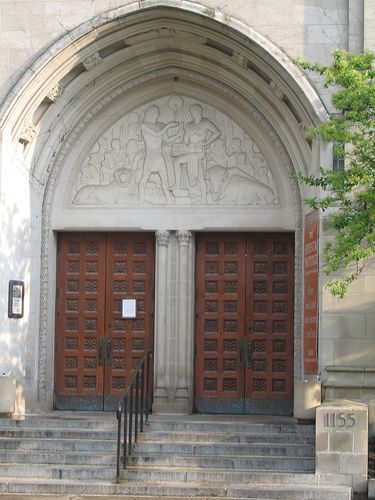
The Institute for the Study of Ancient Cultures in Chicago (ISAC), known until April 2023 as the Oriental Institute, runs the ISAC Museum at 1155 East 58th Street, on the University of Chicago campus in Hyde Park. It holds art and artifacts from ancient Egypt, Mesopotamia, Persia, Nubia and the Levant: a 40-ton winged bull (lamassu), a monumental statue of Tutankhamun, a colossal bull head from Persepolis. Adult admission is $15, and Friday from 4 to 8 pm is free for everyone.
History of the Oriental Institute
The University of Chicago was founded in 1891, and its Department of Semitic Languages studied West Asia and North Africa from the start. In 1896 the department moved into the Haskell Oriental Museum, funded by Caroline E. Haskell, which opened the first galleries for those regions. In 1904 the university sent its first field expedition, to Bismaya in Iraq.
The institute itself came in 1919. Egyptologist James Henry Breasted, the first American to earn a PhD in Egyptology, championed it, and John D. Rockefeller, Jr. paid for it as a laboratory for studying the rise of ancient civilization. It was the university's first research institute.
In 1921 Breasted started the Chicago Assyrian Dictionary, now 19 volumes. In 1924 the Epigraphic Survey began work in Luxor, Egypt. In 1931, again with Rockefeller money, the institute moved into its current building with laboratories, libraries and galleries, and the museum opened to the public.
Most of the collection came from expeditions of the 1920s to 1940s: Megiddo (1925-39), Medinet Habu (1926-33), the Iraq Expedition at Khorsabad (1929-35) and the Persian Expedition at Persepolis, Tall-e Bakun and Istakhr (1931-39). The institute says it has worked in every country of West Asia and North Africa since 1919; current projects run in Egypt, Iraq, Israel, Jordan, Oman, Spain, Syria, Turkey and Uzbekistan.
A major reinstallation in the 1990s and early 2000s added a climate-controlled wing for collections and archives, and the galleries were renovated for the centennial in 2019 without closing. On April 4, 2023, the institute took its new name. UChicago News reported that it better reflects the geographic focus of the work, and that the meaning of "oriental" has changed over time.
What to see at the ISAC Museum
The museum holds about 350,000 objects, with roughly 5,000 on view in eight permanent galleries.
Khorsabad Court and the lamassu
The court recreates part of a palace courtyard of the Assyrian king Sargon II (721-705 BCE) at Dur-Sharrukin. A 40-ton human-headed winged bull guards it. Nearby are glazed bricks from the Sin Temple facade and a relief of a winged sage (apkallu) from Nimrud. Most objects came from the institute's Iraq Expedition of 1929-35.
Egyptian Gallery
Nearly 800 objects from 5000 BCE to 600 CE. Look for the monumental statue of King Tutankhamun, the painted coffin of the temple singer Meresamun, the Milbank Papyrus with the Book of the Dead, and an acacia game board with its pieces and storage drawer.
Mesopotamian Gallery
One of the most complete displays of Mesopotamian material, from prehistoric to Islamic times, including the earliest writing system in history, a clay tablet about a court case still with its envelope, and a gold-capped lapis lazuli cylinder seal from Eshnunna.
Persian Gallery
The centerpiece is a colossal bull head from Persepolis, a dynastic center of the Achaemenid Empire, with a bull column capital from its audience hall and an Egyptian-blue wall peg inscribed for Darius.
Megiddo Gallery
The museum calls Megiddo the setting of biblical Armageddon. Here are the Megiddo ivories, a gold-covered statue of the Canaanite god El, a Dead Sea Scrolls fragment and a cast of the Mesha Stela.
The Nubian, Assyrian Empire and Syro-Anatolian galleries and an Islamic collections exhibit round out the visit.
How to get to the ISAC Museum
The museum sits at the southeast corner of 58th Street and University Avenue, at the eastern edge of the main quadrangles, one block north of the Midway Plaisance. Enter on 58th Street.
- Metra. Take the Metra Electric to 59th St./Univ. of Chicago at 59th Street and Harper Avenue, then walk west across campus. Metra lists the station as not accessible.
- CTA bus. The Metra station connects with CTA routes 2, 6, 15, 28, 59, 171, 172 and 192. Route 172 (U. of Chicago/Kenwood) runs between Hyde Park/East End and 60th/University, across the Midway from the museum, from early September to mid-June; in summer it runs weekday rush periods only.
- Car. Approach on University Avenue, since 58th Street between University and Woodlawn is a pedestrian walkway, and drop passengers off on the west side of the building. The Ellis Avenue Parking Structure at 5505 South Ellis Avenue charges a fee around the clock. The museum points to the university's Driving and Parking page for rates and street parking.
- Bike. Racks are in front of the building.
An accessibility ramp is on the west side of the building on University Avenue. Accessible parking permits can be reserved in advance at (773) 702-9522.
Hours and tickets
| What | Hours or price |
|---|---|
| Tuesday, Wednesday, Thursday | 10 am-4 pm |
| Friday | 10 am-8 pm |
| Saturday, Sunday | 10 am-4 pm |
| Monday | Closed |
| Adults | $15 |
| Seniors 65+, children 4-17, Chicago residents, students | $10 |
| Children under 4, military and veterans, ISAC members, UChicago students, faculty and staff | Free |
| Free for All, Friday 4-8 pm | Free for everyone |
Hours and prices checked November 11, 2026 on isac.uchicago.edu.
Walk-ins are welcome, or reserve tickets ahead from the admission, hours and directions page. The page does not list holiday closures, so call (773) 702-9514 before a holiday visit. All group visits need an advance reservation.
Rules and tips before you go
- No backpacks, parcels or bags larger than 11 by 13 inches, no umbrellas, no e-cigarettes.
- No food or drink in the galleries.
- Non-flash photography is allowed in all permanent galleries except objects marked otherwise; no tripods, monopods or selfie sticks.
- Sketching in pencil only. Do not touch objects, cases or labels.
- Lobby elevators reach all floors, accessible restrooms are on the lower level, and a few free wheelchairs are lent first come, first served.
- Adult and family groups can book one-hour docent-led tours.
The cheapest visit is Friday evening, free from 4 to 8 pm. To build a day around it, see our Chicago city guide and the list of Chicago sights.
Questions people ask
Is the Oriental Institute the same as ISAC?
Yes. The University of Chicago's Oriental Institute changed its name on April 4, 2023, to the Institute for the Study of Ancient Cultures, West Asia & North Africa (ISAC), and its museum became the ISAC Museum. The address stayed the same: 1155 East 58th Street in Hyde Park.
Is the ISAC Museum free?
Not in general. Adult admission is $15 and reduced admission is $10, but Friday from 4 to 8 pm is free for everyone. Children under 4, military and veterans, ISAC members and UChicago students, faculty and staff get in free at any time the museum is open.
Can you take photos at the ISAC Museum?
Yes, without flash, in all permanent galleries, except a few objects marked with signs because of lender restrictions. Tripods, monopods, selfie sticks and extra lighting are not allowed, and sketching is pencil only. Food, drink, backpacks and bags larger than 11 by 13 inches cannot go into the galleries.
How heavy is the lamassu in Chicago?
The museum says the human-headed winged bull in its Khorsabad Court weighs 40 tons. The court recreates part of a palace courtyard of the Assyrian king Sargon II (721-705 BCE) at Dur-Sharrukin, and most of its objects were excavated by the institute's Iraq Expedition in 1929-35.
What days is the ISAC Museum closed?
The ISAC Museum is closed on Mondays. It opens 10 am to 4 pm Tuesday through Thursday and on weekends, and 10 am to 8 pm on Friday. Its website does not list holiday closures, so call (773) 702-9514 before visiting on a holiday.
Places on the map
Sources
- UChicago ISAC: Institute for the Study of Ancient Cultures
- ISAC Museum: Admission, Hours & Directions (prices, hours, rules, driving)
- ISAC Museum: Visitor Accessibility (ramp, elevators, parking)
- ISAC: About (founding 1919, Rockefeller, Breasted)
- ISAC: History of ISAC (1891-1931 timeline)
- ISAC Museum: About the Museum (collection, Haskell Museum, renovations)
- ISAC Museum: galleries overview
- ISAC Museum: Yelda Khorsabad Court Gallery
- ISAC Museum: Egyptian Gallery
- ISAC Museum: Mesopotamian Gallery
- ISAC Museum: Persian Gallery
- ISAC Museum: Megiddo Gallery
- ISAC Museum: Tours & Group Visits
- UChicago News, April 4, 2023: Oriental Institute changes name to ISAC
- Metra: 59th St., Univ. of Chicago station
- CTA: 172 U. of Chicago/Kenwood
- UChicago Library exhibit text: the Haskell Oriental Museum (Caroline E. Haskell donation, 1896)